Roller Blinds · 17 min read
Double Roller Blinds Australia: Day and Night Control for NSW Homes
Chris & Campbell · 15 July 2026
Can you get proper daytime light with real blackout privacy at night without stacking two entirely separate blind systems on one window? That is the exact question we hear on measure and quote visits from Temora to Wagga. Double roller blinds Australia are the answer for most Riverina homes: one head rail, two independent fabrics, half the wall fixings. Here is how they work, what they cost in 2026, and when they beat a two-blind stack.
How double roller blinds Australia work compared with two single blinds
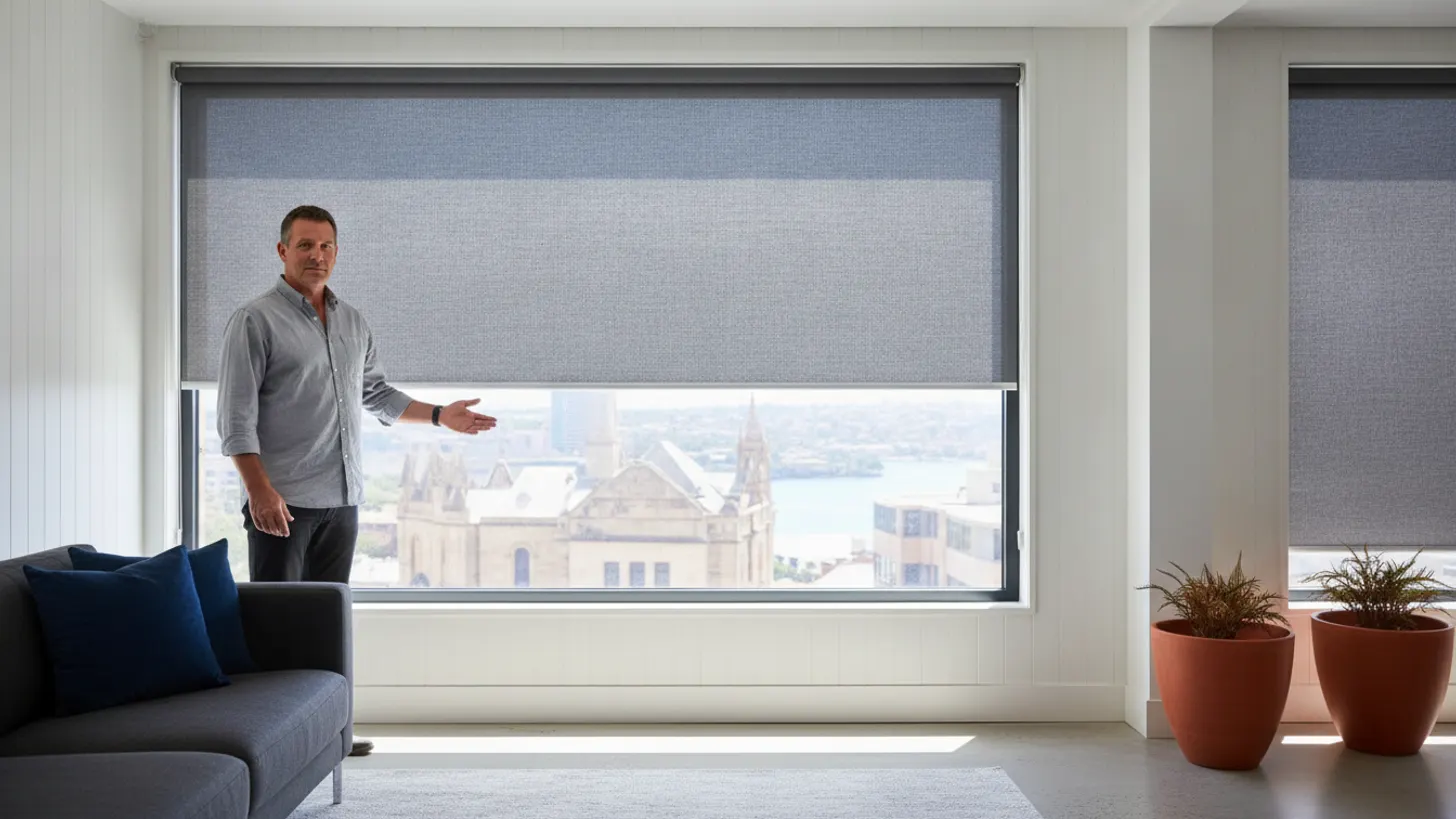
A double roller blind system stacks a sheer roller and a blockout roller inside a single aluminium head rail with two independent chains or motors. Each fabric operates on its own tube, so you drop the sheer for filtered daylight and privacy, then run the blockout down when the sun sets or the bedroom needs full darkness.
Two separate roller blinds achieve the same effect but need two mounting kits, two head rails and four wall fixings per window instead of two. Double roller blinds Australia buyers choose them for the cleaner reveal, faster install and lower ongoing service load. The sheer usually sits closest to the glass so it shades the window during the day; the blockout is on the room side so it seals against the frame at night.
The trade-off is that the combined tube stack projects further from the wall than a single blind - typically 100 to 130 mm - which needs planning if the window sits in a shallow reveal or under a shelf. On a face fix in a standard NSW window opening this is rarely an issue, and we measure and quote every job on-site to confirm clearance before ordering. For a deeper look at whether roller blinds suit your rooms in the first place, see our guide to choosing roller blinds.
Which NSW rooms suit double roller blinds Australia best
The best rooms for a double roller blinds Australia setup are bedrooms, living rooms, media rooms and home offices: the four room types Sustainability Victoria's window guidance identifies as offering the highest return from insulating window treatments in Australian homes. In a typical Riverina three-bedroom home, these account for four to six windows worth fitting first.
Bedrooms are the strongest use case. A sheer knocks glare off the morning sun without blacking the room out; the blockout locks the room down for shift workers, kids napping, or long Riverina summer evenings when the sun does not set until after eight. Living rooms follow the same logic: daytime privacy while the family is home and blackout for movie nights. For a full room-by-room look at bedroom picks, see our bedroom window treatment guide.
Home offices facing north or west across NSW get a second win: a sheer controls glare on the monitor without cutting outward view, then the blockout drops for calls or focus work. Bathrooms with high humidity are usually a poor fit; even moisture-rated fabrics fatigue faster with twin exposure. Kitchen splashback windows rarely need both layers either. Refer to Your Home's glazing chapter for context on how much heat gain enters an unshaded NSW window in summer.
Sheer and blockout fabric picks for day and night roller systems
For most Riverina living rooms and bedrooms, a 5% sunscreen sheer paired with a 100% opaque polyester blockout delivers the best balance of UV rejection and night blackout. Sheers are graded by openness factor, the percentage of the weave left open. Common grades run 3%, 5% and 10%; lower openness means less heat and light transmission but a narrower outward view.
Openness factor (OF) is the proportion of a sunscreen fabric left open as voids between yarns, expressed as a percentage, and the number drives every shading and heat-control decision in a dual roller specification. A 3% openness fabric passes roughly 3% of incident daylight through the weave; a 10% fabric passes around 10%. In practical terms, a 3% sunscreen rejects approximately 95% of UV radiation and cuts solar heat gain by around 70%, making it the right pick for west-facing rooms in the NSW Riverina, where Bureau of Meteorology climate data records afternoon temperatures regularly clearing 35 degrees Celsius across six to eight weeks of summer each year. A 5% sheer rejects around 90% of UV while keeping a wider outward view, which is why it suits most living rooms and east-facing bedrooms. A 10% openness sheer allows more glare and heat into the room but delivers the clearest sight lines and works well for south-facing windows with minimal direct solar load. In a double roller blinds Australia system, the blockout layer sits at effectively 0% openness and overrides the sheer whenever you lower it, so the openness rating only governs your daytime experience.
In the Riverina, where Bureau of Meteorology climate averages show summer maximums regularly clearing 35°C for weeks at a time, we often step west-facing rooms down to a 3% sheer for stronger heat rejection. For the sheer fabric itself we regularly specify Verosol UV screen cloth, which carries independently tested openness and UV performance ratings across the full 3%, 5% and 10% grade range. The 10% openness sheer keeps a clearer outward view but lets in more heat and glare, and suits south-facing windows or shaded courtyards.
Blockout fabric is either PVC-coated polyester (durable, wipe-clean, best for wet rooms) or a triple-weave textile (softer drape, quieter on the tube, better in bedrooms). For thermal work, look for a foam-backed or acrylic-coated blockout. Energy.gov.au window covering guidance shows that a well-sealed blockout can cut heat loss through the glazing by around 30% in an average Australian home.

How much do double roller blinds Australia cost to supply and install in NSW in 2026
Expect a supplied-and-installed double roller blinds Australia setup to sit 20 to 40 percent above the price of a single blockout roller for the same window. The two fabrics, twin tubes, larger head rail and second bracket set all add cost. Canstar Blue's 2024 roller blind pricing survey puts single roller blinds in the $150 to $500 range per window depending on size and fabric grade; double roller systems on the same windows land in the $220 to $700 range.
Bigger windows push cost up faster than small ones because both fabrics scale together, and motorised head rails add a fixed per-window premium covered further down. Face-fix versus recess-fix does not usually change price, but bay windows, arched reveals and windows over 2400 mm wide add joins in the fabric and sometimes an intermediate bracket. We measure and quote every job on-site because ordering long-drop double rollers off a phone photo leads to fabric bows and tube sag we then have to warranty.
Ongoing cost is minimal. A quick wipe-down every few months and a proper vacuum once a year covers most fabrics; if you need step-by-step cleaning, our roller blind cleaning guide walks through it. Total cost of ownership is where the dual roller system pulls ahead of a stacked pair of singles: one head rail means one place to service and one warranty per window.
The table below compares a double roller blinds Australia system against a single blockout and two separate singles across the five metrics that matter most at quote time.
| Feature | Double roller system | Single blockout | Two separate singles |
|---|---|---|---|
| Supply and install cost (standard window) | $220 to $700 | $150 to $500 | $300 to $1,000 |
| Wall fixings per window | 2 | 2 | 4 |
| Head rail projection from wall | 100 to 130 mm | 60 to 80 mm | 120 to 160 mm (stacked pair) |
| Daytime light filtering | Yes (sheer fabric) | No | Yes (if one is sheer) |
| Full blackout available | Yes (blockout fabric) | Yes | Yes (if one is blockout) |
| Independent motorisation per tube | Yes | N/A | Yes (one motor per blind) |
| Child safety compliance points | One head rail, one standard | One standard | Two head rails, two standards |

Motorising your day and night roller system with Matter and Google Home
Double roller blinds Australia are compatible with every mainstream motorisation platform sold locally. Both tubes take independent battery or hardwired motors, and each responds to its own scene or schedule, so an evening routine can drop the sheer at 5 pm and the blockout at 9 pm without touching a remote.
Battery run time depends on how often the blinds cycle. The table below shows typical battery life and smart home reach by motor tier for a double roller blinds Australia installation.
| Motor tier | Battery life at 2 cycles per day | Smart home protocol | Matter-native |
|---|---|---|---|
| Standard battery motor | 12 to 18 months | Wi-Fi, app only | No |
| Smart Wi-Fi battery motor | 12 to 24 months | Alexa, Google Home via bridge | No |
| Matter-certified battery motor | 18 to 36 months | Google Home, HomeKit, Alexa | Yes |
The Matter smart home standard, ratified in November 2022, now underpins the major Australian motorised blind brands and talks natively to Google Home, Apple HomeKit and Amazon Alexa. That matters because before Matter, each brand shipped its own bridge and app; today one hub controls the lot. In a double roller blinds Australia setup, both tube motors can run as a single group in any of those platforms, letting one scene drop the sheer at sunset and the blockout at bedtime. For a fuller breakdown of what motorisation is worth on a per-window basis, see our motorised blinds cost guide.
On safety, corded double roller systems (the manual chain-driven versions) must comply with the Consumer Goods (Corded Internal Window Coverings) Safety Standard 2014 as enforced by the ACCC. That means proper cord tensioners, warning labels, and installer sign-off. Motorised rollers side-step cord safety entirely, which is why Standards Australia and child-safety groups both point families with young kids toward motorised or cordless options.
Frequently asked questions
What is the difference between double roller blinds and day-night roller blinds?
Day-night roller blinds and double roller blinds are the same product sold under different names. Both refer to a system with one head rail carrying two independent rollers: usually a light-filtering or sheer fabric plus a blockout. Terminology varies by manufacturer, and some brands market the same hardware as day and night or dual rollers. What matters is whether the head rail is a combined extrusion (one aluminium housing, two tubes) or simply two blinds mounted side by side. Sustainability Victoria's windows and natural light guide uses the dual term interchangeably.
Do double roller blinds Australia stop bedroom light better than curtains?
For pure blackout, a properly sealed blockout curtain with side channels edges out most retail double roller systems, because fabric curtains close against the wall while roller blinds have a light gap along each side of the tube, typically 5 to 10 mm per side depending on the bracket and reveal. Where double roller blinds Australia pull ahead is versatility: you get filtered daytime light on the same window without opening or closing anything, which a single-fabric curtain cannot offer. If the room is a bedroom for a shift worker, we normally recommend a face-fixed dual roller with generous overlap on both sides and a fascia cover to close off the tube gap at the top. For day-to-day bedrooms in the Riverina, the dual roller system covers most needs without the bulk of floor-length curtains. Your Home's passive design guidance covers the trade-off between shading and view control.
Can I motorise only one of the two blinds in a dual roller system?
Yes. Because the sheer and blockout run on independent tubes, you can motorise one and leave the other on a chain, or add the second motor a year later. This is common in bedrooms where owners motorise the blockout for morning wake-up scenes and keep the sheer manual to save cost. Battery-powered motors have made retrofits easy with no cabling through the wall. If you plan to add smart home control, buy a Matter-certified motor from the start so you are not locked into a single-brand bridge. The Energy.gov.au home heating and cooling guide covers scheduling benefits.
How much space do double roller blinds project from the wall?
A standard double roller head rail projects 100 to 130 mm from the mounting surface, depending on brand and fabric thickness. That extra depth matters for windows in shallow reveals, under pelmets, or behind curtains you want to keep. On a face fix with the head rail above the architrave, the projection is invisible. Inside a recess, always check the reveal depth is at least 130 mm clear before ordering. We measure and quote on-site precisely because reveal depths in older Riverina homes vary window to window. CSIRO building performance research discusses the impact of window depth on shading effectiveness.
Are double roller blinds Australia safe for homes with young children?
Corded versions must meet the Consumer Goods (Corded Internal Window Coverings) Safety Standard 2014, enforced by the ACCC. That includes cord tensioners, warning labels, and cords kept out of a child's reach at install. Motorised or cordless versions remove the cord risk entirely and are what we recommend for cots, nursery windows and any bedroom used by children under 10. Retrofitting a motor onto an existing corded dual roller is straightforward on most brands, so this is not a decision you have to lock in forever. See the Canstar Blue guide to child-safe blind features for a compliance walk-through.
How long do the sheer and blockout fabrics actually last in NSW conditions?
Sunscreen sheers with a UV-stabilised weave typically hold their shape and colour for 8 to 12 years in an NSW-facing window; polyester blockouts sit in the 10 to 15 year band before the coating starts to craze. West-facing rooms in the Riverina wear faster because the afternoon sun angle is lower and more direct, and we replace west-facing sheers roughly two years earlier than east or south-facing equivalents. Regular vacuuming every three to four months stops dust binding into the open weave, which is where most premature failure starts: bound dust acts as an abrasive each time the fabric rolls up. Keeping the blockout fabric clean also prevents the coating from cracking ahead of schedule. Bureau of Meteorology UV index data shows why the western Riverina, with a UV index regularly hitting 12 or above through summer, is harder on fabric than the same product installed in a coastal Sydney suburb.