Child Safety · 10 min read
Child safe blinds Australia: what every parent must know in 2025
Chris & Campbell · 15 May 2026
How safe are the blinds in your child's bedroom right now? In Australia, looped blind cords have killed at least one child a year on average since the late 1990s, and the 2010 mandatory standard only covers products sold after that date. Child safe blinds Australia is not a marketing claim, it is a Commonwealth product safety obligation. This guide walks through what the law requires, what it misses, and what to do about the older blinds already hanging in your home.
Why child safe blinds Australia laws changed in 2010
On 1 January 2010, federal rules for child safe blinds Australia retailers had to follow took effect. It became illegal to sell internal window coverings with accessible looped cords longer than 220 mm unless the product carried warning labels, installation instructions, and a tension device that anchored the cord to the wall or floor. The change followed at least 12 confirmed child deaths over the previous decade.
The standard was made permanent by the Australian Competition and Consumer Commission and is enforced under the Australian Consumer Law. Every retailer, importer, online seller, and installer is bound by it. The Product Safety Australia regulator publishes the exact technical clauses, including the requirement that any pull cord must be either out of reach (above 1.6 m from floor level) or fully anchored.
The 2010 rules sit on top of Standards Australia documents AS/NZS 4938.1 and 4938.2, which cover construction, installation labelling, and warning content. If you buy a blind today from any reputable Riverina or NSW supplier, those documents are why the package contains tension cleats and a wall-mount tie-down.
None of this applies retroactively. If your home was built or fitted out before 2010, you may have looped cords that pre-date the rules, sitting at toddler head height. That is the gap this guide is written for.
The cord and chain risk every parent should test tonight
Tonight, walk through every room with a tape measure. Any continuous loop of cord, chain, or beaded pull longer than 220 mm that hangs within 1.6 m of the floor is a strangulation risk under the federal standard. A child can lose consciousness from cord pressure on the carotid arteries within 15 seconds and die within two to three minutes.
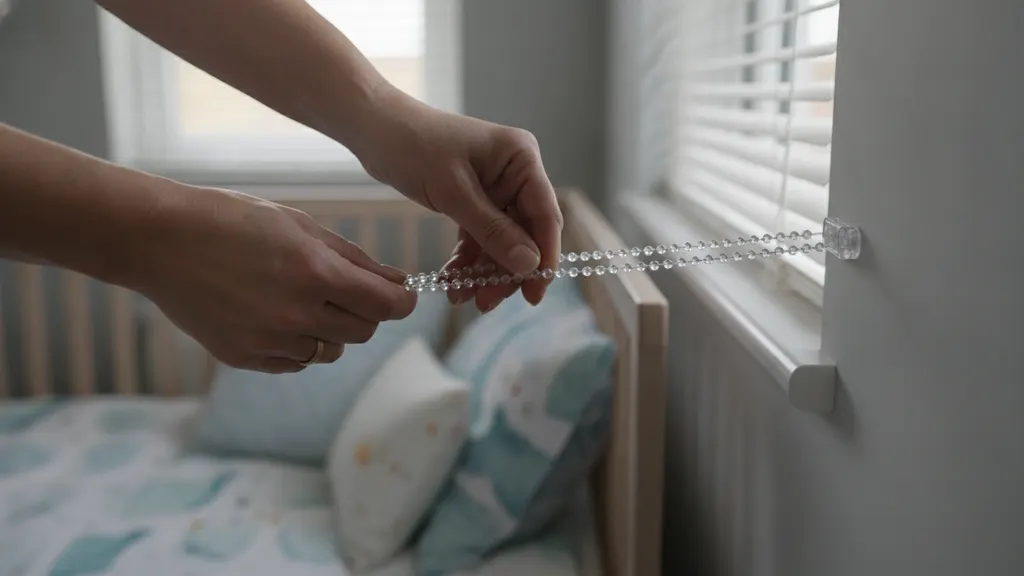
The high-risk fittings we find most often during in-home consultations across Temora, Wagga, and Griffith are continuous-loop roller blinds with no tension device, vertical blind chains pooled on the floor behind a cot, Roman blind back cords on older fabric installs, and ceiling-mounted cellular blinds with side-pull cords. These older units pre-date the child safe blinds Australia standard by years, sometimes decades.
If you find any of these, the immediate fix is to cut the loop (turning it into two separate ends) or anchor it tight with a wall-mounted cleat. Both are short-term. Replacement is the long-term answer, and replacement does not have to be costly. The consumer advocacy work published by CHOICE on cord-related deaths over the past decade documents how often these temporary fixes get forgotten and reverse over time. For a deeper breakdown of in-home audit steps, see our Temora and Wagga blockout blinds guide.
Choosing child safe blinds Australia: cordless, motorised, or wand-operated
Three operating systems remove the cord risk entirely: spring-tensioned cordless, motorised (battery or hardwired), and wand-tilt for shutters and verticals. Each has a price point, a use case, and a Riverina climate consideration worth weighing before you spend.
Cordless spring blinds are the cheapest swap. You pull the bottom rail down or push it up by hand. They work well on windows up to about 1.5 m wide. Above that, the spring tension becomes hard for a child or an elderly homeowner to operate smoothly.
Motorised blinds add 80 to 200 dollars per window depending on motor type, but remove every cord on every window in the same install. Hardwired is the cleanest finish, battery is the cheapest retrofit. For child safe blinds Australia wide, motorised is the option we fit most often into renovated bedrooms where a wand or spring would be awkward. See our motorised blinds cost guide for Wagga homes for a full per-window breakdown.
Wand-operated systems apply mostly to plantation shutters and vertical blinds. A short rigid rod tilts the louvres or panels with one hand. No cord, no chain, no loop. The CanstarBlue 2024 blinds and shutters consumer survey places the average price premium for cordless or wand options at 10 to 25 percent over corded equivalents, a gap that has narrowed every year since 2018.
Plantation shutters: the safest child safe blinds Australia option for nurseries
Plantation shutters have no cord, no chain, no loop, and no internal mechanism a child can pull on. The louvres tilt with a hidden tilt-rod or a small offset wand at the side. The panels open with a small handle. There is nothing for a curious 18-month-old to wrap around their neck.
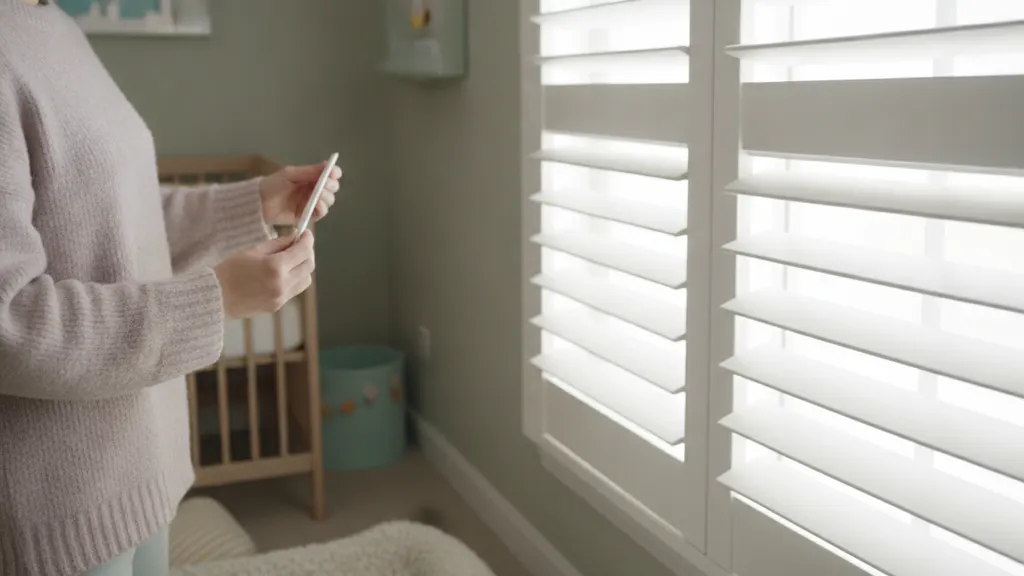
The other reason we fit shutters into Riverina nurseries is climate. Temora, Wagga and Griffith run summer overnight lows above 22 degrees for weeks in January and February, and winter daytime highs below 12 degrees in July, per Bureau of Meteorology climate averages. Solid PVC and basswood louvres insulate the window glass far better than a fabric blind, which means the room stays a usable sleeping temperature without the air conditioner running through the night.
Shutters cost more upfront than blinds. A standard 1200 mm by 1500 mm window comes in around 700 to 1100 dollars supplied and fitted depending on material. They typically last 20 to 25 years with no moving fabric parts, no spring tension to fail, and no cord to fray. We measure and quote them as the default option whenever a client has children under six. The plantation shutters vs blinds guide for the Riverina covers the cost-per-year maths in detail.
For a closer look at this, see Bay window blinds and shutters Australia: fitting solutions for NSW.
Roller blinds, zipscreens, and curtains: what to ask before you buy
Not every window suits a shutter, so the child safe blinds Australia question changes shape for each opening. Wide living-room glass, sliding doors, and outdoor entertaining areas usually call for a roller, zipscreen, or curtain. The cord safety question shifts with each.
For roller blinds, ask for spring-tensioned cordless on bedroom and play-area windows. On larger lounge windows above 1.8 m wide, ask for motorised. Avoid continuous-loop chain systems on any room a child can reach without supervision.
Zipscreens (also called ziptrak outdoor blinds) live mostly on alfresco areas and patios. The internal cord is fully enclosed in a side track, which makes them cord-safe by design as long as the bottom rail crank or motor is installed at adult height. We fit a lot of these across Wagga back patios because they double as wind, sun, and insect barriers.
For curtains, the question is the tieback. Ribbon or rope tiebacks can form the same kind of loop a blind cord does. Magnetic clip tiebacks or holdback hooks at 1.6 m height solve it. The YourHome shading and window coverings guide covers the thermal pairing of curtains and blinds, which is the other reason we suggest layering them on Riverina west-facing windows.
What it costs to make older windows safe across the Riverina
Most homes we measure and quote in Temora, Wagga, and Griffith have a mix: a few new compliant blinds, several pre-2010 corded units in spare rooms, and at least one cord pooled behind a couch in the lounge. A complete swap to cordless or motorised across an average four-bedroom home runs between 3,200 and 7,800 dollars supplied and fitted, including disposal of the old units.
That number breaks down roughly as follows for a four-bedroom Riverina home: four bedroom roller blinds in cordless spring, two bathroom blockout cellular, one wide lounge motorised double roller, one nursery plantation shutter, and assorted tension cleats and tiedown anchors. The energy.gov.au household guidance on window coverings shows that replacing a 30 year old blind with a modern insulated unit also returns energy savings of 10 to 15 percent on the heating and cooling cost of that room.
If budget is tight, prioritise bedrooms first, then play areas, then any window within 1.5 m of a cot or change table. Cleats and tiedowns are an interim measure on the lower-risk rooms while you plan the staged replacement. CSIRO research on thermal envelope performance shows why staging by exposure (west and north faces first) makes the cost-per-degree-saved drop fastest. Either way, the upfront cost of bringing a home into line with current child safe blinds Australia practice is a one-off, not a recurring bill.
| Blind type | Cord risk | Approx. installed cost (1.2 x 1.5 m window) | Best for |
|---|---|---|---|
| Plantation shutters | None | $700 to $1100 | Nurseries, west-face bedrooms |
| Cordless roller | None | $220 to $380 | Kids' rooms, bathrooms |
| Motorised roller | None | $420 to $650 | Wide lounge windows |
| Corded roller (pre-2010) | High | Replace | Not recommended near children |
| Wand-tilt vertical | None | $340 to $520 | Sliding doors |
Frequently asked questions
Are child safe blinds Australia compliant by law for every home?
The 2010 mandatory standard applies to retailers and installers, not to existing homes. If a blind was sold before 1 January 2010 and is still hanging, it does not automatically have to be replaced. The legal duty sits with the seller at the point of sale. The practical duty sits with the parent. Product Safety Australia recommends every home with children under six audit every window for accessible looped cords and either anchor them with a tension device or replace the blind with a cordless system. Rental properties are a grey area, landlords have a duty of care under state tenancy laws but no automatic obligation to swap pre-2010 units.
What is the cheapest way to make existing corded blinds safer tonight?
The cheapest immediate fix is to fit a wall-mounted cleat or tension device that anchors every cord at adult height, taking the loop out of a child's reach. A pack of cleats and a tube of mounting adhesive costs under 25 dollars at any Bunnings. This is a short-term step, not a substitute for compliant blinds. Cleats only work if every adult in the house resets the cord every single time the blind is used, which research from Standards Australia shows fails in normal household routine within weeks. Treat the cleat as the gap-fill while you save for the swap.
Do motorised blinds count as child safe blinds Australia compliant?
Yes. Battery and hardwired motorised blinds with no exposed cord or chain meet the federal standard by design. The remote, the wall switch, and the app trigger replace the pull cord entirely. The only thing to watch is the battery charging cable, which should be routed inside the wall cavity or behind furniture out of toddler reach. We fit motorised systems with rechargeable lithium tubes that need topping up every six to twelve months, and the cable plugs in at adult-shoulder height for that operation only. Confirmed by Product Safety Australia, motorised installations have not been involved in a single recorded cord-related child injury since the standard took effect in 2010.
How long do compliant cordless blinds last in the Riverina climate?
Cordless spring rollers we install across Wagga and Temora typically last 8 to 12 years before the spring tension softens enough to need replacement. Motorised systems run 10 to 15 years on the motor, with rechargeable batteries needing replacement every 4 to 6 years. Plantation shutters in PVC or basswood last 20 to 25 years with no moving parts to fail. The Riverina summer UV and dry winter air are harder on fabric and cord than on solid louvres, which is the other reason shutters work out cheaper across a 20 year window even though the upfront cost is higher. Energy savings of 10 to 15 percent per room compound the gap, per energy.gov.au household guidance.