Window Coverings · 18 min read
Vertical Blinds for Sliding Doors: What NSW Homeowners Need to Know
Chris & Campbell · 11 June 2026
What's the simplest way to cover a 3-metre stacker door in a Wagga or Griffith home without spending $2,000 on curtains? Chris and Campbell answer that question on most site visits across the Riverina. The honest answer is usually vertical blinds for sliding doors Australia, the same product spec accounting for nearly one in five commercial window furnishing fits nationally. They're light, they stack tight against the wall, and they cost roughly half what equivalent S-fold curtains do.
Why vertical blinds for sliding doors Australia outperform horizontal systems on wide openings
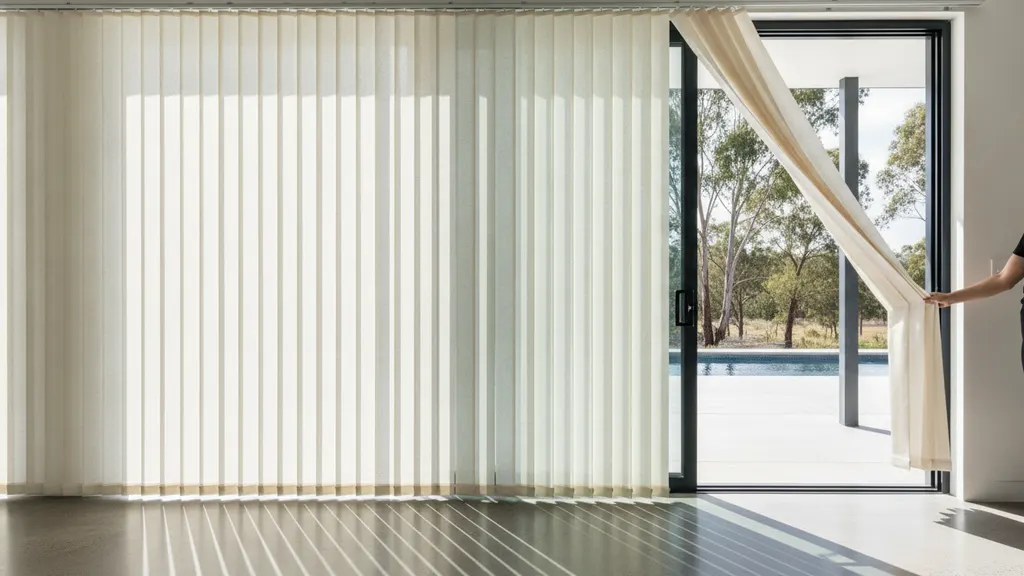
Vertical blinds for sliding doors Australia outperform horizontal blinds across 2.1m to 3.6m openings because the slats stack vertically off to one side and clear the entire glass when opened, while horizontal blinds sag at the middle, twist under their own weight, and bang against the sliding panel every time someone steps onto the patio.
Standard Australian sliding door and stacker door openings sit between 2.1 metres and 3.6 metres wide, per the residential construction guides published by Master Builders Australia. That span is where horizontal blind systems become mechanically problematic and vertical slat operation runs noticeably smoother. The headrail carries every slat from a single track, so the load stays distributed. Pull the wand once and the whole stack slides off to one side in two seconds.
Horizontal venetians of the same width need a continuous cord lift that struggles under weight, and roller blinds wider than 2.4m start to telescope sideways on the tube. Both systems were designed for windows, not for openings you walk through forty times a day. Per Window Furnishing Association of Australia installation records, the residential fit default shifts to vertical systems for any opening above 2.2m wide, the span where vertical blinds for sliding doors Australia were purpose-built to perform. See our vertical blinds service page for the full product range we fit across the Riverina.
There's also the airflow question. Stacker doors are how most NSW homes ventilate in summer, when overnight temperatures across the Riverina average 17 degrees per Bureau of Meteorology long-term records. Vertical slats can be left half-tilted overnight, letting the breeze through without anything rattling. A roller blind has to be fully up or fully down.
What slat materials and widths suit Australian indoor-outdoor living areas
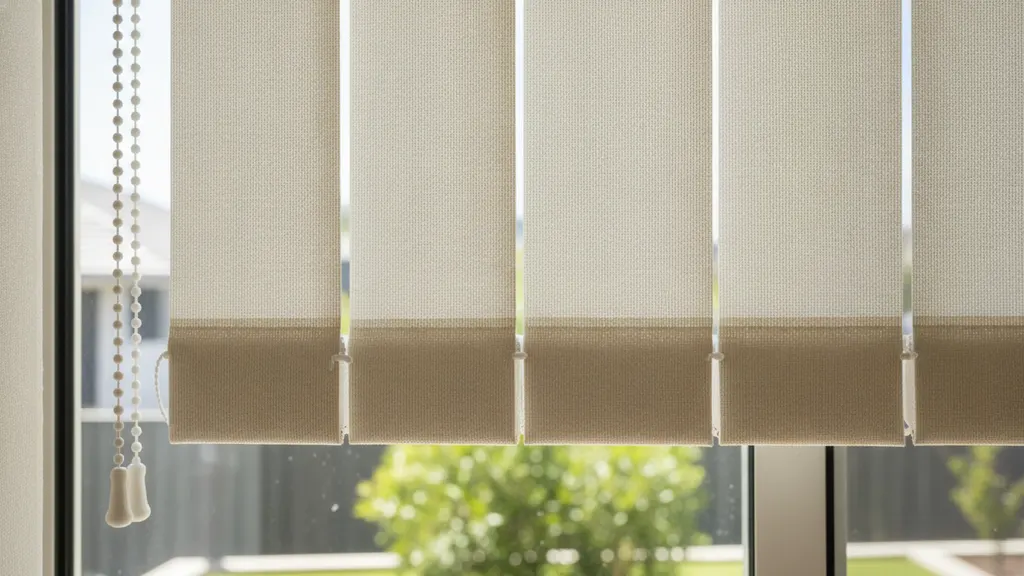
The two slat widths that suit Australian conditions are 89mm and 127mm. PVC slats resist heat warping through Western NSW summers, fabric slats soften light in cooler coastal homes, and aluminium slats suit commercial fits but feel cold and noisy in a residential lounge during a southerly.
89mm slats give a tighter visual rhythm and work well on doors under 2.4m wide. 127mm slats reduce the slat count by roughly a third, which means fewer items rotating when you open the blind, and they're the default for stacker doors of 3m or more. Per Window Furnishing Association of Australia installation data, 127mm slats have led residential fits for door-width applications since 2019.
PVC is the workhorse material. It tolerates temperatures from 5 degrees to 60 degrees without warping, the operating range the Your Home government building guide lists as the required tolerance for any internal window covering in Australian conditions. Mid-range PVC slats from Australian distributors like CWGlobal have a UV-stable inner layer that resists yellowing over a decade in north-facing rooms.
Fabric slats look softer and absorb more sound, which matters in open-plan rooms with hard floors. Tradeoff: they fade faster, they hold dust, and they shouldn't be used in kitchens. Choice consumer testing puts the practical fabric slat lifespan at 7 to 9 years against PVC's 12 to 15.
Aluminium slats appear in commercial settings and shopfronts. They're durable but conduct heat, which means a row of aluminium verticals on a west-facing sliding door turns into a heat conductor by 4pm. The energy.gov.au window furnishing guide rates aluminium poorly on thermal performance for that reason. Stick with PVC for vertical blinds for sliding doors Australia in any Riverina or NSW home.
For a closer look at this, see Bifold door blinds Australia: NSW guide to indoor-outdoor living.
Vertical blinds for sliding doors Australia versus panel glides and curtains
Compared head to head, vertical blinds for sliding doors Australia win on cost and light control, panel glides win on bedroom blackout, and S-fold curtains win on winter insulation per CSIRO 2023 residential window thermal performance data. The right pick comes down to which trade-off the room actually needs.
Panel glides use 4 to 6 wide fabric panels that slide on a multi-track headrail, layering behind each other when opened. They're quieter than verticals and the panels don't catch the breeze. The downside: a panel glide blocks roughly 25% of the door opening even when fully drawn back, because the panels stack across the headrail rather than off to one side. Per the Canstar Blue 2026 window furnishings report, panel glides cost between $180 and $280 per linear metre supply-and-fit, roughly 80% more than equivalent PVC verticals. Our panel glide vs vertical blinds comparison walks through the full feature-by-feature breakdown.
S-fold curtains are the premium option. They insulate better than any blind product, retaining roughly 40% more heat in winter per CSIRO 2023 residential window thermal performance data, and they soften room acoustics. But they sit between $250 and $450 per linear metre installed, they need professional dry cleaning every 2 to 3 years, and they're a poor fit for indoor-outdoor traffic because the fabric drags every time someone walks past with a hand on it.
Vertical blinds for sliding doors Australia split the difference. Light filters through angled slats, the operation is straightforward, slats can be washed in place, and replacing one damaged slat costs around $12. The table below compares all three products across the buying criteria that matter most for NSW homeowners.
| Product | Price/m (supply-and-fit NSW 2026) | Typical lifespan | Stack clearance needed | Blackout rating | Maintenance |
|---|---|---|---|---|---|
| Vertical PVC blinds | $90 to $160 | 12 to 15 years | 12% of opening width | Medium (angled slats allow edge light gaps) | Wipe slats in place; replace single slats at ~$12 each |
| Panel glide blinds | $180 to $280 | 7 to 10 years | 25% of opening width (panels stack on headrail) | High (full-width fabric panel coverage) | Washable panels; headrail track lubrication annually |
| S-fold curtains | $250 to $450 | 10 to 15 years | 30 to 40% of opening width | Variable (depends on lining weight) | Professional dry cleaning every 2 to 3 years |
Supply-and-fit cost for NSW homeowners in 2026
Expect to pay between $90 and $160 per linear metre supply-and-fit for vertical blinds for sliding doors Australia in 2026. A standard 2.4m wide stacker door fitted with 127mm PVC slats and a heavy-duty headrail lands around $260 to $385 installed, including the on-site measure and quote.
Pricing tracks four variables: slat width, slat material, headrail spec, and the wand-versus-chain operation choice. 89mm slats run cheaper than 127mm for the same metre count because the headrail carries lighter cassettes. Wand operation costs roughly $35 less per blind than chain-and-cord but caps the maximum width at about 2.7m before the wand becomes too long to handle.
Heavy-duty headrails matter for any door above 2.4m wide. The bottom-tier headrails sag under their own weight after 18 months, particularly in the Riverina where summer humidity swings between 20% and 80% inside a single week per Bureau of Meteorology data. A heavy-duty rail adds $40 to $70 to the total and lasts the life of the blind.
Installation labour in NSW sits at around $85 per blind for a measure-and-fit visit. Most installers, Chris and Campbell included, fold the labour into a single supply-and-fit price rather than line-item it, so the per-metre figure already covers the visit. Compare that to our broader NSW window covering cost guide for the full range across product types.
Two pricing traps to avoid. Online-only sellers quote $40 to $70 per linear metre, which excludes installation, freight to regional NSW, and any margin for return visits if a slat arrives damaged. The other trap is upmarket fabric verticals, which can push past $200 per linear metre without delivering measurably better light control on a sliding door application. For most homes, mid-grade PVC at the $120 to $140 mark keeps vertical blinds for sliding doors Australia competitive against every alternative on the market.
How to measure vertical blinds for sliding doors Australia without mistakes
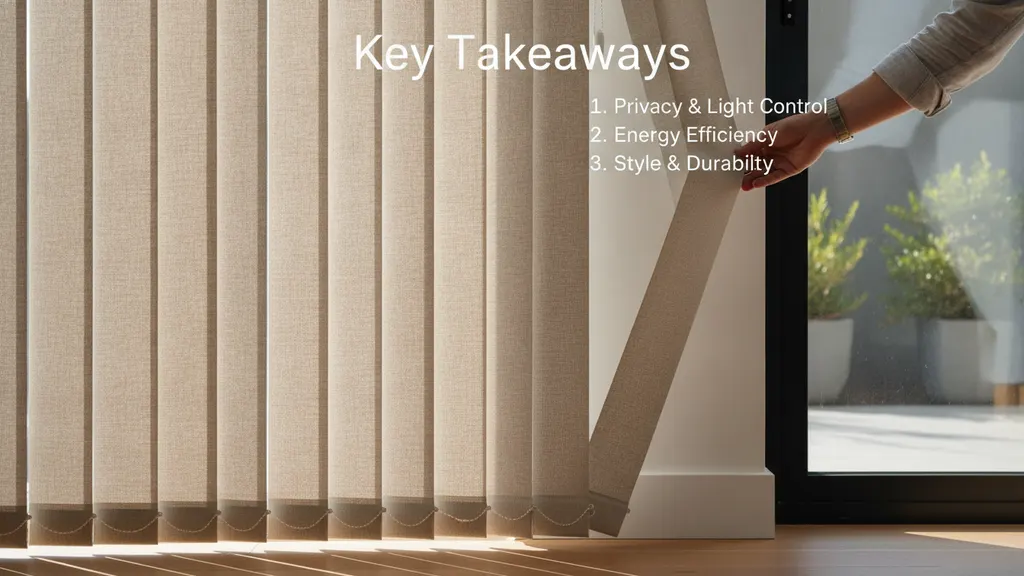
Most measurement mistakes on vertical blinds for sliding doors Australia come from three causes: ignoring the architrave depth, forgetting to add stacking space, and confusing recess fit with face fit. Run a tape across the opening at three heights and write the smallest figure down.
Start with the width. Measure across the architrave (the timber frame surround) at the top, middle, and bottom of the opening. Old Riverina homes settle over decades, so the bottom of an opening can be 8 to 15mm narrower than the top. Take the smallest of the three measurements. Add nothing if you're face-fitting (the headrail screws to the wall above the architrave). Deduct 10mm on each side if you're recess-fitting (inside the architrave) to let the slats rotate freely.
Next, the drop. Measure from the proposed headrail location to the floor or window sill. For sliding doors, the headrail typically sits 50mm above the top architrave, with the slats finishing 10mm above the floor. Carpet adds another 5 to 10mm to that floor clearance. A slat brushing the carpet wears at the bottom edge in under three years.
The stacking space catches most DIY orders. When a 3m vertical blind is fully drawn back, the stacked slats need roughly 12% of the opening width to park against the wall. That's 360mm on a 3m opening. If the wall to the side of the door is narrower than 360mm, the blind has to centre-stack or split-stack, both of which need to be ordered in. Order the wrong stack direction and the slats sit in front of the door handle.
Order any vertical blinds for sliding doors Australia by checking three measurements: width at three heights, drop with carpet allowance, and stacking-space clearance to the side wall. Stand inside the room facing the door, decide which side the chain or wand should hang from, and write L or R on the order before signing off. Product Safety Australia mandates that chain controls be tensioned to the wall under AS/NZS 4848.4 to prevent loop hazards to children, so the control side also affects where the tensioner is screwed in.
For most homes, the cleanest answer is letting an installer measure and quote on site. Chris and Campbell do this across the Riverina at no charge, with the measurement underwritten by a written quote that locks the price for 90 days. That removes the order-error risk entirely.
Frequently asked questions
Can vertical blinds work on stacker doors over 3.6 metres wide?
Yes, but expect a multi-section split rather than a single blind. Most Australian headrail systems max out at 3.6 metres in a single span before the rail starts to bow under slat weight. For openings up to 4.8 metres, a two-blind split with a centre meeting point is standard. For 4.8 to 6 metres, three sections work. Larger commercial spans use rail-coupling hardware rated to AS/NZS 4848.4. Pricing scales linearly with linear metres rather than per blind, so a 4.8 metre two-blind run costs roughly the same per metre as a 3 metre single. When ordering vertical blinds for sliding doors Australia across a multi-section span, specify the meeting point location in writing on the order. A centre-stack on a 4.8m opening shifts roughly 600mm of slat mass to each side, and the wall clearance on both sides needs to accommodate both stacks before the final measure is signed off.
How long do PVC vertical blinds last in Australian conditions?
PVC slats from reputable Australian distributors carry 10-year material warranties and typically reach 12 to 15 years of usable life, per Choice consumer testing. The first parts to fail are usually the bottom slat chains, which carry the chain weight cycling thousands of times per year and snap at the connector clips after 5 to 7 years. Replacing the bottom chain costs around $80. The slats themselves yellow slightly in north-facing rooms over the decade but rarely warp if the original PVC was UV-stabilised. Fabric slats give 7 to 9 years, aluminium 15 to 20. Across LuxeShutters' 1,400-plus Riverina installs since 2013, the most common service call is a single broken bottom chain on a blind that is otherwise fully serviceable, a 20-minute fix. Keeping the headrail track clean and the slat hooks lightly lubricated every two years extends the mechanical life of the drive system.
Are vertical blinds child-safe?
Vertical blinds sold in Australia must comply with AS/NZS 4848.4, the corded internal window covering standard, which requires either a cordless wand control or a tensioned chain anchored to the wall with at least 1600mm of slack-free clearance. Product Safety Australia links corded window covering entanglement to preventable child fatalities at home, which prompted the mandatory standard that took effect in 2014. A wall tensioner for a chain-operated blind costs around $8 to $15 and takes under five minutes to install at the base of the chain drop point. Older blinds without tensioners can be retrofitted, but the result must leave no free loop at floor level. Wand-operated verticals avoid the chain hazard entirely and are the simpler child-safe choice. Our child-safe blinds guide breaks down the full installation requirements. For chain-operated blinds, the tensioner must be fitted at the time of installation, not handed to the homeowner in a packet.
Can vertical blinds be installed inside or outside the door frame?
Both work. Recess fit (inside the architrave) gives a cleaner look and lets the slats sit flush with the surrounding plaster, but it loses 20mm of width per side because the slats need clearance to rotate. As a practical guide, if the architrave depth is 70mm or more, recess fit works with most 89mm slat systems; architraves shallower than 70mm generally require face fit to keep the slats from catching the frame on rotation. Face fit (outside, with the headrail screwed to the wall above the architrave) covers the full opening plus light gap, blocks more side light, and works better when the architrave is too shallow for recess mounting. Per the Your Home government guide referenced earlier, face fit is the recommended choice for any south-facing sliding door where draught control matters more than visual neatness. Most Riverina jobs end up face-fit for that reason.