Bushfire and Safety Compliance · 15 min read
Bushfire shutters Australia: BAL ratings and NSW compliance guide
Chris & Campbell · 16 October 2026
"Will shutters actually help if a fire comes through?" It is the first question we get asked in Temora and Griffith, and the honest answer is that it depends entirely on the numbers they were specified against. Any bushfire shutters Australia homeowners fit on bushfire-prone land have to answer to a BAL rating, AS 3959:2018 and the NSW planning rules, not to a brochure. Here is how those pieces fit together before you order anything.
What does a BAL rating mean for bushfire shutters Australia wide?
A Bushfire Attack Level, or BAL, measures how hard a bushfire is likely to hit your building. The NSW Rural Fire Service explains that bushfire attack levels consider radiant heat, ember attack and direct flame contact, and that rating then drives the construction requirements for every external opening on the house. Your BAL comes from an assessment of the site: vegetation classification, the effective slope beneath that vegetation, and the separation distance to the external wall. Categories run from BAL-LOW through BAL-12.5, BAL-19, BAL-29, BAL-40 and BAL-FZ. AS 3959:2018 Construction of buildings in bushfire-prone areas, published by Standards Australia, provides construction requirements across BAL categories from BAL-12.5 through BAL-40, and the number in each name is the radiant heat flux, in kilowatts per square metre, that the building elements have to tolerate.
That number is why the bushfire shutters Australia builders specify cannot be chosen on looks. A system rated for one exposure band is not interchangeable with the next, and the step from BAL-19 to BAL-40 is roughly a doubling of the heat load the assembly has to survive. The Your Home guidance on designing for bushfire, published by the Australian Government, applies the same logic to walls, decks and roof spaces.
How do ember attack, radiant heat and flame contact change the bushfire shutters Australia homeowners choose
The three attack mechanisms do different damage, so they ask different things of a shutter. Embers lodge in gaps and ignite debris, radiant heat cracks glass and ignites nearby material without any flame touching the house, and direct flame contact loads the whole assembly with both at once.
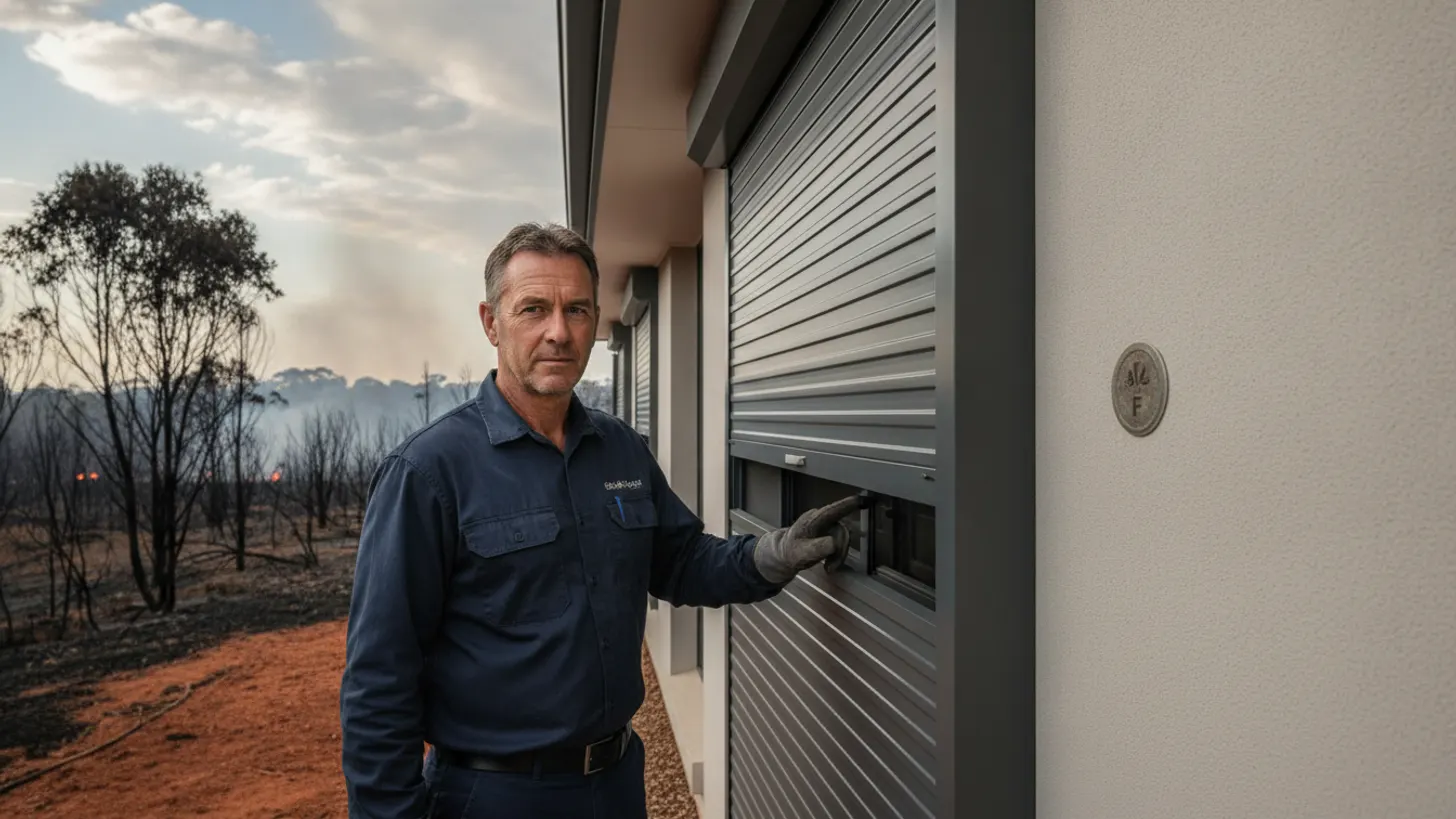
Ember attack destroys more homes than flame front contact, which is why CSIRO bushfire research keeps pushing builders back toward gaps, vents and window reveals. AS 3959:2018 answers that with screening: external screens using a mesh aperture no larger than 2 mm, in corrosion-resistant metal appropriate to the BAL. A solid roller shutter that leaves a 6 mm gap at the guide rail has not solved the ember problem, it has relocated it.
Radiant heat is the mechanism most homeowners underestimate. Ordinary annealed glass can fail well before a flame front arrives, and once the glazing goes the opening becomes an entry point. The Bureau of Meteorology fire weather and fire danger rating service shows how severe conditions get across the Riverina, and shutters have to be rated for the worst of those days, not an average one.
Which standards cover bushfire shutters Australia homeowners should check?
Five documents decide what you can legally fit. Read them in this order: your bushfire assessment report, AS 3959:2018, Planning for Bush Fire Protection 2019, the National Construction Code, and the test report for the product in front of you.
The NSW Rural Fire Service Planning for Bush Fire Protection 2019 document applies to development proposals on bushfire-prone land in NSW, and councils apply it through the development application. The NSW Rural Fire Service publishes it, and the NSW planning portal bushfire-prone land mapping shows which lots it covers. If your block is mapped, the window and shutter specification stops being a style decision and becomes part of the consent.
| Document | Published by | What it governs |
|---|---|---|
| AS 3959:2018 | Standards Australia | Construction requirements for BAL-12.5 through BAL-40 and BAL-FZ |
| Planning for Bush Fire Protection 2019 | NSW Rural Fire Service | Development proposals on bushfire-prone land in NSW |
| National Construction Code | Australian Building Codes Board | Calls up AS 3959 as the construction pathway |
| AS 1530.8.1 and AS 1530.8.2 | Standards Australia | Test methods for elements up to BAL-40, and for BAL-FZ |
| Bushfire assessment report | Accredited bushfire practitioner | The BAL applying to each elevation of your house |
Builders work from the same list. Master Builders Australia publishes member guidance on building in bushfire-prone areas, and any contractor supplying bushfire shutters Australia councils will accept should be able to name which of those five documents their product answers to. If they cannot, that is your answer.
Can bushfire shutters Australia homeowners fit form part of a compliant window system?
Yes, but only as part of a tested window system, never as an accessory bolted on afterwards. Under AS 3959:2018 a shutter can satisfy the window requirements where the complete assembly, including frame, guides, fixings and the wall it mounts to, has been tested and documented as one thing.
AS 1530.8.1 covers testing of elements for BAL-12.5 through BAL-40, and AS 1530.8.2 covers the harsher BAL-FZ condition. A product sheet claiming to be bushfire rated without naming one of those test methods and the BAL it was tested at tells you nothing. Material choice follows from there, and our comparison of basswood, PVC and aluminium shutter materials explains why the metals dominate at the higher ratings.
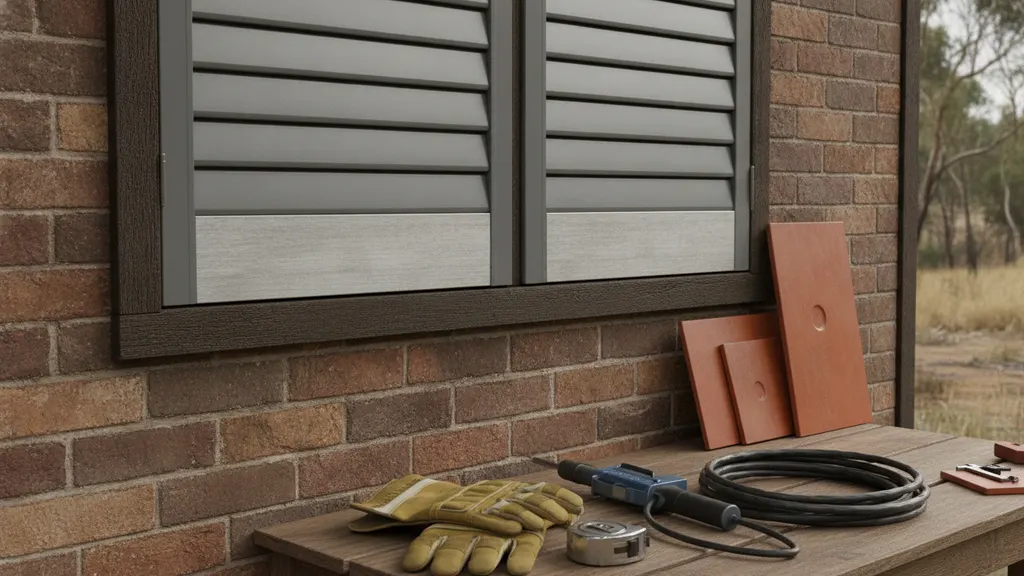
In practice, the systems manufacturers can certify are aluminium or steel roller shutters with closed guide rails, a bottom rail that seats into a sealed track, and a documented fixing detail into masonry or structural framing. They look much like the systems in our guide to security shutters for NSW homes, but the test evidence behind them is different, and so is the price.
Related reading: Custom shaped shutters Australia: unusual NSW window solutions.
Related reading: Window shutters cost Australia: pricing factors for NSW renovations.
What to ask your builder about bushfire shutters Australia certifiers will accept
Most of the risk in this job sits in the paperwork, not the product. Before you sign, ask the builder or certifier for the evidence that the shutter being sold to you matches the BAL printed on your assessment report, and ask for that evidence in writing.
- Which BAL applies to this elevation, and which report states it?
- Has this exact blade, guide and fixing combination been tested to AS 1530.8.1 or AS 1530.8.2?
- Does the screening meet the 2 mm maximum mesh aperture required at my BAL?
- Who signs off at completion, and which document do I keep on file?
- What maintenance keeps the system compliant, and how often is it due?
Get those answers before the deposit, not at handover. The bushfire shutters Australia certifiers accept are always the ones with a paper trail attached, and suppliers who can produce test reports on request are the ones worth dealing with. One job outside Gundagai has stuck with us: the owner had already bought roller shutters before her bushfire assessment report came back at BAL-29, two bands above what she had budgeted for, and none of what she owned would have passed AS 1530.8.1. We measure and quote every opening on site across the Riverina, and if no tested system exists for your rating, we will say so rather than sell you a lookalike. Our guide to measuring and fitting window shutters covers the installation side, and our plantation shutters energy efficiency guide for NSW heat covers summer performance.
Frequently asked questions
Do bushfire shutters actually stop a house from burning down?
No. No product makes a house fireproof, and any supplier who says otherwise is selling you something. What correctly specified bushfire shutters Australia homeowners fit do is protect the weakest part of the external envelope, which is the glass. They stop embers lodging in the reveal, shield the pane from radiant heat, and buy time in the hours either side of a fire front. Fire and Rescue NSW frames preparation as a layered plan, with cleared gutters, screened vents and a written survival plan sitting alongside the building work rather than being replaced by it.
How do I find out my BAL rating before ordering shutters?
Your BAL comes from a site assessment, not from a catalogue. An accredited bushfire practitioner or your council assesses the vegetation classification, the effective slope and the separation distance, then issues a bushfire assessment report stating the BAL for each elevation. On bushfire-prone land in NSW that report forms part of the development application, and the NSW Government bushfire-prone land information service shows whether your lot is mapped. Get the report before you shop, because the rating can differ between the north and south faces of the same house, and so can the shutter specification.
Will bushfire shutters also cut summer heat through the glass?
Often yes, though that is a side benefit rather than the design goal. A closed external shutter sits outside the glass and stops heat before it reaches the room, which is the same physics that makes external shading the strongest summer option. The energy.gov.au guidance on heating and cooling at home ranks external shading ahead of internal coverings for that reason. If you are choosing bushfire shutters Australia summers will also test, ask about the blade profile and the guide rail detail, because an insulated blade behaves differently from a plain extruded one on a 40 degree day.
Are aluminium shutters better than timber in a bushfire zone?
Material matters less than the tested system, but non-combustibility is where timber struggles at the higher ratings. Aluminium and steel shutters with steel guides are the common answer from BAL-19 upward, while timber blades are generally limited to lower exposures or to internal use behind compliant glazing. The National Construction Code, published by the Australian Building Codes Board, calls up AS 3959 and the non-combustible material definitions sitting behind those choices. Ask for the test report covering the exact blade, guide and fixing combination, not a generic brochure claim about the metal used.
What do BAL rated shutters cost in regional NSW?
Cost depends on the BAL, the opening size, the drive type and whether the wall needs reinforcing, so a figure quoted over the phone is guesswork. Tested systems cost more than standard roller shutters because the guides, blades and fixings are heavier and the testing has to be paid for somewhere. The Canstar Blue window covering buying guides are a fair starting point for understanding how this pricing is structured, but they are no substitute for a site visit. Bushfire shutters Australia homeowners rely on are priced per opening, after measurement.
Can I retrofit bushfire shutters to an older home?
Usually yes, and on an older house it is often the upgrade that buys the most protection, because the window openings are the weak point. A retrofit has to deal with the wall substrate, the existing reveal depth and any lintel limits, which is why the fixing detail forms part of the tested system rather than being left to site judgement. Sustainability Victoria guidance on upgrading windows and external shading explains what retrofitting an existing opening involves. On bushfire-prone land, changing the window system may still need certifier sign-off first.