Plantation Shutters · 16 min read
Custom shaped shutters Australia: unusual NSW window solutions
Chris & Campbell · 21 October 2026
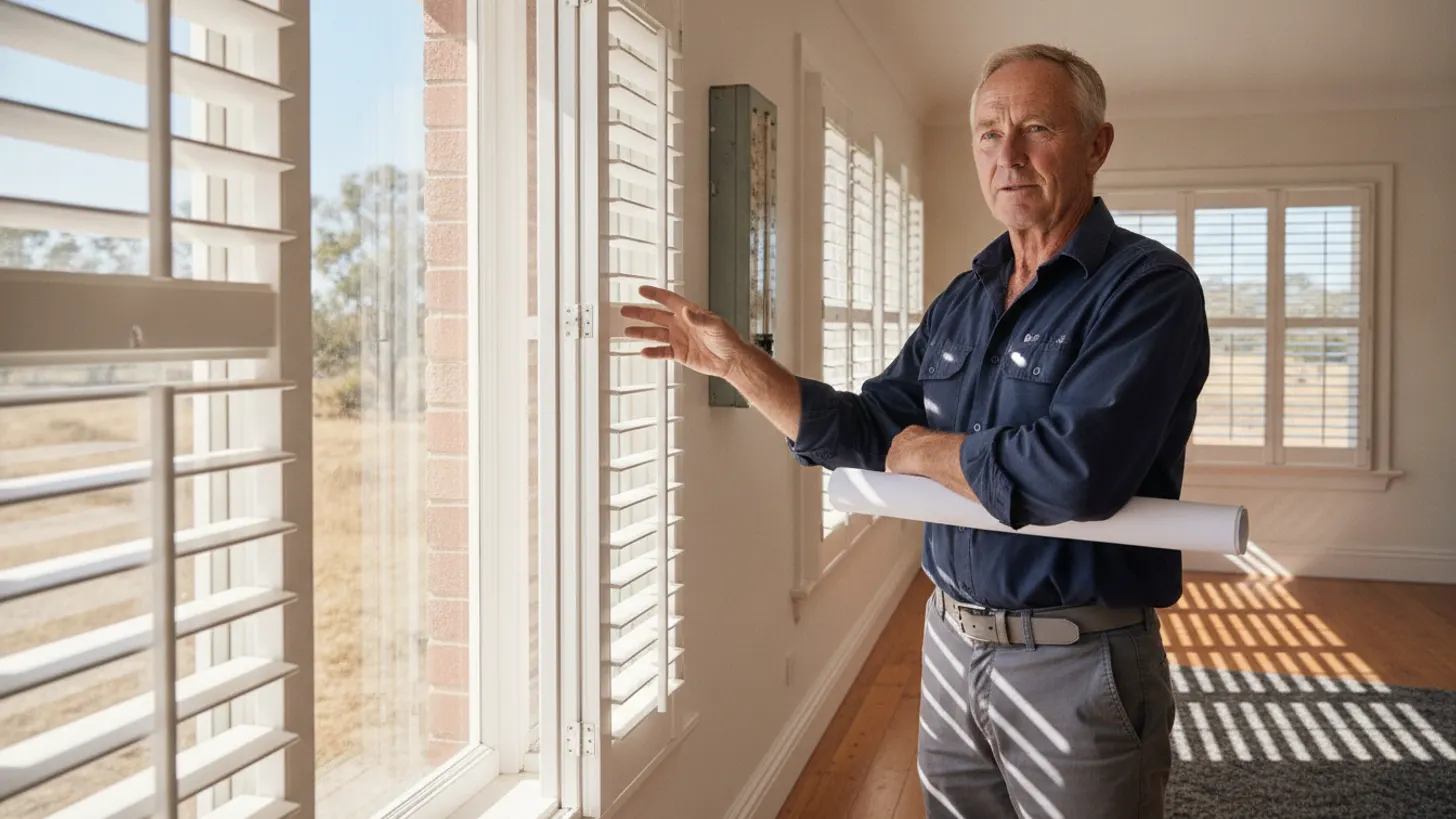
"Can you even do shutters on a triangle?" is the question we field most often in Temora. Yes, and the answer is less about the shutter than the frame around it. Custom shaped shutters Australia wide are built from a measured template of the opening, so a raked gable, a porthole or a 30 degree bay all come down to angles, radii and one honest decision about which panels open.
Which unusual window shapes suit custom shaped shutters Australia wide?
Almost any glazed shape can be shuttered: half-round and quarter-round arches, raked gables, triangles, circles, ellipses, trapezoids, octagons and angled bays. What changes is the frame, not the louvre. Custom shaped shutters Australia wide begin as a frame cut to the real outline of the opening, with blades and panels arranged inside it.
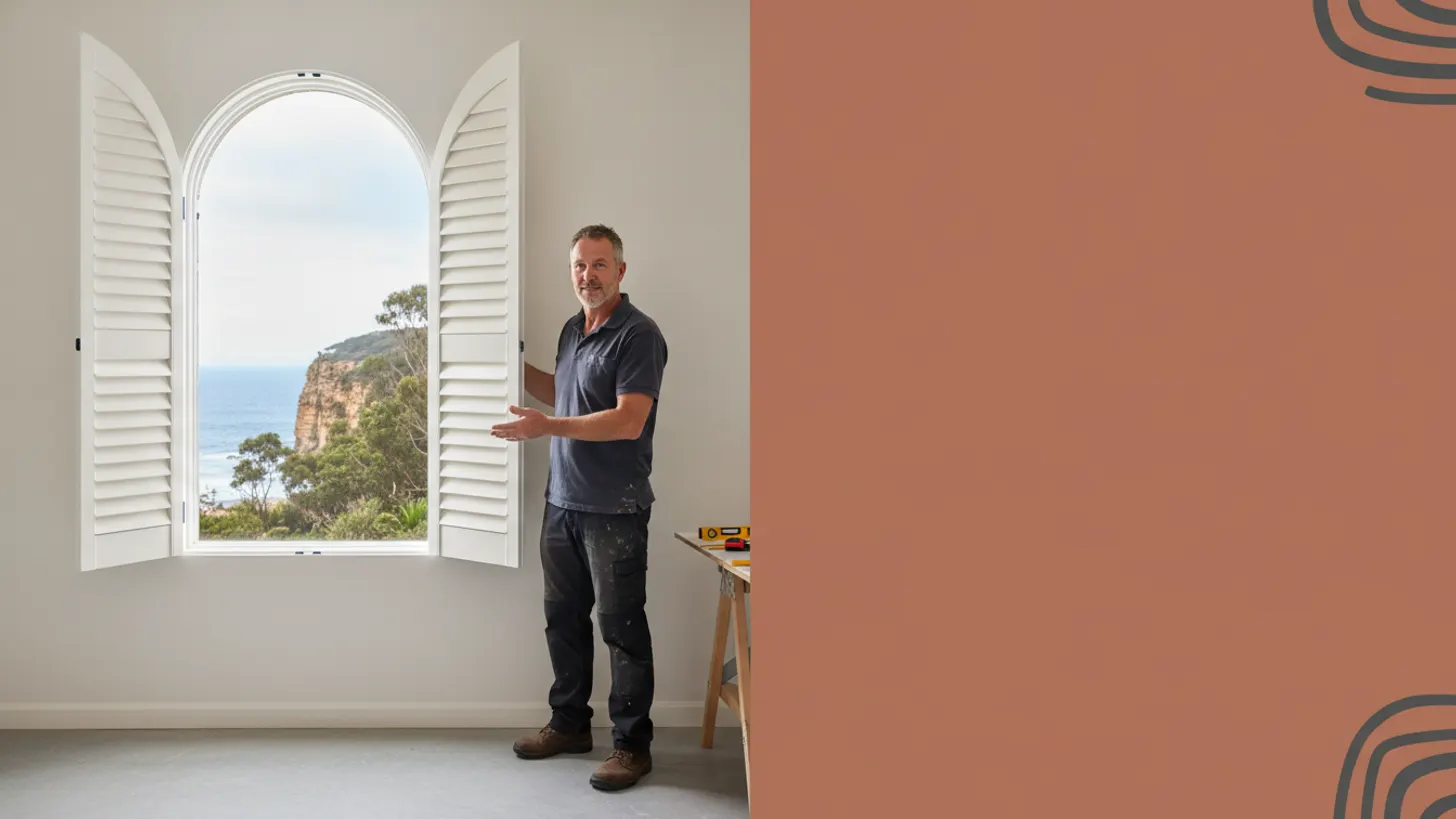
Around Temora and Wagga we see four shapes often: the raked gable above a lounge room with a cathedral ceiling, the stairwell window with one angled head, the porthole in a gable end or bathroom, and the half-round arch sitting over a double-hung. Each behaves differently once you ask it to open. Our guide to arched window shutters covers the half-round case in detail, so this article sticks to the harder geometry. Shading a west-facing shaped window matters more in the Riverina than on the coast, and the Australian Government Your Home shading guidance explains why orientation sets the brief before style does.
| Window shape | Where we see it in the Riverina | Usual panel strategy | Operable? |
|---|---|---|---|
| Raked gable (right triangle) | Cathedral ceilings, high lounge walls | Fixed shaped head, operable panel below sill line if reachable | Rarely |
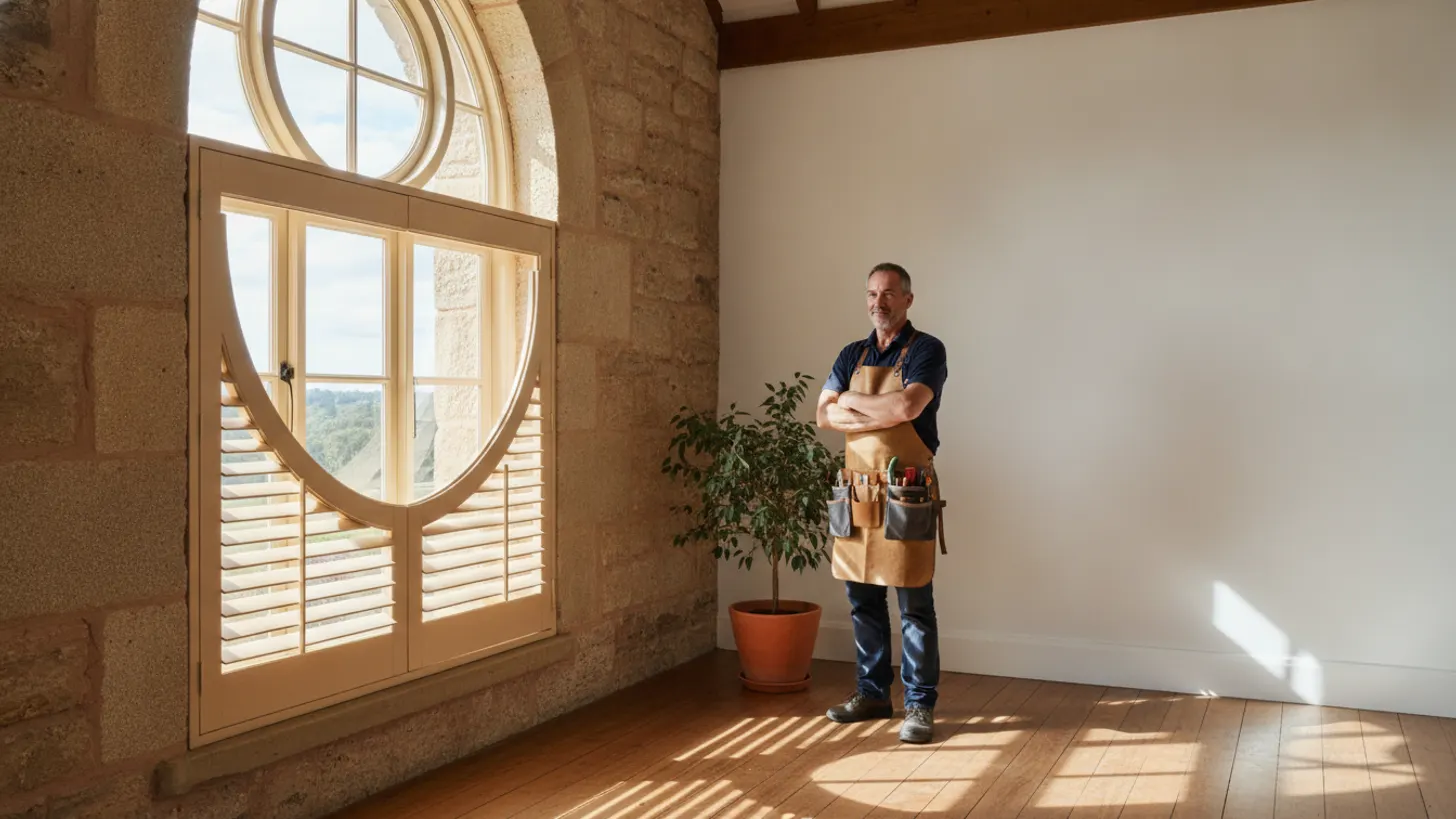
| Circle or porthole | Gable ends, bathrooms, entry voids | Two-piece split frame, often fixed louvres | Sometimes |
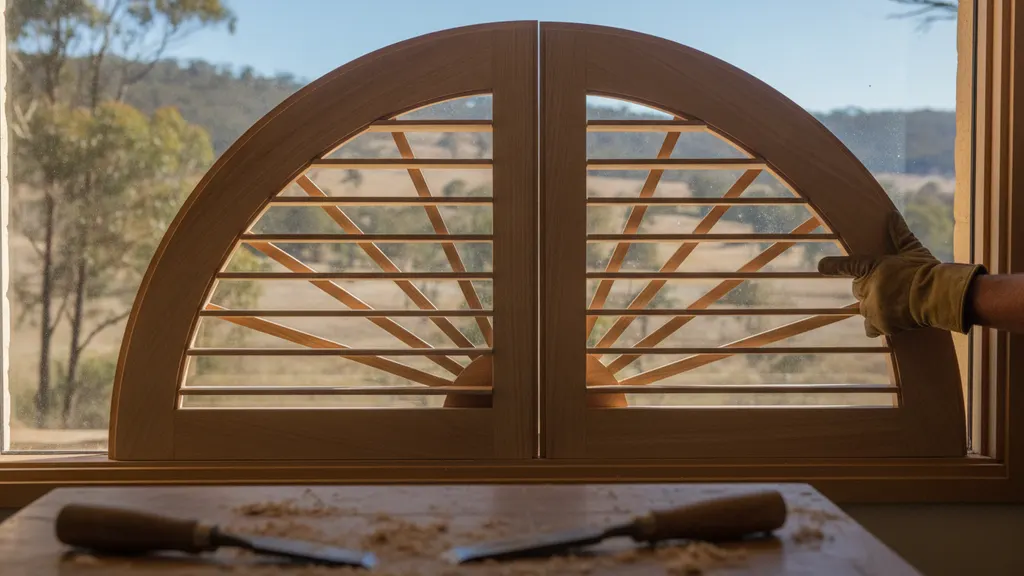
| Half-round arch over double-hung | Federation and Hamptons style frontages | Shaped sunburst head over hinged lower panels | Lower panels yes |
| Angled bay (90 or 135 degrees) | Dining and living bays, brick homes of the 1980s | Separate frame per facet, mitred posts | Yes |
| Trapezoid stair window | Split-level and two-storey stairwells | Single frame, angled head rail, fixed blades | Rarely |
Related reading: Window shutters cost Australia: pricing factors for NSW renovations.
How are triangular, circular and angled windows measured?
Not in width by height. A shaped opening is measured as a set of side lengths, included angles and radii, then checked against a physical template. We record between four and twelve points per opening depending on the shape, because one degree of error at the head shows up as a visible gap at the sill.
For a triangle we take all three side lengths, all three internal angles and the plumb of each reveal, since a gable rake is seldom the angle the plan claims. For a circle we take four diameters at 45 degree steps, which exposes the oval that most round windows turn out to be. For an angled bay we measure each facet on its own, then both post angles, then reveal depth at each end. The method extends what we describe in our measuring and fitting guide, with templating added. Templating is what makes custom shaped shutters Australia dependable in the field, because the frame is verified against the opening before anything is machined. Made to measure shutters NSW wide live or die on that step, and we measure and quote on the same visit so the template is cut while we are standing in the room.
Standards Australia publishes AS 1288, the glass in buildings standard that governs the glazing behind these frames, and the Standards Australia catalogue is where the current edition sits. Knowing the glass type before cutting a frame changes the detail: a toughened pane in a low stair window can carry a different reveal depth to the pane beside it.
Opening, cleaning and light control trade-offs with custom shaped shutters Australia
Three compromises come up on every shaped job: not all blades can tilt, not every panel can open, and tight corners hold dust. Custom shaped shutters Australia projects go best when the homeowner decides early which of those three matters least in that particular room.
In a triangle, blades near the acute corner are too short to tilt on a normal rod, so shutters for triangular windows usually fix those blades at a set angle or leave them out. In a circle, a horizontal split lets the top half stay fixed while the bottom half tilts. Dust is the honest one: a sunburst head or a tight apex wants a soft brush head rather than a cloth, and the detail traps more lint than a flat panel does. For light control, a fixed louvre set at 45 degrees still blocks direct sun, and Your Home glazing guidance sets out how much of a room heat load arrives through the glass itself.
Which materials and hinge systems suit custom shaped shutters Australia?
Shaped frames load hinges unevenly and need a material that machines to a curve without splitting. For custom shaped shutters Australia wide we use basswood for painted curves, PVC or aluminium where moisture or heat is the problem, and heavier offset hinges on any panel wider than it is tall.
Basswood takes a bent or segmented curve cleanly and holds paint on a sunburst head. PVC suits bathrooms and laundries, where a shaped frame near a shower would otherwise move with the moisture, a point covered in our materials comparison. Aluminium earns its place on west-facing gables inland, where Bureau of Meteorology climate records for inland NSW show how many hot summer days a Riverina gable faces, and timber on an unshaded rake has a harder life than timber in a hallway. Hinge choice follows geometry: butt hinges for square-edged panels, offset or crank hinges where a shaped head would foul the architrave, and a cranked stay on tall narrow panels so they do not twist out of square.
When is a fixed panel preferable to an operable shutter panel?
When nobody can reach the window, when the shape leaves a stile too thin to hinge, or when the glazing is the thing being protected. A fixed panel on a high gable gives the look and the shading with none of the sag that follows a hinge carrying an odd-shaped load.
Three questions decide it on site. First, height: anything above a safe reach line goes fixed, since an operable panel you cannot reach is a hinge waiting to fail. Second, geometry: an acute corner under about 30 degrees leaves no room for a stile, a hinge and a blade together. Third, duty: a shaped window beside a stair or in a hazardous location is better left fixed so the glazing is not loaded by a swinging panel. Custom shaped shutters Australia specifiers often pair a fixed shaped head with operable panels below, which is also how we treat high light wells in our skylight heat and glare guide. The energy.gov.au household heating and cooling advice is worth a read before fixing a panel permanently, because a sealed opening changes how a room vents in summer.
NCC 2022, glazing safety and compliance for shaped windows in NSW
Shaped windows tend to sit exactly where the building code pays attention: low to the floor, beside a stair, or in a wet area. NCC 2022 includes safety requirements for glazing in hazardous locations, which can affect low-level or unusually shaped windows, so the glass comes before the shutter design.
Compliance for custom shaped shutters Australia follows the glass specification, not the other way round. The Australian Glass and Glazing Association recommends assessing glass type, human impact risk and location when designing non-standard glazing, which is a sound order of operations for a builder specifying a porthole or a floor-level trapezoid. Where a literal reading of the code does not suit the shape, the National Construction Code performance requirements allow alternative design solutions when they demonstrate compliance with the relevant building provisions, and Master Builders Australia guidance on the National Construction Code is a useful starting point for how that documentation is prepared. Heritage frontages add another layer, since the shape is often the thing being conserved, and our heritage window treatment guide works through that tension. For thermal claims, CSIRO building performance research and Sustainability Victoria window treatment advice beat any brochure.
Frequently asked questions
Can you really fit shutters to a triangular window?
Yes. A triangle is one of the more common shaped jobs we measure and quote across the Riverina. The frame is cut to the three measured side lengths and internal angles, and the blades run horizontally, with the shortest ones near the acute corner either fixed at a set angle or left out. Custom shaped shutters Australia wide behave this way because a very short blade has nowhere to carry a tilt rod. On a high gable rake, expect a fixed or part fixed panel. The Your Home guidance from the Australian Government explains why those high west-facing triangles are worth covering at all.
How do you measure a round window for shutters?
With a template, not a tape alone. We take four diameters at 45 degree steps, because most windows sold as round are slightly oval once the render and the reveal are finished. We then mark reveal depth at four points and cut a physical template so the two-piece frame closes on the real circle. Circular window shutters usually split horizontally, which lets the lower half tilt while the upper half stays fixed. The glass behind the frame matters too, so we confirm the pane type against AS 1288, the glass in buildings standard listed in the Standards Australia catalogue.
Should shaped shutter panels open, or is fixed better?
Fixed is the right answer more often than people expect. If the window sits above safe reach, if the acute corner leaves no room for a stile and a hinge, or if the glazing is in a hazardous location, a fixed panel delivers the shading and the look without a hinge carrying an uneven load. Operable panels earn their place at head height and below, in bays, and under a shaped head. A common result on a tall stairwell is a fixed shaped top with hinged panels underneath. Your Home glazing guidance is worth reading first, since a sealed opening changes how a room sheds summer heat.
Are custom shaped shutters more expensive than standard rectangular ones?
Shaped work costs more than a rectangle, because the frame is templated and machined to the opening instead of cut from stock sizes, and because fitting takes longer. We do not publish a figure, since the number moves with shape count, material, access and height. We measure and quote on site and leave itemised written pricing with you. Buyer research such as the Canstar Blue window furnishing reviews is a reasonable way to sanity check the market before you book anyone. Ask any installer whether the quote includes templating, and whether the shaped head is fixed or operable, because that is where quotes diverge.
What shutter material holds up best in a hot inland NSW room?
Aluminium or PVC, in most inland cases. A west-facing raked gable in Temora or Griffith takes long hours of direct sun, and an unshaded timber panel in that position works harder than the same panel in a hallway. Aluminium holds a shaped profile without movement, PVC suits wet areas, and basswood still wins where a painted sunburst head is the look you want and the glass is already shaded. CSIRO building performance research is a good grounding on how much heat moves through glazed openings, which is the load the material has to live with.
Do odd-shaped windows need special glazing or approval in NSW?
Often, yes to the glazing question. NCC 2022 includes safety requirements for glazing in hazardous locations, which can affect low-level or unusually shaped windows, so the glass specification should be settled before anyone orders a shutter frame. The Australian Glass and Glazing Association recommends assessing glass type, human impact risk and location when designing non-standard glazing. Where the standard detail does not suit the shape, the National Construction Code performance requirements allow alternative design solutions when they demonstrate compliance with the relevant building provisions, and Master Builders Australia guidance on the Code outlines how that is documented.