How Much Do Plantation Shutters Cost in Australia? (2026 Price Guide)
By Chris & Campbell, LuxeShutters, Temora NSW · 7 April 2026 · 12 min read
"Just give me a straight number." That's what a Wagga homeowner asked us last Tuesday, and honestly, we hear that request on nearly every enquiry. So here it is: plantation shutters cost between $300 and $800 per square metre installed across Australia in 2026. For a standard opening (1200mm x 1200mm), expect to pay $450 to $750 fully fitted. We've measured, quoted, and mounted hundreds of louvre sets throughout Temora, Wagga Wagga, Griffith, and the broader Riverina, so this guide reflects our real-world trade figures rather than a generic online estimate.
According to energy.gov.au, up to 40% of household heating and cooling energy escapes through glazing (2026). Consequently, well-chosen louvred coverings do far more than simply look attractive. They also meaningfully reduce electricity consumption, lift your property's appraised worth, and perform reliably for decades. Yet they represent a significant outlay too, so you deserve complete transparency on what you'll actually pay.
In this guide, we therefore unpack every variable that shapes the final figure: substrate choice, opening dimensions, fitting complexity, and the extras that nudge the total higher or lower. There's no wishy-washy "call for a quote" padding here. Instead, you'll find verifiable dollar ranges drawn exclusively from jobs we've completed this year.
Quick Summary
- PVC/Poly shutters: $300-$500 per m2 installed, best value for most Australian residences
- Basswood/Timber: $500-$800 per m2 installed, premium natural finish for living areas
- Standard opening (1200x1200mm): $450-$750 fully fitted, including supply + fitting + GST
- Whole-dwelling (3 bed, 8-10 openings): $4,000-$12,000 depending on substrate and quantity
- Because shutters are legal fixtures, they increase property value, with industry ROI estimates reaching 75% (Classic Blinds, 2026)
What Do Plantation Shutters Cost by Material in 2026?
The Window Shading Association of Australia (WSAA) describes louvred panels as sitting "at the pinnacle of window covering types," classifying them as fine furniture rather than a disposable accessory. Consequently, the substrate you select drives the largest portion of your total outlay. As CWGlobal dealers, we carry the full domestically manufactured range, backed by structural guarantees stretching to 25 years on polymer products.
Below is a side-by-side breakdown of what each option runs when professionally fitted in the Riverina. Importantly, these are the installed rates we actually quote, not catalogue suggestions.
| Material | Cost per m2 (Installed) | Best For | Warranty |
|---|---|---|---|
| PVC / Poly (e.g. Forte Select) | $300-$500 | Bathrooms, kitchens, whole-dwelling budgets | Up to 25 years structural |
| ThermoPoly (e.g. Bayview ThermoPoly) | $350-$550 | Wet areas, high-humidity rooms, extreme climates | Up to 25 years structural |
| Basswood / Timber (e.g. Bayview Basswood) | $500-$700 | Lounges, bedrooms, heritage residences | 5 years (painted finish) |
| Stained Timber (e.g. Bayview Basswood Stained) | $600-$800 | Feature openings, natural grain display | 5 years |
| Aluminium | $500-$700 | Alfresco zones, outdoor entertaining, high wind exposure | 10 years |
Prices current as of April 2026. Based on standard fittings in the Riverina, NSW. Your quote may vary depending on opening dimensions, site access, and product selection.
In practice, the majority of our Riverina clients opt for PVC or ThermoPoly. As a result, a three-bedroom dwelling in Temora with 8-10 standard openings typically totals $4,500 to $7,500 including GST. Surprisingly, that's often $1,000-$2,000 less than equivalent Sydney quotes for the identical CWGlobal merchandise. We explain the regional pricing advantage further down.
How Much Does a Single Opening Actually Cost?
Australians tipped over $48 billion into renovations during 2025, marking a 13% surge from the prior year (Magic New Family Homes, 2025). Naturally, glazing treatments capture a meaningful slice of that expenditure. Still, per-square-metre figures can feel abstract when you're staring at your lounge room opening wondering "what will THIS one set me back?" To clarify, here's the plantation shutters cost mapped to everyday dimensions that Riverina homeowners will recognise.
| Opening Size | Area (m2) | PVC Installed | Basswood Installed |
|---|---|---|---|
| Small (900 x 900mm) | 0.81 | $320-$400 | $450-$570 |
| Standard (1200 x 1200mm) | 1.44 | $500-$650 | $720-$950 |
| Large (1500 x 1800mm) | 2.70 | $950-$1,200 | $1,350-$1,750 |
| Sliding Door (2400 x 2100mm) | 5.04 | $1,800-$2,200 | $2,500-$3,200 |
All figures above bundle product supply, professional fitting, and GST into one number. In other words, we don't tack on a separate labour invoice for standard rectangular openings.
What Pushes the Price Up or Brings It Down?
Every dwelling is different. Over years of quoting across the Riverina, we've encountered everything from straightforward rectangles to elaborate heritage bays that consumed half a day just to template. So what actually nudges your louvre investment higher or lower? Essentially, these variables explain most of the variance in plantation shutters cost.
Factors That Increase the Outlay
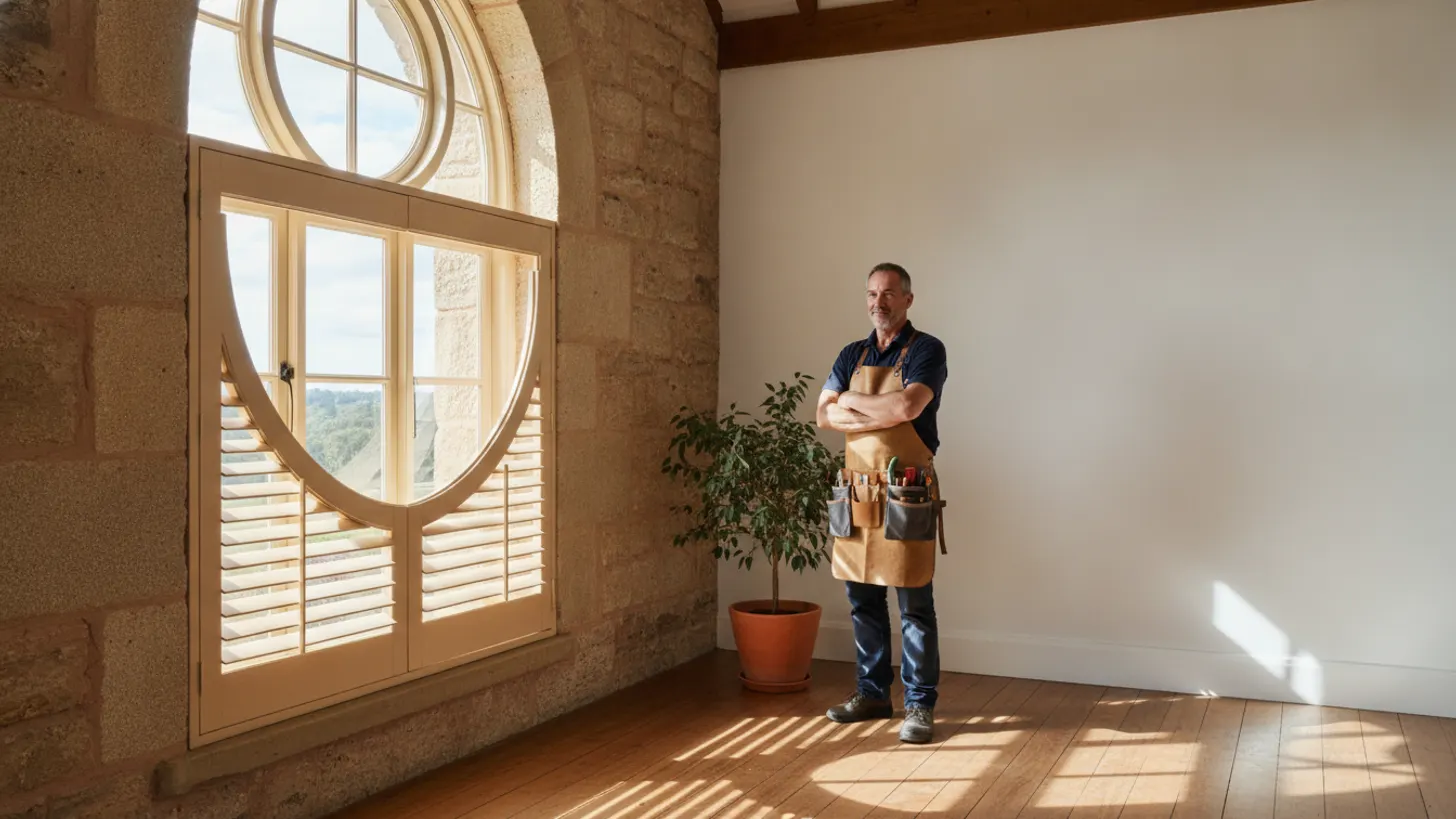
- Non-standard shapes: Arched, circular, or raked openings demand bespoke frames and cardboard templates. Consequently, expect 20-40% above the equivalent rectangular area.
- Bay configurations: Three or more angled panels wrapping around a bay add significant complexity. Specifically, Chris templates the precise angles on site because even two degrees of misalignment ruins the fit.
- Sliding or bi-fold track systems: Rail-mounted assemblies for glass sliders carry higher hardware expenses than standard hinged panels. Therefore, budget accordingly for larger apertures.
- Stained timber finishes: If you'd prefer the natural grain visible rather than painted white, basswood stained typically adds $80-$120 per m2 on top.
- Elevated or restricted-access openings: If scaffolding or specialised equipment is required, fitting naturally takes longer and consequently raises labour charges.
Factors That Reduce Your Spend
- Whole-dwelling orders: Completing 8-12 openings in a single visit is far more efficient than scheduling three separate trips. As a result, we typically discount 10-15% off the per-opening rate for bulk jobs.
- Polymer over timber: Honestly? For white-painted louvres, most homeowners can't distinguish PVC from basswood at arm's length. Choosing polymer therefore saves 30-40% with zero visible compromise.
- Standard rectangular openings: Straightforward geometry means faster fitting and lower labour. It really is that simple.
- Recess-fit mounting: Seating panels inside the reveal is quicker than face-mounting with an external architrave surround. So if your openings allow it, recess-fit trims both time and expense.
Which Material Should You Choose for Each Room?
Laboratory testing demonstrates that louvred panels slash heat flux through glazing by 20-58%, depending on the cavity depth and substrate composition (Luxaflex, 2026). That's a tangible difference on your quarterly electricity statement. However, which substrate belongs in which space?
Having fitted louvres in virtually every dwelling type across the Riverina, from century-old weatherboards in Temora to fresh builds on Wagga's suburban fringe, here's our room-by-room verdict.
PVC (Forte Select, from $300/m2): Easily our highest-volume product. It resists moisture, withstands scorching temperatures, wipes clean with a damp cloth, and in a white lacquer finish it's visually identical to natural timber. If you're outfitting an entire residence on a sensible budget, this is where most Riverina families gravitate. Specifically, it excels in bathrooms, kitchens, laundries, and children's bedrooms where resilience trumps character grain.
ThermoPoly (Bayview ThermoPoly, from $350/m2): This composite is specifically formulated for harsh Australian conditions, sitting a notch above standard polymer in both thermal resistance and panel rigidity. Because Riverina afternoons frequently surpass 40 degrees while winter dawns bring genuine frost, that performance differential is tangible rather than theoretical. We especially advocate ThermoPoly for westerly-exposed openings that absorb relentless afternoon radiation.
Basswood (Bayview Basswood, from $500/m2): Genuine hardwood carrying a tactile warmth and heft that engineered alternatives can't entirely replicate. Additionally, basswood is lighter than polymer yet sturdier than softwood, revealing a beautiful natural figuring in stained variants. It's the preferred selection for lounges and master suites in heritage dwellings across Temora and Wagga, where occupants prioritise a premium aesthetic. Just avoid deploying it in splash-prone zones.
Uncertain which composition suits your circumstances? That's precisely the purpose of the free in-home consultation. We transport samples of all three substrates so you can compare textures and tones against your own walls and daylight.
Why Are Shutters Cheaper in Regional NSW Than Sydney?
This catches many buyers off guard. Although we're headquartered in Temora and service the entire Riverina, from Wagga Wagga and Griffith through to Cootamundra, Young, and West Wyalong, the merchandise itself is identically priced regardless of geography. As authorised CWGlobal dealers purchasing direct from a domestic factory, our raw product expenditure matches any metropolitan competitor. Instead, the gap sits squarely in operational overhead.
Put simply, we don't carry a $200,000-a-year retail lease on a Sydney boulevard. Nor do we shoulder inner-city parking levies, multiple management tiers, or CBD office rent. In concrete terms, an order quoted at $8,000 in Sydney frequently totals just $6,000-$7,000 here for the identical CWGlobal catalogue item and equivalent workmanship.
Beyond pricing, however, Riverina residences face a distinctive climatic test that also shapes material selection. Temora records 33 frost mornings annually, yet summer peaks routinely breach 40 degrees Celsius. That represents a staggering 50-degree annual temperature arc. Polymer and ThermoPoly compositions tolerate this swing far better than natural timber, which gradually warps through repeated thermal expansion and contraction. It's precisely why our ThermoPoly fitting rate exceeds what tradespeople report in temperate Melbourne.
How Do Plantation Shutters Compare to Other Coverings on Cost?
Research from the WSAA confirms that up to 30% of total thermal leakage from an Australian dwelling escapes through bare glazing (2026). Clearly, whatever covering you select carries real financial consequences. But how does the plantation shutters cost equation compare against roller blinds, venetians, and custom drapes across a full decade?
| Covering Type | Typical Outlay per Standard Opening | Expected Lifespan | 10-Year Expenditure | Adds Property Value? |
|---|---|---|---|---|
| Roller Blinds | $150-$400 | 5-8 years | $300-$800 (replace once) | No |
| Venetian Blinds | $200-$500 | 5-10 years | $200-$500 | No |
| Custom Curtains | $300-$800 | 7-12 years | $300-$800 | No (removed at sale) |
| Louvred Panels (PVC) | $450-$650 | 15-25 years | $450-$650 (no replacement) | Yes (legal fixture) |
| Louvred Panels (Basswood) | $700-$950 | 25-30+ years | $700-$950 (no replacement) | Yes (legal fixture) |
Here's the distinction most comparison articles overlook. Because louvred panels are mechanically fastened to the frame, Australian property law classifies them as permanent fixtures, identical in legal status to a granite benchtop or hardwood flooring. At resale, they therefore transfer with the dwelling and appear prominently in the agent's listing. Curtains and roller coverings, by contrast, are categorised as personal chattels and typically depart with the vendor.
That distinction matters financially. Indeed, industry research pegs the lifetime return on investment for quality louvres at up to 75%, while certain agents observe that properties fitted with them transact at a 3-5% premium over equivalent dwellings sporting basic coverings (Classic Blinds, 2026). Although the initial outlay sits above alternatives, the decade-long economics tilt decisively in favour of louvred panels.
Do Plantation Shutters Actually Save Energy in Australia?
Government data paints a stark picture: up to 40% of heating energy escapes through glazing, while nearly 87% of unwanted warmth enters residences the same way (energy.gov.au, 2026). Louvred panels address both problems simultaneously by trapping a still-air cavity between blade and pane, thereby mimicking the insulating principle behind double-glazed units at a considerably lower outlay.
Additionally, the WincovER rating system, purpose-built for Australian climatic zones, evaluates coverings on a 10-star scale spanning both winter retention and summer rejection. Adjustable louvres consistently perform well here because they offer variable control: angle them open on a crisp July morning to harvest solar warmth, swing them closed during a scorching February afternoon to deflect radiant load, or tilt partially for ventilation without compromising seclusion.
For Riverina households in particular, where tariffs keep escalating and the thermometer demands both ducted heating and evaporative cooling across a single calendar year, that adaptability translates to tangible bill relief. Indeed, several of our Griffith clients have reported their split system cycles markedly less after we fitted Bayview ThermoPoly across their western elevation. Can we promise a precise kilowatt-hour reduction? Truthfully, no. But the underlying physics is unambiguous, and Commonwealth data corroborates the trend.
What Happens When You Contact Us for a Quote?
Web-based estimators provide a rough ballpark, yet they can't account for the quirks every Riverina dwelling carries. Specifically, variables that genuinely alter the final tally, such as opening geometry, architrave condition, ceiling height, and mounting approach, only surface during a physical inspection. Here's how our quoting sequence unfolds from first enquiry to final fitting.
- First, book a free in-home consultation. Call 1800 465 893 or use the form on our website. We'll then arrange a time that suits you, anywhere in the Riverina.
- Next, we visit, measure, and show samples. Chris or Campbell arrives at your residence with the full CWGlobal sample range. You can therefore see and feel PVC, ThermoPoly, and basswood side by side, in your own light, against your own walls. We measure every opening to the millimetre.
- Then you receive a detailed quote within 48 hours. Not a ballpark. Instead, it's a line-by-line breakdown showing each opening individually: product, dimensions, configuration, and installed tariff. You can see exactly where every dollar goes.
- Also, there's no pressure and no expiry tricks. We don't do "sign today for 20% off" nonsense. The quote remains valid, and you take whatever time you need to decide.
- Finally, manufacturing and fitting. Once you go ahead, Australian-made CWGlobal products take 4-6 weeks. We handle the entire job ourselves. The same team that measured is the team that mounts your panels. One point of contact from start to finish.
We currently service Temora, Wagga Wagga, Griffith, Cootamundra, Young, West Wyalong, Narrandera, Leeton, and surrounding localities. If you're anywhere in the Riverina, we'll come to you.
Are Cheap Imported Shutters Worth Considering?
Inevitably, some homeowners discover offshore alternatives advertised at $150-$200 per square metre and wonder whether the plantation shutters cost premium for Australian-made products is justified. It's a fair question, so here's what we've observed first-hand.
First, imported panels frequently arrive with dimensional tolerances wider than domestic specifications permit. Even a 2mm discrepancy across a 1200mm span creates visible gaps between louvre and frame. Second, paint adhesion on budget composites tends to deteriorate within 18-24 months, particularly in UV-intense regions like central NSW. Third, warranty enforcement becomes practically impossible when the manufacturer operates from a different jurisdiction altogether.
By contrast, CWGlobal products are fabricated domestically under Australian Standard AS2663.2, verified through the WSAA certification programme, and backed by enforceable local guarantees. Does that justify paying more upfront? In our professional judgement, unequivocally yes. The customers who've asked us to replace failing imported panels after barely two years would almost certainly agree.
Ultimately, the plantation shutters cost discussion isn't purely about the sticker figure on day one. Rather, it's about total expenditure across the product's operational life. A $500/m2 panel that performs flawlessly for 25 years works out cheaper per annum than a $200/m2 import that needs replacing at year three.
Want a Straight Answer on What Your Openings Will Cost?
We'll measure up, show you the full range, and give you a line-by-line quote. No charge, no obligation, no pressure.
1800 465 893 Book Free ConsultationFrequently Asked Questions
Are plantation shutters worth the money in Australia?
For most Australian residences, absolutely. Although the upfront outlay runs higher than blinds or curtains, louvred panels last 15-30 years without needing replacement. They're also classified as permanent fixtures under property law, which means they add directly to your dwelling's appraised value. Industry estimates put the return on investment at up to 75% over the product's lifetime. In regional areas like the Riverina, the energy savings from superior insulation compound year after year, especially with electricity tariffs trending upward.
How much do plantation shutters cost for an entire house in Australia?
A three-bedroom residence with 8-10 standard openings typically ranges from $4,000 to $12,000 for plantation shutters in Australia, depending on your substrate selection. PVC across an average Riverina dwelling runs $4,500-$7,500 fully fitted. Basswood or stained timber, by contrast, pushes toward $8,000-$12,000 for the same property. Whole-dwelling orders usually attract better per-opening pricing because completing everything in one or two visits is more efficient for both the fitter and the homeowner.
Which is cheaper: PVC or timber plantation shutters?
PVC is consistently 30-40% cheaper than timber. Specifically, installed pricing for PVC runs $300-$500 per square metre, while basswood timber costs $500-$700 per square metre. For white-painted louvres, which represent the vast majority of orders nationally, there's genuinely no visible difference between PVC and timber at normal viewing distance. PVC also handles moisture and temperature extremes more reliably, which is particularly relevant for bathrooms, kitchens, and dwellings in areas with wide seasonal swings like the Riverina.
Do plantation shutters block heat in summer?
Yes, and the data clearly supports it. According to energy.gov.au, up to 87% of a dwelling's heat gain enters through glazing. Louvred panels create a trapped air layer between the blade and the glass, thereby reducing heat transfer by 20-58% depending on configuration. ThermoPoly panels from CWGlobal are specifically engineered for thermal performance in Australian conditions. In Riverina summers where temperatures regularly exceed 40 degrees, our clients consistently report their air conditioning cycles noticeably less after fitting louvres on west-facing openings.
How long does it take to get plantation shutters installed?
From placing your order to final fitting, expect 4-6 weeks for Australian-manufactured panels from CWGlobal. The actual mounting on installation day then takes 1-3 hours for a standard room of 3-4 openings, or a full day for a whole-dwelling job covering 10 or more apertures. We handle the complete process from measurement to final fitting with the same team, so there's one point of contact throughout. Imported panels from overseas manufacturers, however, can take 8-12 weeks and sometimes longer if shipping encounters delays.