Sliding Door Blinds · 17 min read
Sliding door blinds Australia: panel glide vs vertical options NSW
Chris & Campbell · 4 September 2026
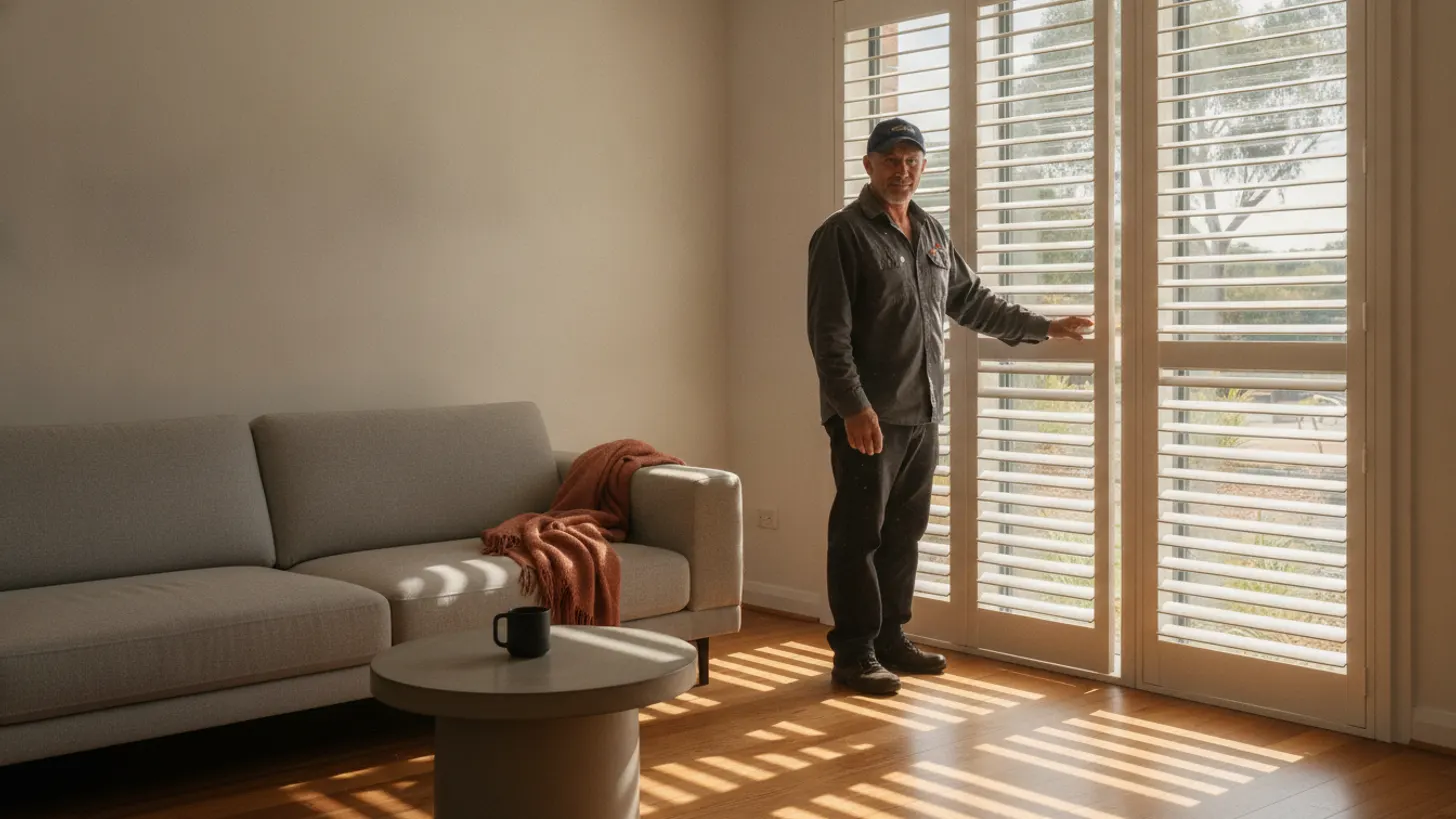
Should sliding door blinds Australia homeowners install for a 3.6 metre alfresco opening be panel glides or verticals? Chris and Campbell get that question every week across the Riverina, and the honest answer depends on stack space, door frequency, and whether pets or kids will barrel through that stack fifty times a day. This guide covers panel glides against verticals, correct measuring for wide doors, materials that survive NSW summers, and the safety details we check before we measure and quote.
Panel glide vs vertical: which sliding door blinds Australia trusts for alfresco living
Answer: Panel glides are the sliding door blinds Australia homeowners choose most for a 3.0 m to 3.6 m opening, costing 20 to 30% more than verticals but running near-silently, stacking to 150 to 260 mm, and covering widths from 1800 mm to 4200 mm. Verticals tilt in 15-degree steps for airflow control.
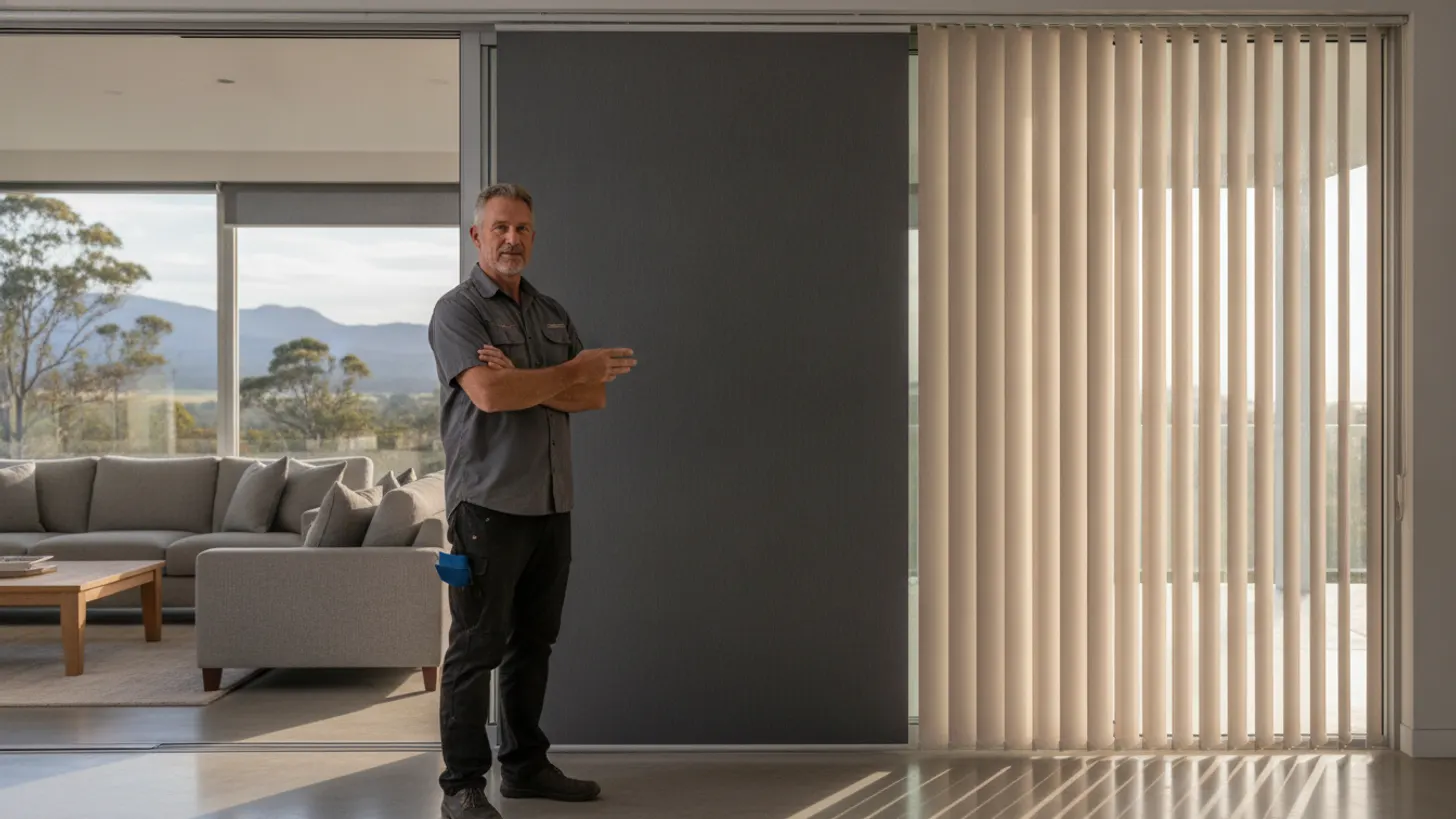
Panel glide blinds and vertical blinds solve the same problem of covering a wide horizontal opening, but with very different mechanics. Panel glides use 4 to 6 wide fabric panels that slide sideways on a headrail track. Verticals use 89 mm or 127 mm louvres that pivot and stack to one or both sides. Panel glides read cleaner in a modern home; verticals cost less and tilt for airflow.
Across most jobs we quote in Wagga, Griffith, and Temora, panel glides win on look and quiet operation, while verticals win on airflow control and price. Panel glides are the default when the sliding door is the main visual feature of an open-plan living zone. Verticals stay popular in rentals, offices, and homes where budget matters and the door is used dozens of times a day. Guidance from Your Home passive design shading advice reinforces that horizontal control at a wide opening beats punching light gaps around a single-drop treatment.
For a 2.4 m door either system works. Past 2.4 m you either commit to a multi-stack panel glide, or the vertical louvre count starts to look busy. Sliding door blinds Australia customers pick most often are 4-panel glides on a 3.0 m to 3.6 m opening, with a single-side stack sitting inside the reveal.
| Feature | Panel glide | Vertical blinds |
|---|---|---|
| Typical width range | 1800 to 4200 mm | 1200 to 4800 mm |
| Stack depth (one side) | 150 to 260 mm | 140 to 180 mm |
| Light control | Draw open or closed | Tilt plus draw |
| Airflow tuning | Panels open or closed | Louvre tilt in 15-degree steps |
| Noise on windy days | Quiet | Louvres can rattle |
| Child-cord risk | Wand only | Chain plus wand, tension device required |
How to measure for sliding door blinds Australia homeowners install without light gaps
Answer: measure the frame opening at three heights and three widths, use the smallest of each pair for an inside mount, and add 150 mm each side plus 150 mm at the top for an outside mount. That is the short version. The long version stops the light gaps and stacking problems that plague DIY installs.
The standard Australian sliding door width sits anywhere from 1800 mm to 4200 mm, per common builder specs and the residential design data captured in Master Builders Australia industry guidance. Past the 2400 mm mark you need a multi-stack panel configuration to prevent a single oversized drop that jams on its track or fails to tension. Standard glass door heights range 2040 mm to 2400 mm; anything taller usually means a custom track order.
Two measurement mistakes we see nearly every week. First, homeowners measure architrave to architrave and forget the wall protrusion that a track-mounted headrail creates. That eats 40 mm to 60 mm off the daylight opening. Second, they forget the 150 mm panel overlap on a panel glide (a minimum Standards Australia and WFAANZ installation baseline), and end up with visible seams when panels are half drawn. For sliding door blinds Australia homes rely on for privacy at dusk, that seam is a dealbreaker.
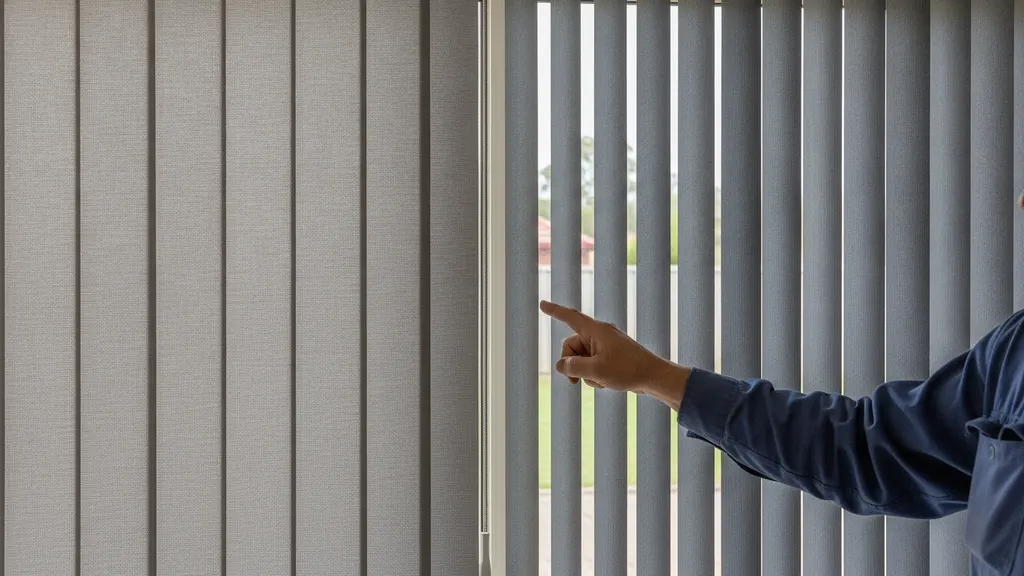
Track choice matters as much as fabric. A 3-channel track handles 3 to 4 panels; a 5-channel handles 5 to 6. Under-spec the track and your panels bind or scrape. Over-spec and you carry more headrail than your reveal will hide. If you are planning around a new build, our guide on planning window treatments for a new build in NSW covers this pre-frame conversation with your builder.
Fabric and material choice for NSW summer heat and UV
Answer: Choose a screen-weave fabric rated 90 to 95% UV block for any west or north-west sliding door in NSW. Bureau of Meteorology data puts inland NSW at UV index 11 or higher between November and February. Cheap PVC louvres crack and yellow within three summers under that UV load; woven acrylic holds colour and hand feel for eight to twelve years.
Riverina and coastal NSW summers throw two things at a sliding door: direct UV load on west-facing glass and drafts of hot air whenever the door opens. Fabric choice on your sliding door blinds Australia summer conditions justify has to handle both. Screen-weave fabrics with a 90 to 95% UV block rating are the practical default on west and north-west exposures. Bureau of Meteorology UV index data puts most of inland NSW at extreme category, index 11 or higher, between November and February. That rating sits at the top of the scale, meaning unprotected materials at the glass surface accumulate intense solar energy on every clear summer day. Fabric behind sliding glass takes that full dose whenever the blind is drawn. Cheap PVC verticals brittle and yellow inside three summers under that sustained load. Woven acrylic and treated polyester hold colour and hand feel for eight to twelve years.
Thermal performance is the second half of the fabric question. Research from CSIRO residential thermal performance work shows that a well-fitted internal blind can cut summer heat gain through glass by roughly a third when the fabric is opaque and the fit is snug. For sliding doors that fit is harder because you cannot use side channels the way you can on a fixed window. A snug reveal fit plus a matching pelmet closes most of the convection loop. If summer bills are the driver, cross-read our energy-efficient window coverings guide for the whole-house view.
Sliding door blinds Australia families use for indoor-outdoor airflow
Answer: match the sliding door blinds Australia families install to how often the door opens. High-frequency doors (kids and pets in and out all day) need centre-stack panel glides or a top-drawn treatment that clears the traffic lane. Low-frequency doors (formal dining, master retreat) can carry a side-stack or a curtain over the top for softness.
Panel glides handle high-traffic doors best because the stack sits flat against the reveal and no fabric hangs in the doorway. Verticals bunch and swing when a door slides through them. In a Wagga home we quoted last spring, the family was tearing louvres off weekly because the labrador shouldered through them. We swapped to a 5-panel glide with a centre split. No more torn louvres, no more louvre replacement calls. Our bifold door blinds NSW guide covers the same airflow logic for bifolds, which are stackable-glass variants with similar treatment rules.
ABS residential approvals data shows over 65% of NSW detached home designs approved in 2023 included at least one sliding or stacking glazed door, most opening onto an alfresco. That means most families need a treatment that survives daily use for a decade. Guidance from the federal Energy.gov.au window coverings advice notes that any treatment that seals to the reveal cuts convective heat loss, which matters as much in Riverina winters as it does in summer. Sliding door blinds Australia families use every day need to earn their keep in both seasons.
Child safety and pet considerations for sliding door window treatments
Answer: cord-operated verticals require an approved tension device fixed to the wall, wand controls are the safest default, and motorised sliding door blinds Australia parents install remove cord risk entirely. This is a legal question in Australia, not a stylistic one. AS/NZS 4074:2018 makes cord safety mandatory for any blind within 1.6 m of a floor.
Under Standards Australia AS/NZS 4074:2018, every corded blind sold or installed in Australia must include cord-restraint devices, warning labels, and installation instructions. Panel glides typically ship with wand controls, which sidesteps the cord problem. Verticals use a continuous chain plus a wand tilt; the chain needs a wall-mounted tension device fitted so children cannot loop it. Every LuxeShutters install includes that device fitted, and we do not leave a job with a loose chain hanging.
Pets are the second consideration. Cats treat louvres as toys. Dogs push through vertical stacks with their shoulders. Both can bend a track or snap a stem in weeks. Panel glides tolerate pets far better because the mechanism is above shoulder height and the fabric drops flat. For families with young kids, cross-read our child safe blinds Australia guide for the room-by-room checklist. Sliding door blinds Australia parents choose most often for family rooms are wand-operated panel glides or motorised systems, because both remove the cord entirely. Independent product-choice data from Canstar Blue blinds and curtains reviews reflects the same shift toward cord-free operation across the Australian retail market.
Frequently asked questions
What is the difference between panel glide blinds and vertical blinds for sliding doors?
Panel glide blinds use 4 to 6 wide fabric panels that slide sideways on a headrail track, drawing fully open or closed like a folding screen. Vertical blinds use narrow 89 mm or 127 mm louvres that pivot for tilt control and stack to one or both sides. Panel glides give a cleaner architectural line and near-silent operation, but only open or close with no partial tilt. Verticals cost about 20 to 30% less on a like-for-like opening and let you tune airflow in 15-degree steps, but louvres can rattle on windy days and take more punishment from pets and kids. Guidance from Your Home passive design shading advice supports either option when the fit is snug and the fabric is UV rated for the aspect.
How wide can panel glide blinds go on a single track?
Standard track widths run from 1800 mm to 4200 mm. Past 2400 mm you need a multi-stack configuration, commonly a 4-panel or 5-panel setup, to keep each panel to a workable 600 to 900 mm width. A single panel over 900 mm gets floppy and can bind on the track when the room heats up and the fabric relaxes. WFAANZ installation guidance also requires a minimum 150 mm overlap per stack to prevent light gaps when panels are partially drawn. For openings above 4200 mm, we usually run two tracks with a centre split so panels stack to either side. That matches Master Builders Australia new-build data showing wider glazed openings becoming the default in NSW.
Do sliding door blinds Australia block enough heat for a west-facing NSW alfresco?
A well-fitted internal treatment cuts west-facing summer heat gain by roughly a third when the fabric is opaque and the reveal fit is snug, per CSIRO residential thermal performance research. For a west-facing sliding door in Wagga or Temora, you want a 95% UV block screen fabric plus a matching pelmet to trap the convection layer at the top of the door. External awnings or zipscreens give a bigger thermal knock, cutting solar gain at the glass rather than after it enters, but they cost more and need motor drives on wide openings. Federal Energy.gov.au window coverings advice confirms external shading is thermally superior; internal treatments still deliver most of the comfort benefit.
How much do panel glide blinds cost in Australia for a standard 3-metre door?
Retail range across NSW installers for a 3.0 m panel glide in a mid-tier screen fabric sits in the low-to-mid four figures, depending on fabric, motorisation, and track spec. Motorised drives add 30 to 50% to the base price. Screen fabrics with 95%+ UV block sit above translucent basics. We do not publish a price sheet because every opening measures differently: reveal depth, wall type, and fit-out finish all shift the quote. Any installer quoting sight-unseen is guessing. Guidance from Canstar Blue blinds and curtains research shows quoted prices vary widely between suppliers, so always compare fabric and track spec, not just headline dollars.
Are cord-operated vertical blinds legal in Australia?
Yes, but only with an approved cord-restraint device fitted to the wall, warning labels applied, and installation compliant with AS/NZS 4074:2018. This is enforced under Australian consumer product safety rules. In practice most installers now default to wand-operated verticals for anything within reach of children or pets, because it removes the compliance question. If you have an older vertical blind installed before 2010, check whether a tension device is fitted; if not, retrofit one or replace the operation. Refer to Standards Australia AS/NZS 4074:2018 for the technical requirement.
What size sliding doors are common in NSW homes?
ABS data on new residential approvals shows over 65% of NSW detached homes approved in 2023 included at least one sliding or stacking glazed door to an outdoor entertaining area. Standard widths run 1800 mm to 4200 mm, with 2400 mm and 3000 mm the most common single-opening sizes. Heights sit at 2040 mm or 2400 mm for most builds. Newer builds increasingly spec 3600 mm and 4200 mm stacking systems as the norm for alfresco living. That is a good reason to size your track and fabric selection to the door you have, not to a generic template. For Wagga-specific climate advice see our window treatments Wagga Wagga guide.