Blinds and Shutters · 16 min read
Bifold door blinds Australia: NSW guide to indoor-outdoor living
Chris & Campbell · 2 September 2026
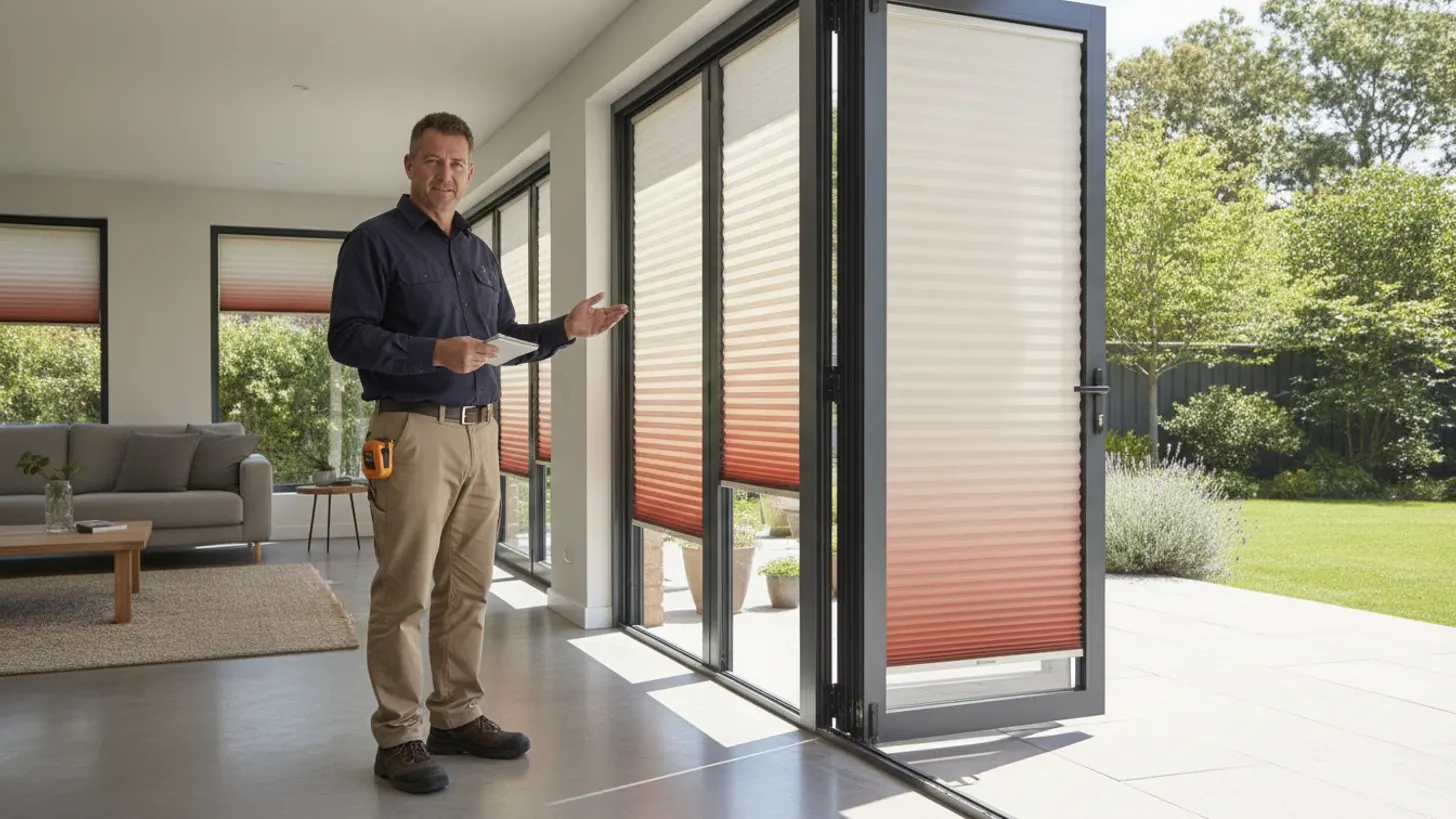
Bifold doors were meant to blur the line between lounge room and deck, so nobody wants to hang a heavy pelmet across the opening. Bifold door blinds Australia buyers ask about most fall into three groups: slim-profile roller or honeycomb blinds on each individual panel, external roller shutters or zipscreens mounted over the whole opening, and S-fold or wave-fold curtains on a track offset from the door. Which one fits your home depends on wall clearance, wind zone and how the doors are used day to day.
What are the best bifold door blinds Australia homeowners fit today?
Bifold door blinds Australia buyers get five compatible formats, and the list is narrower than most showrooms admit. Any blind on a bifold panel has to concertina with the door, sit in a shallow reveal, and clear the hinges when panels stack. The realistic set: per-panel slim rollers, honeycomb blinds, S-fold curtains, external zipscreens, and external roller shutters.
Per-panel roller blinds fit each door leaf individually, so the blind travels with the panel. Slim brackets need a depth of about 20mm, which slides inside most Australian bifold frames. Honeycomb (cellular) blinds work the same way, with the added upside of a trapped-air cell that trims heat loss on south-facing openings. Both formats behave predictably when doors fold, provided the fabric stack sits above the header when raised.
| Format | UV block tier | Reveal depth needed | Preserves door operation | Smart-home compatible | Installed price (AUD) |
|---|---|---|---|---|---|
| Per-panel roller | Medium (fabric-dependent, 1-10% openness) | 20-25mm | Yes | Yes (motorised option) | $250-1,000 per panel |
| Honeycomb per-panel | Medium-High (cellular insulation bonus) | 30-35mm | Yes | Yes (motorised option) | $400-1,400 per panel |
| External zipscreen | High (stops heat before glass) | None (wall-fixed) | Yes | Yes (Wi-Fi bridge) | $2,500-5,500 per opening |
| External roller shutter | Very High (full blackout available) | None (wall-fixed) | Yes | Yes (remote or bridge) | $600-900 per panel |
| S-fold or wave-fold curtain | Low-Medium (lining-dependent) | 200-250mm wall offset | Yes (offset track) | Limited | $180-450 per panel |
External systems change the equation. Zipscreens and roller shutters mount above the outside face of the opening, leave door operation completely free, and give you shade and privacy without any panel-mounted hardware. Our guide on living room window treatments Australia covers how the same format choices apply to standard windows, and our post on vertical blinds for sliding doors tackles a related door type where fitting geometry drives the shortlist.
Should bifold door blinds Australia sit inside the frame or external?
The inside-versus-outside decision drives everything else about the fit and the finished look. Bifold door blinds Australia installers face a hard geometry constraint: Australian Window Association member specifications put bifold panel-to-wall clearance at 25-40mm, which rules out chunky face-fix headboxes on almost every job we measure in the Riverina.
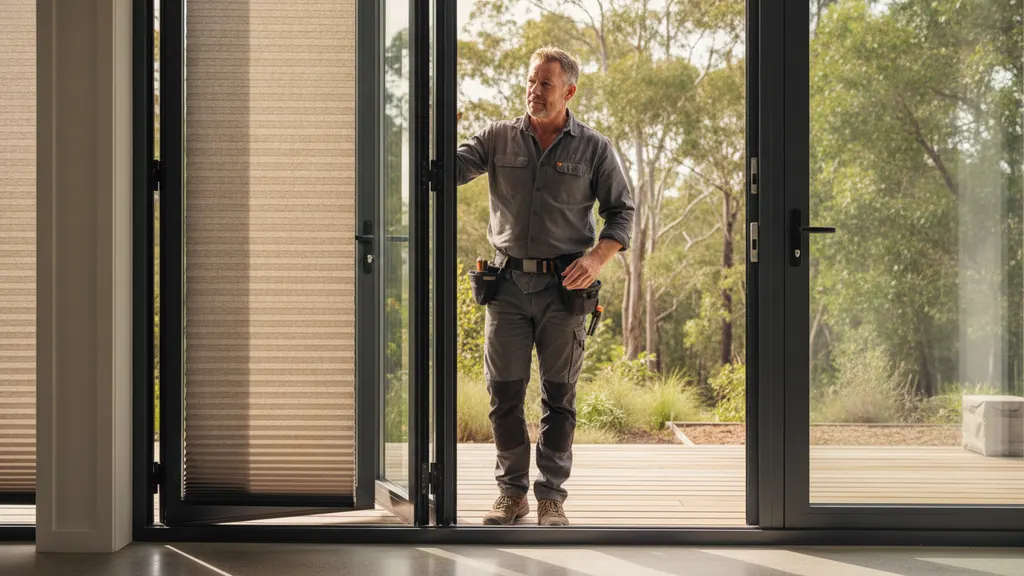
Inside-mount means the blind sits inside the door's own reveal, moving with each panel as it folds. That preserves the flush look and full glass width, but limits you to sub-25mm brackets, thin bottom bars, and lightweight fabrics. Outside-mount means the blind or zipscreen sits above the opening on the wall or eave, spanning the full run of doors as one continuous system.
A 24mm reveal on a powder-coated aluminium bifold frame is a scenario we encounter several times a year across Wagga. At that depth, a slim roller bracket fouls the door glass by 1-2mm when the panel closes, so the right call is an outside-mount headbox fixed 50mm above the lintel rather than risk a failed fitment. Check the bracket depth specification in the product datasheet before ordering, not after the door is already hung and measured.
External systems have to meet AS 2047, the Australian standard for window and door performance ratings, particularly the wind load class relevant to your property's wind zone. The Master Builders Association member guidance and the Standards Australia catalogue both point to that classification chain as the compliance path for any exterior blind, shutter or zipscreen installed on an Australian home.
On a west-facing family room where the bifolds get sun from lunch through dusk, external zipscreens usually win because they stop UV before it reaches the glass, which is where heat is easiest to control per YourHome, the Australian Government guide to sustainable homes. On a south-facing dining room where the priority is privacy and light diffusion, per-panel honeycomb blinds are usually the right call. Either way, the right pick among bifold door blinds Australia specifiers use depends on aspect first, budget second, and we measure and quote every configuration on site before committing to a track path.
How do bifold door blinds Australia handle UV and glare in NSW?
Fabric openness factor determines UV control for bifold door blinds Australia: a 1% weave blocks 95% of UV, a 5% weave blocks 78%, and a 10% weave blocks 55%, per Australian Government energy portal fabric testing data. That single specification separates an opening that stays cool from one that fades furniture by the second summer.
A 1% weave rejects most visible light alongside UV, keeping timber floors and dining table finishes safer over years of direct sun exposure. At 5% openness, daytime glare drops to a manageable level while the outward view stays mostly readable. At 10% openness the fabric behaves close to a sheer curtain: pleasant outlook, limited heat protection. The chart below plots those three openness bands against UV block percentages, drawing on fabric testing summarised by the Australian Government energy portal.
Openness alone is not the whole story. Reflective fabric backings, external mounting position and blockout linings all shift real-world heat gain. But if you had to pick one specification to shortlist by, openness factor is the number that separates a bifold blind that works from one that gets abandoned by the third summer.
CSIRO building science research repeatedly puts external shading systems ahead of internal blinds for heat control, particularly on west-facing openings where afternoon sun does the most damage. That is why zipscreens keep winning on NSW builds where the bifold opens onto a west-facing deck: treating the glass externally is the fastest lever on summer overheating in an Australian room.
For a closer look at this, see Sunscreen roller blinds Australia: UV and glare control for NSW homes.
Can curtains replace bifold door blinds Australia buyers usually specify?
Curtains are the surprise contender for bifold doors, and they work if you offset the track. A wall-mounted S-fold or wave-fold track fixed 200-250mm above and 150mm proud of the bifold header lets the curtain stack cleanly beyond the door swing. When the doors open, the fabric parts to the sides and the whole opening clears.
S-fold curtains give a soft vertical line, drape well in linen and polyester blends, and pair naturally with an external zipscreen or roller shutter for the light-and-heat job. Our post on S-fold curtains Australia walks through the fabric shortlist we specify across Riverina homes. What curtains cannot do is stop UV or heat load the way an external shading system can, so on hot-aspect openings we usually run curtains alongside a rear zipscreen rather than instead of one. Among bifold door blinds Australia buyers who prefer a softer look, wave-fold sheer curtains fitted on an offset track are the most common workaround for a full-height frameless opening.
How much do bifold door blinds Australia cost supplied and installed?
Bifold door blinds Australia pricing in NSW runs in clearly defined tiers: manual per-panel roller blinds at $250-600 per panel installed, motorised honeycomb blinds at $800-1,400 per panel, external zipscreen systems at $2,500-5,500 per full opening, and external roller shutters at $600-900 per panel for manual operation. Four variables push any job up or down within those tiers: fabric grade, motorisation, mount type, and how many panels the opening runs.
Per Canstar Blue's Australian window furnishings category benchmarks, those tiers hold across standard NSW jobs. Aspect also matters because a north or south room can specify a lighter fabric than a west-facing room needing high UV rejection. Wagga, Griffith and Temora homes we work on regularly land in the mid-range for a two-blind zipscreen system, and we measure and quote every opening on site rather than by phone. The good news for bifold door blinds Australia buyers is that per-panel formats scale linearly, so a four-panel door usually costs roughly twice a two-panel door for the same product.
Where energy efficiency matters more than aesthetics, spending up on a higher fabric grade tends to return the investment through lower cooling load. Where a room mostly needs daytime privacy, an entry-grade product line does the job well without over-specifying. The fastest way to a real number for your opening is a site visit.
Frequently asked questions
Can I fit blinds on bifold doors without drilling into the frame?
Not really. Any per-panel blind needs bracket fixings into the door frame or panel top. There are peel-and-stick options sold online, but on doors that swing and stack many times a day, adhesive fittings tend to detach within a season, especially in Riverina temperatures where the backing sees regular 40-degree afternoons. If your door frame is aluminium and you rent, an outside-mount blind fixed to the wall or eave above the opening is usually the least invasive path, since it drills the wall rather than the door. The YourHome government guide to window shading covers external mounting patterns homeowners can consider before committing.
Do bifold door blinds work with automation and smart home systems?
Yes, and the fit is cleaner than most people expect. Motorised per-panel rollers and honeycomb blinds run off battery motors or hardwired 240V motors depending on the header depth, and both integrate with the common smart-home protocols. External zipscreens and roller shutters usually run on a wall switch, remote, or Wi-Fi bridge. If you are already planning a smart lighting or aircon setup, aligning the blind protocol with that system saves a duplicate hub. Our post on motorised blinds Australia walks through control tiers, and the federal energy portal notes that motorised shading tied to HVAC schedules trims summer cooling load.
What is the minimum reveal depth for inside-mount blinds on bifold doors?
Typically 25mm for a slim roller and 30-35mm for a compact honeycomb. Any less than that and the bracket, chain guide or bottom bar will foul the door glass when the panel folds. Australian bifold frames commonly ship at 25-40mm reveal on the door face per Australian Window Association member specifications, so most homes sit right at the threshold. The safe move is to measure the reveal before ordering, not after, and to specify a slim-profile product line that lists a documented bracket depth. On borderline reveals, an outside-mount system is more reliable than shaving 3mm off the fabric edge, and the AS 2047 door assembly specification published by Standards Australia underpins those clearance ranges.
Are zipscreens or roller shutters better for west-facing bifold doors?
Zipscreens usually win on west aspects because they stop UV and heat before the glass, keep the view mostly readable, and vent airflow through the fabric weave. Roller shutters block more, including full blackout when down, but at the cost of the view and any breeze. On a Riverina west-facing patio door where afternoon sun runs from 2pm to sunset, most of our clients pick a zipscreen for daytime shading and rely on internal blinds for nighttime privacy. The YourHome government guide to window shading maps external shading choices to aspects and applies directly across NSW climate zones.
How do child safety rules affect blinds fitted on bifold doors?
The mandatory Australian information standard for corded internal window coverings applies to all looped operating cords, and bifold door blinds are no exception. Any chain-operated blind fitted anywhere a child can reach it must have a tensioner or breakaway safety device installed, and the cord must not form an accessible loop. Motorised blinds sidestep the issue entirely. If you have small children, either specify motorised per-panel blinds or specify manual blinds with the tension device fitted at install, not left as a kit in a bag. Our post on child safe blinds Australia covers the compliance picture, alongside the YourHome shading and safety pages for context.
Will blinds fitted to bifold doors void the door manufacturer's warranty?
In most cases, no, but the risk is real for external-mounted systems that transfer load onto the frame. Manufacturers of aluminium and timber bifold systems typically permit slim inside-mount roller and honeycomb blinds fitted with self-tapping screws to the header, provided the seal remains intact. What can void a warranty is drilling into the outside frame face for a wall-mounted headbox or track. Before installing external zipscreens or shutters, we check the door manufacturer's fitting guide and, on newer builds, refer to the Master Builders Association compliance guidance for the door assembly.
What openness factor should bifold door blinds Australia buyers specify for west-facing rooms?
For west-facing rooms in NSW and the Riverina, bifold door blinds Australia installers specify fabrics in the 1-3% openness range as a starting point. A 1% weave blocks roughly 95% of UV and stops most direct glare from 2pm through sunset, which is the main period of heat stress for west aspects across Wagga and Griffith. A 3% weave cuts the UV block to around 88% but retains more outward view during the day. Anything above 5% openness starts to behave like a sheer curtain on a west aspect: afternoon glare reads straight through and the room heats up at the hours that matter most. If you are running a zipscreen on the outside face of the opening, the same weave logic applies: 1-3% openness for west-facing rooms, 5% or above if outward view takes priority over heat control at peak hours.