Plantation Shutters · 16 min read
Living room shutters Australia: control glare, privacy and daylight
Chris & Campbell · 23 October 2026
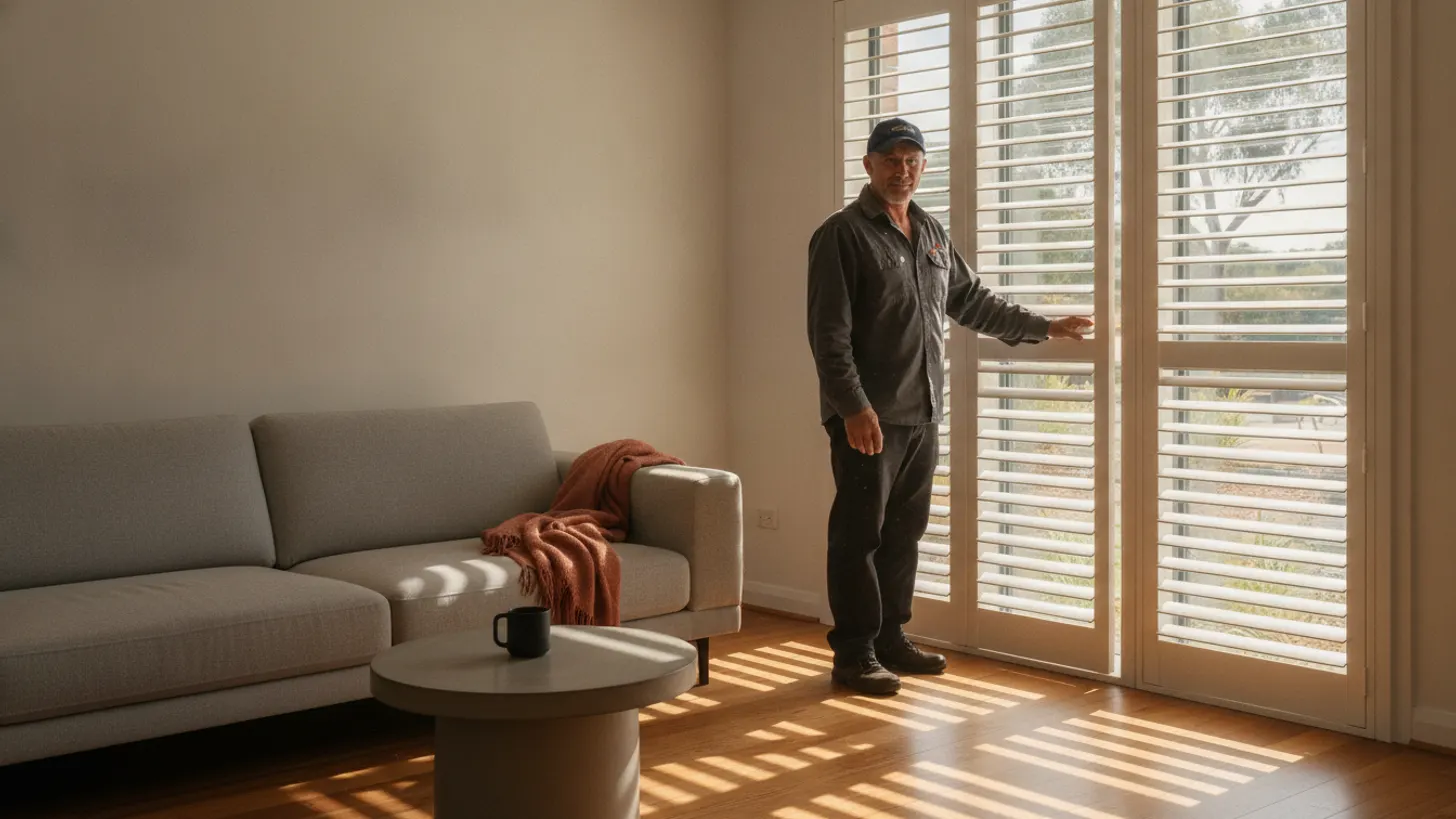
"Can I watch the cricket at four in the afternoon without closing the whole room down?" That question comes up on nearly every Temora and Wagga quote we do. The honest answer is yes: living room shutters Australia homeowners fit to west-facing glass angle the louvres away from the screen, so glare drops while the room keeps its view and its daylight.
How living room shutters Australia balance daylight and privacy
A shutter panel does two jobs at once because the frame and the blade move separately. The panel can stay shut for privacy while the louvres tilt open for light, so a shutter fitted to street-facing glass gives you a sightline block and a bright room at the same time.
That split is the whole trick. A curtain or a roller blind works on one axis: more cover means less light. A shutter works on two, so the panel position sets the privacy and the louvre angle sets the brightness. On a west-facing lounge window in Temora we often leave panels closed from about three in the afternoon and simply walk the louvres down by ten degrees as the sun drops. The Your Home passive design chapter published by the Australian Government treats window coverings as part of passive solar design and heat control rather than decoration, and adjustable shading is the part of that approach a living room benefits from most.
The comparison below is the one we sketch on the quote sheet when a client asks what each setting actually gives them.
None of those three settings is wrong. A living room is used differently at 10am, 4pm and 9pm, and that is exactly what living room shutters Australia homeowners value in open-plan spaces: one set of panels covers all three without swapping anything out.
Choosing louvre sizes for living room shutters Australia
A louvre is the single angled blade that makes up a plantation shutter panel. The width in millimetres is what everyone means by shutter size, and three widths cover almost every living room job here: 63mm, 89mm and 114mm. The wider the blade, the fewer blades in the panel, so you get more open view and more daylight when the louvres sit level. Narrow blades give finer control and a tighter look.
For a standard Riverina living room window, 1200mm to 1800mm wide, 89mm is the default we recommend and the one most clients land on after holding samples against their own glass. It keeps enough blades for staged light control while still reading as a clean horizontal line from the street. 114mm suits tall stacker doors and big picture windows where you want the glass to disappear. 63mm belongs on narrow panels, servery windows and anything where the blade needs to look proportionate to a small frame.
Material changes the sensible maximum. Timber holds a wide blade across a long span without sagging, PVC usually needs a mid-rail sooner, and aluminium behaves differently again, which we cover in our breakdown of basswood, PVC and aluminium shutter materials. Climate matters too: the Bureau of Meteorology climate records for inland New South Wales show how hard the summer sun loads a west wall out here, and that load is what decides whether a blade stays straight over ten years. Choosing a louvre width straight off a city showroom sample sheet ignores that local load.
How living room shutters Australia cut television and furniture glare
Glare is a geometry problem, not a brightness problem. You need to break the direct line between the sun and the screen, or the sun and the glossy coffee table, without dropping the whole room into gloom. A tilted louvre does that, and it does it from a single wall.
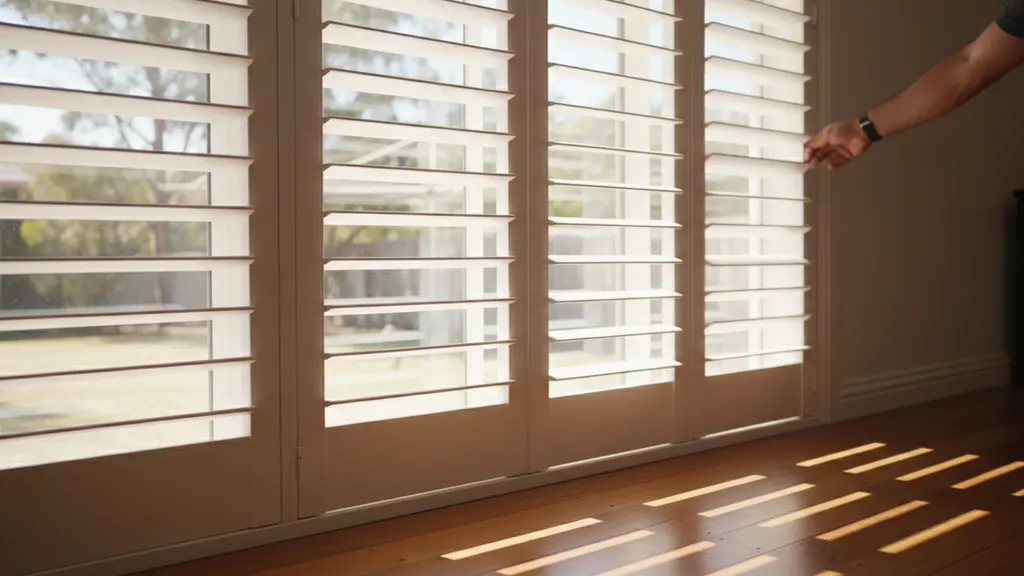
Two practical rules. First, point the louvres away from the screen rather than toward it, so the light that gets through hits the ceiling and comes back diffuse. Second, treat the window the screen faces, not just the window behind it: reflected glare off a wall of glass on the opposite side of an open-plan room is the complaint we hear most often and the one most people forget to ask about.
There is a comfort payoff beyond the screen. Blocking that beam before it lands on the floor keeps the slab and the furniture cooler, and the Australian Government's energy.gov.au guidance on windows and household energy use puts adjustable and external shading ahead of almost everything else you can do to a window. We go further into that in our guide to plantation shutter energy efficiency in NSW heat. That is the same glare control living room shutters Australia households install for, and it is also what keeps the room liveable at five in the afternoon.
Colours and finishes for living room shutters Australia in NSW interiors
Most of what we fit is white or near-white, because it reads as architecture rather than furniture and it keeps the reveal looking wide. Stains and darker colours work when the shutter is meant to be a feature, and they behave very differently in direct sun.
Three things decide the finish. Heat load on the panel, since dark surfaces run hotter and that tells on a west-facing stacker. Match to the existing trim, because a shutter sitting 10mm off your architrave white is more obvious than a shutter in a deliberately different colour. And fade behaviour over time: Cancer Council Australia states that ultraviolet radiation can fade and damage interior furnishings, and the same radiation works on paint and stain, which is why CSIRO research on materials weathering in Australian conditions is worth more to you than a swatch book when you are choosing for a sun-loaded room.
Satin and low-sheen finishes hide dust and fingerprints better than gloss, which matters on a louvre you will be turning every day. If the room already carries layered fabric, keep the shutter quiet and let the fabric do the colour work. Renovators change their mind about colour choice less than anything else at the quote stage, so take the samples home and look at them at three in the afternoon, not under showroom downlights.
How do shutters compare with curtains for living room comfort?
They solve different problems. A shutter gives you adjustable daylight, a hard sightline block and nothing to launder. A curtain gives you softness, acoustic damping and a better seal against draughts at the edges. Plenty of Riverina living rooms end up with both.
| Need | Shutters | Curtains | Roller blinds |
|---|---|---|---|
| Light and privacy at the same time | Yes, louvre tilts independently | No, cover is all or nothing | No, position sets both |
| Screen glare control | High | Moderate with sheers | Moderate |
| Draught seal at the edges | Moderate | High with a pelmet | Low |
| Airflow with cover in place | High | Low | Low |
| Cleaning | Wipe down | Launder or dry clean | Wipe down |
The seal at the top and sides of a window is what stops air movement in winter, and that is where a pelmeted curtain beats a framed shutter. If winter warmth is the priority in a high-ceilinged room, our guides to S-fold curtains for NSW living rooms and layering window treatments cover the combinations that work. Where daytime use dominates, living room shutters Australia households rely on through long hot afternoons will do more work than any single curtain.
Planning living room shutters Australia from measure to install
The order of operations matters more than the product choice. Check the opening, confirm what the panels will clear, agree the stack direction, then measure and quote against the actual reveal rather than a plan dimension. Plans and built walls disagree more often than people expect.
Three checks we run in every living room. Handle and door clearance on stacker and sliding units, so a hinged panel does not foul the lever. Power points and switch plates inside the reveal. And ceiling-height windows where a mid-rail is unavoidable, which is better decided with you standing in the room than discovered on install day. Our measuring and fitting guide walks through the sequence in order.
Compliance sits underneath all of it. The Australian Building Codes Board publishes the National Construction Code requirements relevant to glazing, daylight and ventilation in homes, which is why a window covering cannot block a required opening or a means of ventilation, and the Australian Standards those provisions call up are published by Standards Australia. For renovations where walls or openings are changing, get the opening measured again once it is actually built, not just off the plan. Measuring before the opening is finished is the most common way a job goes wrong.
Frequently asked questions
Do shutters stop glare on the TV without making the room dark?
Yes, and that is the main reason people pick them over a blockout blind. The blade tilts independently of the panel, so you can break the direct beam off the screen while light still bounces off the ceiling into the room. Point the louvres away from the screen, not toward it. The Australian Government's Your Home shading guidance ranks adjustable shading above fixed shading for exactly this reason: a fixed cover forces one compromise all day, while living room shutters Australia owners can retune by hand as the sun drops.
What louvre size is best for a living room?
89mm suits most Australian living rooms. It keeps enough blades for staged light control, reads as a clean line from the street, and spans a typical 1200mm to 1800mm window without a mid-rail in timber. Go to 114mm on stacker doors and picture windows where you want the maximum open view, and down to 63mm on narrow or small frames where a wide blade looks out of proportion. Glazing orientation changes the answer as much as width does, and the Your Home glazing chapter sets out how much heat and light a given aspect delivers.
Are shutters better than curtains in a living room?
Neither wins outright, because they do different jobs. Shutters give adjustable daylight, a hard sightline block, airflow with the cover still in place, and nothing to launder. Curtains soften a room, damp echo in a hard open-plan space, and seal the window edges better against winter draughts. Canstar Blue's consumer research on window furnishings shows buyers weigh light control, privacy and upkeep differently, which is why the honest answer depends on your room. Many homes we fit end up with living room shutters Australia style on the sun-loaded glass and curtains on the rest.
Will shutters give me privacy at night with the lights on?
With the louvres fully closed, yes, a well-made shutter blocks a sightline from the street at night. The qualifier is the gap: a closed louvre still has a hairline between blades, and a panel hung with a loose reveal fit can leak light at the edges. Ask for a tight frame and a closing stile where panels meet. If the room is a front lounge facing a footpath, that detail matters more than the blade width. The Australian Government's Your Home guide treats privacy and light control as part of the same design decision rather than separate add-ons.
What colour shutters suit a modern Australian living room?
White and near-white still dominate, because they read as architecture, keep the reveal looking wide, and sit easily against existing trim. Match to your architrave rather than picking white in isolation; a shutter 10mm off your trim colour looks like a mistake, while a deliberately dark stain looks like a choice. Dark surfaces run hotter in direct sun, so think about aspect before committing. Cancer Council Australia states that ultraviolet radiation can fade and damage interior furnishings over time, and Bureau of Meteorology solar exposure records show how much of that load an inland NSW room takes.
Do living room shutters help with heat as well as light?
They do, though an internal shutter is working after the heat has already hit the glass. Closing the panels and dropping the louvres before the sun reaches the window stops the beam landing on your floor and furniture, which keeps surface temperatures down through the afternoon. The energy.gov.au household energy advice puts shading near the top of low-cost measures for Australian homes. On a west-facing wall, living room shutters Australia households close by mid-afternoon will take noticeable sting out of the evening, though external shading does more again.