Accessibility and design · 15 min read
Accessible window shutters Australia: easier controls for NSW homes
Chris & Campbell · 20 November 2026
"Mum can see the window, but she can't work the blind." We hear that call most weeks across the Riverina, and the fix is rarely a whole new window. We started checking grip and reach on every job in 2014, after fitting out Chris's own grandmother's house, and it reshaped how we quote. With accessible window shutters Australia wide, three things decide it: where the control sits, how much grip it takes, and whether the panel swings clear of a walker or chair. Get those right and daylight, privacy and airflow stop being someone else's job.
What makes accessible window shutters Australia easier to operate?
Easier operation comes down to four things you can measure: the force needed to move the control, the size of the grip, the height it sits at, and how far the hand has to travel. Change any one of those and a window that needed help becomes a window someone works alone.
Force is what most people miss. A centre tilt rod on a tall panel asks for a pinch grip and a steady push through the whole arc, while a side lever asks for a palm. After a cold Temora morning, the palm wins. The Australian Government's YourHome guide to designing homes for all ages puts the same test on fittings: design for the person who lives there. That is the test we apply when we measure and quote a job.
Grip, force, height and travel
Travel is next. A full tilt on a tall panel means a long sweep of the hand, twice a day, every day. A mid-rail splits the panel so the top half stays shut for privacy while the bottom tilts for light, and each movement gets shorter. For buyers comparing shutters against roller blinds, that split control is often the deciding feature, along with the fact that nothing dangles. Panel weight matters too, which is where basswood, PVC and aluminium part ways.
Which tilt mechanisms suit limited hand strength?
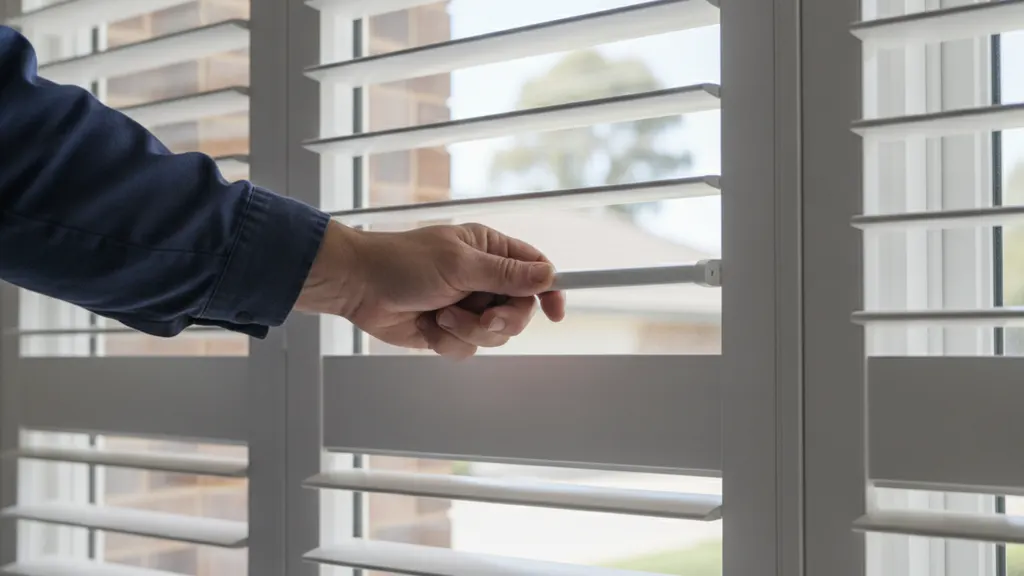
Three mechanisms cover most of what we fit: a centre tilt rod, a hidden tilt where the hand pushes a louvre directly, and a side-mounted lever. For limited hand strength the lever and a well-set hidden tilt both beat the rod, because the load spreads across the palm instead of two fingertips.
| Mechanism | What the hand does | Limited hand strength | Watch for |
|---|---|---|---|
| Centre tilt rod | Pinch and push through the arc | Hardest of the four | Rod height on tall panels |
| Hidden tilt | Push a louvre with the palm | Good, if louvres are wide | Needs clear reach to the blade |
| Side lever or wand | Palm or hook grip, short travel | Best for weak grip | Set the side before manufacture |
| Motorised louvre | One press, or voice | Best for no grip | Power supply and a flat-battery plan |
Cords are a separate problem, and a hazard for children and pets as well as a dexterity one, which is covered in our guide to cordless blinds and child safety in NSW. Where accessible window shutters Australia homes need one hand to do everything, we put the lever on the hinge side, swap a turn knob for a magnet catch, and widen the stile so the panel has something to grab.
Motorised accessible window shutters Australia: do they add independence?
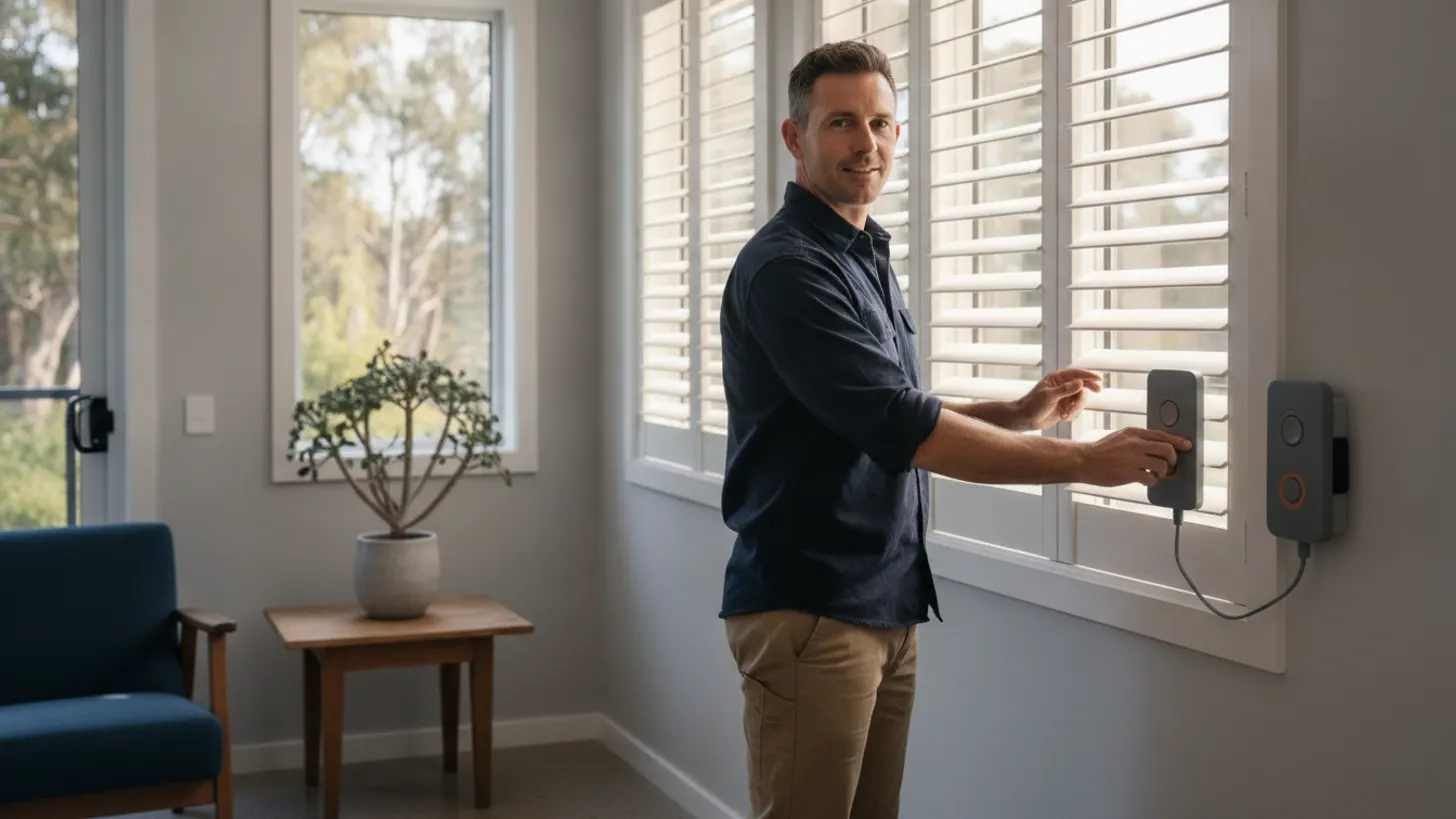
Yes, for the right person and the right window. A motor takes grip, reach and force out of the task and replaces them with one press, a voice command or a timer. The trade is a new dependency: power, a control device, and someone to pair a replacement remote when it goes missing.
Motorised shutters need an appropriate power supply and a control method chosen to suit the user, and wireless controls should be selected and installed to the product instructions. Hard-wired work belongs to a licensed electrician, working to the wiring rules published in the Standards Australia catalogue. Battery tubular motors avoid new cabling but hand someone a charging routine, so write down who owns it.
Match the control to the hand, not to the gadget. A wall plate at a fixed height beats a slim remote that slides down the side of a recliner, and a wall plate cannot be left in another room. Our guide to motorised shutters and smart home control in NSW covers pairing and timers. For accessible window shutters Australia projects, the fallback question matters most: what happens on a flat battery or during a blackout?
Where should accessible window shutters Australia controls sit for wheelchair users?
Put the control inside a seated reach band and keep the floor in front of it clear. Accessible design guidance uses roughly 900 to 1100 mm above the floor for hand controls, with enough clear space to get square to the window instead of reaching across a sill or furniture.
Two other dimensions decide whether the window is reachable at all: the clear width of the doorway into the room, and the clear approach in front of the window. The Livable Housing Design Standard, the Australian Government's design guidance for homes that are easier to enter, move around and use, is the document to read before moving a single bracket. Building science work from CSIRO housing and building research makes the same case for settling layout early.
Hinges and swing path finish the job. A panel that opens into the approach space blocks the chair that came to open it, so on accessible window shutters Australia installs we hang panels to swing away from the approach, or specify a bi-fold stack so the whole set clears to one side.
How do accessible window shutters Australia requirements differ room by room?
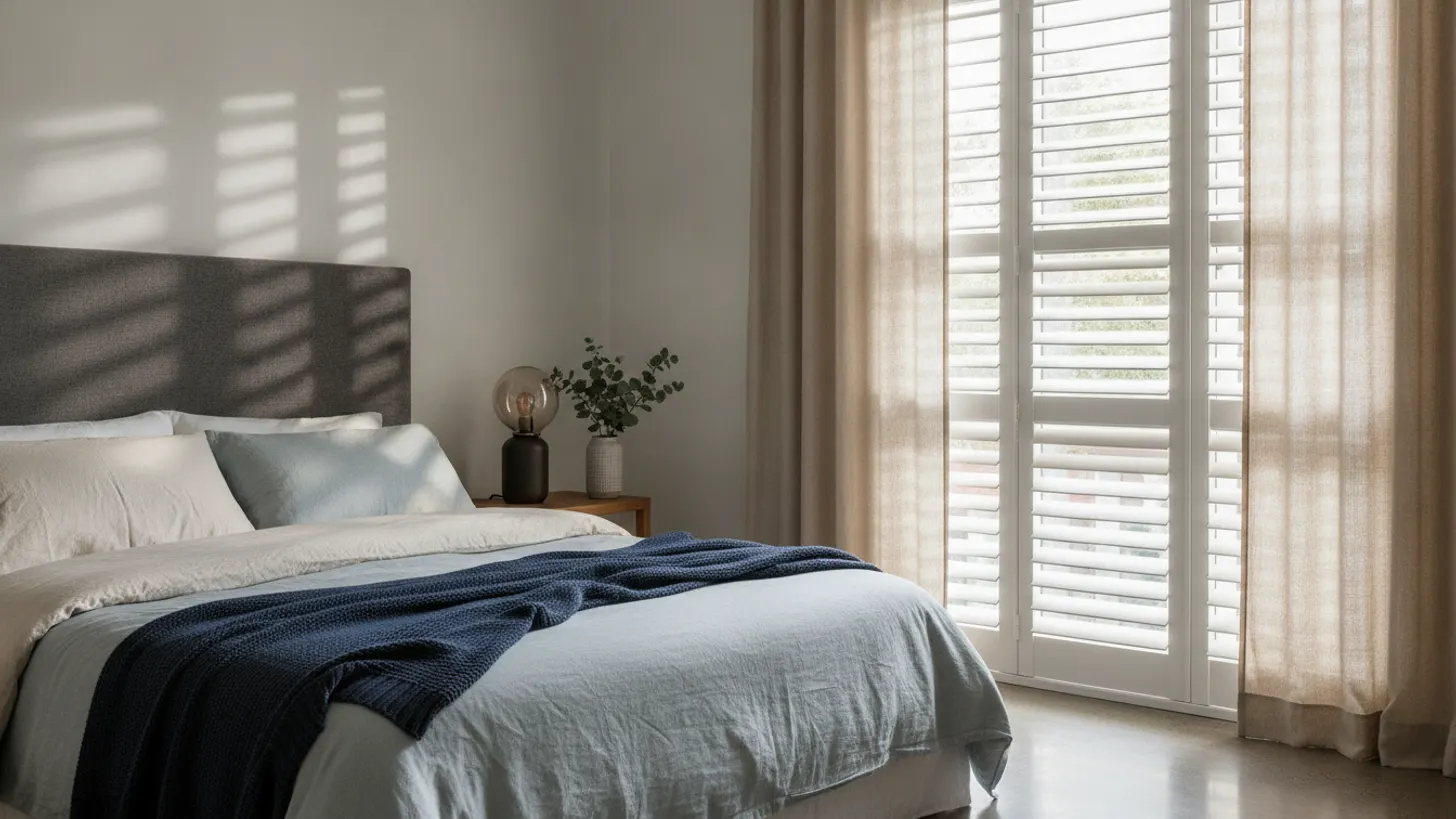
Requirements shift by room, not by house. A bedroom needs a control reachable from both the bed and standing height, a kitchen needs it clear of a 600 mm bench reach, and a living room needs glare control without a long sweep across the pane. Match the mechanism to the room instead of specifying one control for the whole house.
Heat is the other half of the decision in the Riverina, where summer afternoons run hot, as Bureau of Meteorology climate records for inland NSW show. A shutter that is hard to close in the morning does not get closed, so the easier control is also the better thermal result. Our notes on bedroom privacy and light control go further on the sleep side, and shutter buyers should plan the two together.
In bathrooms and kitchens, reach is often limited by a bench or a bath rather than by the hand, so a motorised louvre earns its keep on the window nobody can get to.
What should you check before installing accessible window shutters Australia?
Check six things before you order a panel: control height against the 900 to 1100 mm reach band, clear approach in front of the window, swing path, grip type, power supply for any motor, and who maintains the batteries. Most access problems are decided at the measure, not at the factory.
Walk the job with the person who will use the window. Sit where they sit, reach what they reach, and write down the height that works. Government guidance on household energy use is worth reading on the power question before you commit to a hard-wired motor.
Rights sit behind all of this. The Disability Discrimination Act 1992 protects people with disability from discrimination in areas including access to premises and services, which is the backdrop for anyone renovating a rental, a group home or a public-facing space. For accessible window shutters Australia renovations, our measuring and fitting guide covers the install side, and we measure and quote the access detail on site.
Frequently asked questions
Are shutters easier to use than blinds for someone with arthritis?
Shutters usually win on grip, but only if you pick the control. A hidden tilt or a side lever spreads the load across the palm instead of asking for a pinch and a sustained push, which is what a thin centre rod does. Add a mid-rail so each movement is short, and keep the handle on the hinge side. For accessible window shutters Australia households are retrofitting, we also check the catch: a magnet beats a turn knob. The Australian Government's YourHome design guide frames fittings the same way, around the person using them.
What height should window shutter controls be for a wheelchair user?
Aim for the band accessible design uses for hand controls, roughly 900 to 1100 mm above the floor, and check it from the chair rather than with a tape against the wall. Shoulder height and reach vary between people, so the band is a starting point and not a rule for every user. Keep a clear approach in front of the window so the person can face it square, and make sure the panel does not swing into that space. The AS 1428 access and mobility standards published by Standards Australia are the reference point for reach and circulation.
Do motorised shutters need an electrician?
Only when the motor is hard-wired. A battery tubular motor or a plug-in transformer can often be fitted without new cabling, while a motor wired into a circuit is licensed electrical work in NSW and belongs to an electrician. Either way the shutter needs an appropriate power supply and a control method chosen for the user, installed to the product instructions. For accessible window shutters Australia installs, we confirm the power path at the measure so nobody finds a missing outlet on install day. Master Builders Australia, the national building industry body, is a sound starting point on licensed trades.
Can you add a motor to shutters I already have?
Sometimes. Retrofitting a motor depends on the louvre linkage, the stile width and whether there is a path for power, so it is a measure-first question rather than a catalogue one. Older timber panels with a centre rod usually mean rebuilding the tilt mechanism, not bolting on a motor. Where a retrofit is not practical, moving the control, adding a mid-rail or changing the catch often solves the access problem for far less work. If you are weighing power use for a motorised set, government advice on household energy use covers standby and household load.
Which shutter material is easiest for a carer to clean?
PVC and powder-coated aluminium wipe down with a damp cloth and tolerate repeated cleaning, which matters when a carer is doing it weekly rather than seasonally. Wider louvres also mean fewer blades to wipe for the same window. Painted timber suits heritage rooms but needs a gentler touch, and aluminium handles wet rooms without swelling. Avoid fabric and cords in any room where cleaning is frequent, since both trap dust and add a snag risk. Consumer buying guides on blinds and shutters are a useful cross-check on materials before you shortlist.
Will easier controls mean giving up blockout or heat control?
No, if the hardware is chosen with both jobs in mind. A side lever or a motor changes how the louvres move, not how well a closed panel blocks light or slows heat, since that comes from the panel, the frame fit and the seal around it. What does hurt comfort is a control too hard to use, because then the shutter simply stays open. That is the practical case for accessible window shutters Australia households, and the Australian Government's YourHome guide explains why a well-fitted covering that actually gets used outperforms a better product left open.