Child Safety · 17 min read
Cordless blinds Australia: child safety guide for NSW families
Chris & Campbell · 11 September 2026
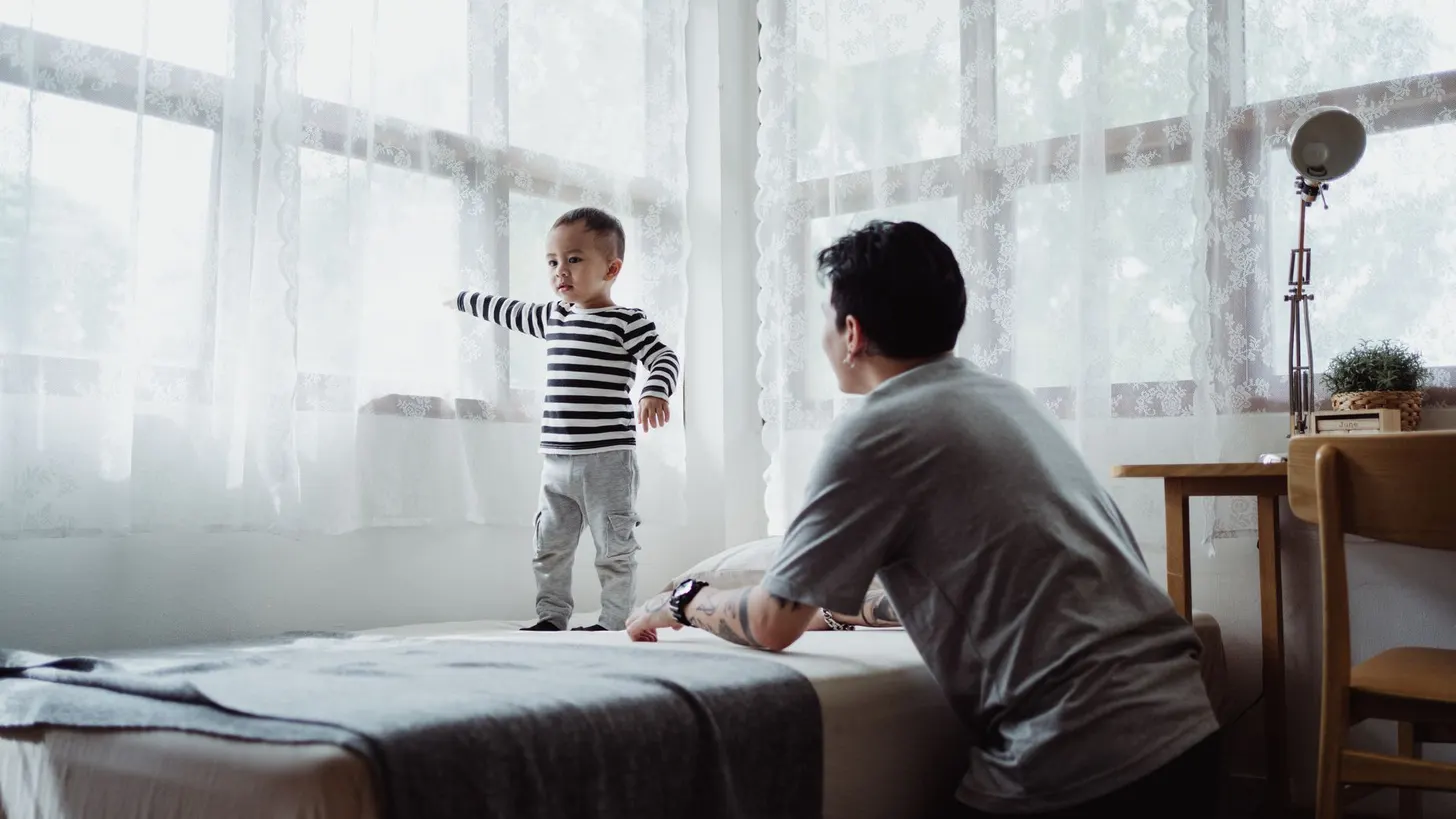
When a Wagga mum called us about her toddler's bedroom last spring, she wasn't asking about colour. She wanted to know which cordless blinds Australia parents actually trust after her neighbour's near-miss with a Roman blind loop. That question sits at the top of nearly every measure and quote we run across the Riverina, from Temora nurseries to Griffith apartments. Here's the safety guide we hand every family.
Why corded blinds still injure NSW children every year
Corded blinds pose an ongoing strangulation risk in homes across NSW because pre-2014 blinds remain in service, and even compliant loops can become dangerous when a cleat breaks or a child climbs furniture near a window. Chris and Campbell see these hazards every week when we measure and quote across the Riverina.
The pattern is depressingly repetitive: a cot pushed against a window, a curious toddler, a looped chain within arm's reach. Kidsafe Australia records blind and curtain cord strangulation among the top causes of preventable death in children under five in Australian homes, with the government's Regulatory Impact Statement for the 2014 mandatory standard citing at least three Australian child deaths from corded window coverings as direct justification for regulatory action. The physics is simple, and the outcome is often fatal within minutes.
Corded Roman blinds, corded verticals, and older roller blinds with continuous looped chains carry the highest risk. Rooms most likely to contain these hazards, according to Kidsafe advisory material, are children's bedrooms, nurseries, and family lounges where furniture is pushed close to windows for space efficiency. Older homes across Wagga, Griffith and Temora still hold thousands of these window coverings from the 1990s and early 2000s.
The cordless blinds Australia standards every parent should know
Cordless blinds Australia families rely on are governed by the ACCC's Competition and Consumer (Corded Internal Window Coverings) Safety Standard 2014, which restricts the sale of new internal blinds with accessible looped cords in residential settings. Gazetted in 2014 following a two-year consultation, the rule covers all blind styles and the ACCC has enforced it since mid-2015.
The standard requires warning labels, cord cleats or tension devices for any residual cord, and design features that prevent loops from forming within a child's reach. The technical baseline sits in Standards Australia AS/NZS 4515.2, which spells out the geometry, cord length limits, and mounting height requirements.
For NSW homes, the practical outcome is that any blind we install today has to be cordless, motorised, or fitted with an ACCC-compliant tension device that anchors the cord to the wall. The yourhome.gov.au windows chapter from the Australian Government reinforces cordless and motorised choices for child-occupied rooms and rooms where accessible cords are impractical.
Older stock sold through discount channels sometimes slips through, so parents buying online should check for the ACCC compliance mark before purchase. When we measure and quote in Temora and Wagga, we recommend replacing every accessible-cord blind in a child's room outright rather than relying on retrofit alone. Our roller blind buying guide walks through what the ACCC compliance mark looks like on product packaging.
There is a full breakdown of this topic in Bamboo blinds Australia: natural woven wood window treatments NSW.
There is a full breakdown of this topic in Layering window treatments Australia: curtains and blinds for NSW.
Best cordless blinds Australia parents pick for kids bedrooms
The best cordless blinds Australia parents install in kids' bedrooms combine total cord elimination with darkness control for sleep. Cellular (honeycomb) blinds with a top-down/bottom-up spring lift, motorised roller blinds, and plantation shutters top our fitting list across the Riverina.
Cellular and motorised cordless options lead the Riverina's child-safe installation shortlist for reasons that stack. Cellular (honeycomb) blinds trap air in their pleated cells, lifting the window's R-value and cutting heat transfer in both directions: the energy.gov.au window coverings guidance rates cellular blinds among the highest-performing insulating options for Australian homes, a thermal benefit that pairs directly with their cordless push-lift mechanism and makes them the standout choice for Temora's frosty winters and Griffith's 40-degree summer days. Motorised roller blinds solve the problem cellular alone cannot: variable blackout control without any cord within arm's reach of the cot. Running on rechargeable lithium batteries or hard-wired 12-volt systems, they pair naturally with a lightweight day shear on the same double bracket, both motorised and controllable from a wall switch or phone app. A cellular day blind plus a motorised blockout roller on a double bracket gives a Riverina nursery insulation, complete light control, and total cord elimination in a single window installation.
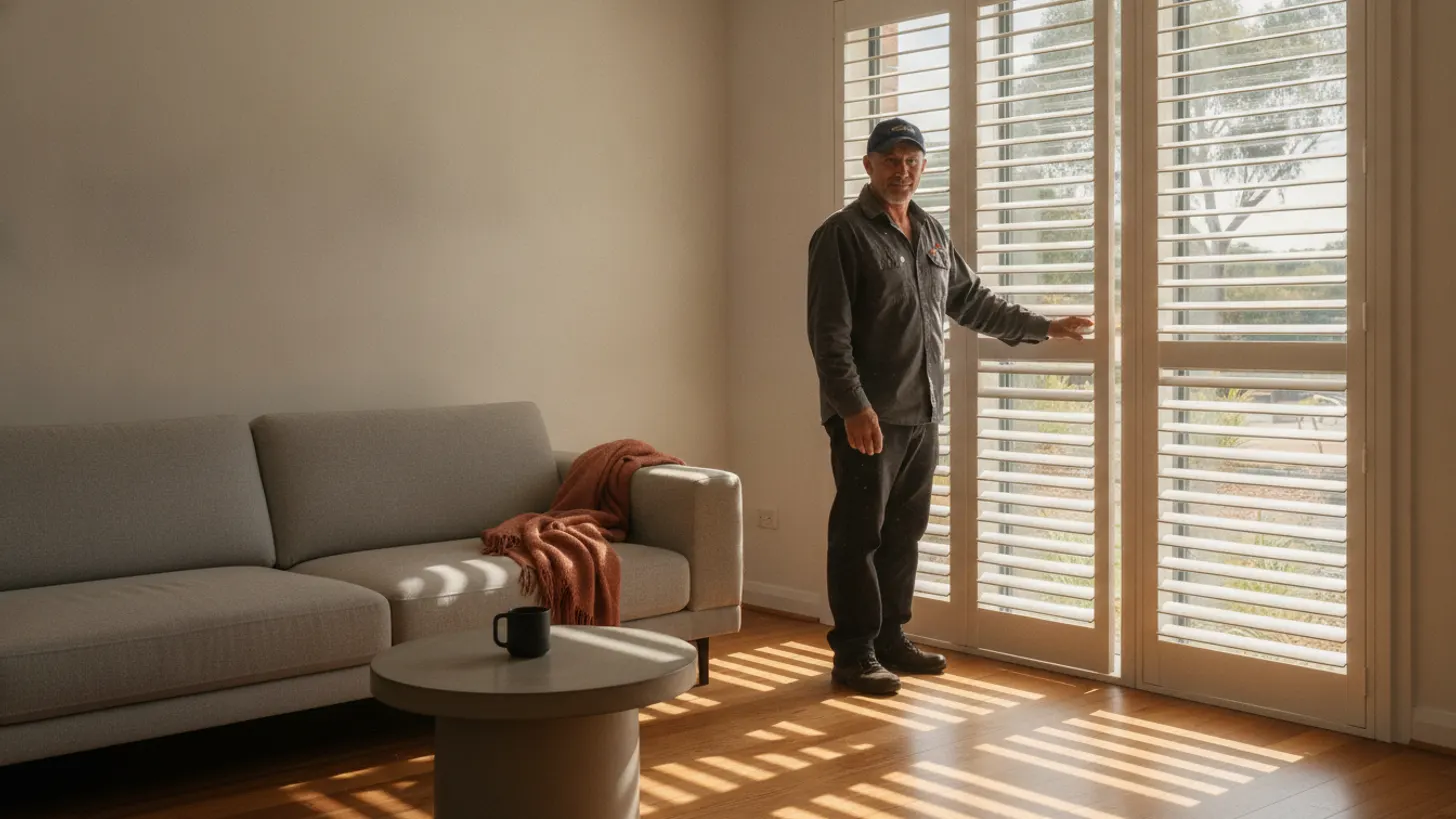
For parents balancing style with cordless safety, plantation shutters give you fixed louvres with a tilt rod, no cords, no chains, nothing to grab. They also handle the salt air on the coast and the dust storms out west. See our blackout blinds baby room guide for how we combine cellular, roller, and shutter setups in NSW nurseries.

Did Australia ban corded blinds? What the 2014 rule actually says
Australia did not ban all corded blinds outright. The Competition and Consumer (Corded Internal Window Coverings) Safety Standard 2014 restricts the sale of new blinds with accessible cords that can form a loop within reach of children. Existing corded blinds in homes are not illegal, but any new installation has to meet the standard.
That distinction matters when you're buying or renting. A Riverina rental fitted in 2005 might still have looped Roman cords hanging free. The landlord isn't breaking the standard by leaving them, but the tenant carries real risk. Our apartment blinds strata guide covers what tenants and owners can request without breaching strata rules.
For new-build homes, builders are required to install compliant window coverings. If your builder's spec sheet lists corded blinds without a tension device, ask them to swap to cordless blinds Australia standards require.
If you're buying from an overseas seller or a marketplace, the ACCC's mandatory standard still applies, and imported non-compliant stock can be seized. Check the label. If there's no ACCC compliance mark and no cord cleat in the packaging, it's not lawful to install in an Australian residential window.
Retrofitting cordless blinds Australia rules for older Riverina homes
Retrofitting cordless blinds Australia rules apply the same way whether you're replacing one bedroom blind or the whole house. For pre-2014 stock, you have three options: full replacement with a cordless system, motor conversion using a battery kit, or fitting an ACCC-compliant tension device that anchors the cord to the wall or frame. The right choice depends on the room's occupants, the condition of the existing mechanism, and the level of residual cord risk you are prepared to accept. Full replacement gives a completely cord-free system: new headrail, new fabric, and a cordless lift mechanism from the factory. Motor conversion keeps the existing brackets and tube but removes the operating chain entirely, replacing it with a lithium battery drive and wall switch so no pull cord is reachable from inside the room. Tension devices are the lowest upfront cost but leave a cord physically in the system, anchored rather than absent, and depend on correct stud fixings and regular inspection to stay within the ACCC 2014 standard. For any room where a child under five sleeps or plays, most NSW installers recommend full replacement as the preferred path, because a cord that is anchored is still a cord: if a cleat pulls from plasterboard or a child reaches the bracket, the protection is gone.
Full replacement is the cleanest route in a child's room and is what we recommend on nearly every measure and quote we run for NSW families. The old brackets often stay, the fabric swaps, and the new headrail is cordless out of the box. Cost per window varies with fabric and size, so we always give a written itemised quote before you commit.
Motor conversion suits homes where the existing roller mechanism is sound. A lithium battery motor slots into the tube, a wall switch or remote replaces the chain, and the old chain is removed entirely. CSIRO research on residential building performance shows that motorised coverings, when scheduled around solar gain, also cut summer cooling load, which matters in Wagga and Griffith summers.
Tension devices are the cheapest fix but require ongoing vigilance. The cleat or anchor has to be screwed into a stud, at the height specified in AS/NZS 4515.2, and inspected regularly. See our Roman blinds versus curtains comparison for style-specific retrofit paths.
Related reading: Skylight blinds Australia: manage heat and glare in NSW homes.
Motorised versus manual cordless blinds Australia families compare
Cordless blinds Australia buyers weigh two paths: manual push-lift or spring-tension mechanisms, or fully motorised systems on battery or 12-volt power. Both are compliant. The choice comes down to window height, budget, and how many blinds you want on a schedule.
Manual cordless roller blinds use a spring inside the tube. You push the bottom rail up or pull it down, the spring holds position, and there's no chain, no wand, no external cord. They're a good fit for standard 1200 mm to 1800 mm windows in bedrooms and living areas, but not ideal for very tall windows where you can't safely reach the bottom rail.
Motorised systems remove the reach problem. Rechargeable lithium batteries last months per charge depending on usage, and a solar top-up strip on the fascia can push that further. Wall switches, remotes, or a smartphone app control single blinds or whole rooms. Scheduling around sunrise and sunset also lifts thermal performance in NSW homes.
The cordless blinds Australia comparison table below summarises the tradeoffs for a typical Riverina family home.
| Mechanism | Best window size | Ongoing input | Child-room fit |
|---|---|---|---|
| Spring push-lift roller | Up to 1800 mm high | Manual daily | Excellent |
| Motorised roller (battery) | Any height | Charge every few months | Excellent |
| Cellular push-lift | Up to 2000 mm high | Manual daily | Excellent, plus insulation |
| Plantation shutters | Any height | Wipe clean only | Excellent |
Frequently asked questions
Are corded blinds actually illegal in Australia now?
Not quite. The ACCC's mandatory 2014 standard restricts the sale of new internal blinds with accessible looped cords in Australian homes, but existing corded blinds already installed are not automatically illegal. What's changed is that no retailer, builder, or installer can lawfully supply a new blind that fails to meet the standard. Every new unit must include a cordless mechanism or an ACCC-compliant tension device plus warning labels. If you're buying today, look for the compliance mark. If you're moving into an older Riverina home, treat every accessible cord as a hazard to be replaced before children move in.
What cordless blinds are best for a baby's nursery in NSW?
The safest nursery setup pairs a motorised or spring-lift blockout roller with a lightweight day shear or cellular blind, both on the same double bracket, both cordless. Motorised rollers on rechargeable batteries eliminate every accessible cord and let you dim the room without leaning over the cot. Cellular (honeycomb) blinds add insulation for cold Riverina winters and hot summers, and the top-down/bottom-up option lets in light without exposing the baby to view from outside. The Australian Government yourhome.gov.au window guidance backs cordless and motorised choices in child-occupied rooms. Plantation shutters are a third option, especially if you also want daytime privacy and long-term durability.
What's the difference between ACCC compliant and really cordless blinds?
ACCC-compliant blinds meet the 2014 safety standard, which means any residual cord is either inaccessible, permanently anchored by a tension device, or shorter than the reach limits set out in Standards Australia AS/NZS 4515.2. Really cordless blinds go further: they have no cord anywhere, so there's nothing to anchor, break, or slip. Motorised rollers, spring-lift rollers, cellular blinds with cordless push-bars, and plantation shutters all sit in the really cordless category. Both categories are lawful. In a home with young children, the really cordless category removes the risk of a broken cleat, a snapped tension device, or a child climbing to reach a raised cord.
Can I retrofit my existing corded blinds instead of replacing them?
Yes, for many blind types. Retrofit kits include tension devices that anchor the cord end to the wall or frame, cord cleats that wind up excess cord out of reach, and motor-conversion kits that replace the chain with a battery motor. Fitting has to follow AS/NZS 4515.2 mounting heights and stud fixings, or the retrofit doesn't hold. In practice, retrofits work well for adult rooms and back-of-house windows. For any child's room, most installers now recommend outright replacement with cordless blinds Australia standards actively encourage. Retrofit devices depend on ongoing maintenance, and a broken cleat in a toddler's room is a live hazard.
How high should blind cords be from the floor to be safe?
Australian Standards AS/NZS 4515.2 sets specific reach limits so that any residual cord end sits well above a climbing toddler's reach when anchored by a tension device or cleat mounted into a stud. The exact height depends on the blind type and cord length, and installers must fix cleats into structural timber, not plasterboard alone. Kidsafe Australia and the yourhome.gov.au windows guidance both stress that furniture placement matters as much as cord height: a cot, dresser, or armchair pushed under the window gives a child the boost they need to reach a cleat. The safest choice is to remove the cord entirely with a cordless system.
Do cordless blinds work well on very tall or wide windows?
Yes, provided you pick the right mechanism. The cordless blinds Australia families install on wide sliding doors and full-height picture windows tend to be motorised for this reason. Manual spring-lift rollers get awkward above about 2100 mm because you can't reach the bottom rail comfortably. Motorised roller blinds solve the reach problem entirely: the tube runs the full window width, the motor handles the lift, and a wall switch or remote drives it. For very wide expanses, motorised zipscreens or dual roller setups keep everything cordless and controllable from one interface. The Bureau of Meteorology climate records for inland NSW show summer peaks that make automated shading useful in Wagga and Griffith. See our bedroom window treatments guide for wide-window options.