Plantation Shutters · 15 min read
Bay window shutters Australia: practical layouts for NSW homes
Chris & Campbell · 28 October 2026
“Can you do the whole bay in one run, or does it have to be three separate lots?” That question comes up on nearly every Temora and Wagga quote. With bay window shutters Australia homeowners can treat the bay as one hinged system or as three independent panel sets, and that choice decides how the corners close, how much sill you keep, and whether the windows behind still open. Here is how we plan it.
How are bay window shutters Australia measured across angled sections?
Every face of the bay is a separate opening. We take width at the head, middle and sill, drop at both jambs and the centre, then set a bevel gauge into each corner to record the real internal angle. Bay window shutters Australia orders fail most often on that corner reading.
A three-sided bay is three orders on one sheet. Record each width and drop against a numbered face, left to right, and mark which jamb carries the hinge. Do not deduct anything yourself. The deduction belongs to the maker and it shifts depending on the corner post you choose.
A specific Wagga job makes the point. A splayed bay on a brick cottage near Lake Albert came in at a client-measured 135 degrees on the booking form, and we nearly scheduled the corner posts off that figure. When Campbell recorded the bevel gauge reading himself, the true internal angle came back at 127 degrees, because a prior window replacement had re-bricked that one corner out of square. We re-cut both corner posts to match the field reading rather than the booking form, which added two days to the job but meant the stiles still closed flush when the panels went in. It is the reason every Chris and Campbell measure sheet now carries a note next to the angle reading: gauge-checked, not assumed.
A splayed bay has two angled side faces set at 45 degrees off the house wall, which is why its internal corner sits around 135 degrees. A canted bay uses a shallower 30-degree return, closer to a true bow shape, which pushes that internal angle out to roughly 150 degrees.
Reveal depth comes next. An inside-mount frame needs enough depth to clear the sash handle and any flyscreen track, and on older Riverina cottages the reveal often shallows out towards one corner. Where depth runs out, that one face moves to a face-fit frame and the others stay inside the reveal.
Glazing matters before anything gets fixed. The Australian Building Codes Board National Construction Code carries glazing safety requirements for residential buildings, and Standards Australia lists AS 1288 as the standard covering glass in buildings, including selection and installation requirements. If the bay has low sill glass or a window seat people climb on, confirm the glass type first. Our measuring and fitting guide sets out the order we work in.
| Bay type | Internal corner angle | Panel approach | Corner detail |
|---|---|---|---|
| Splayed bay (45 degree return) | 135 degrees | Hinged pair per face | Shaped corner post |
| Canted bay (30 degree return) | 150 degrees | Hinged pair per face | Shaped corner post |
| Square or box bay | 90 degrees | Hinged pairs, or bi-fold on the centre face | Mitred jamb or L-post |
| Projecting or oriel bay | Varies with the build | Each face measured as a flat opening | Packed and scribed to the reveal |
Which panel configurations work best for bay window shutters Australia layouts?
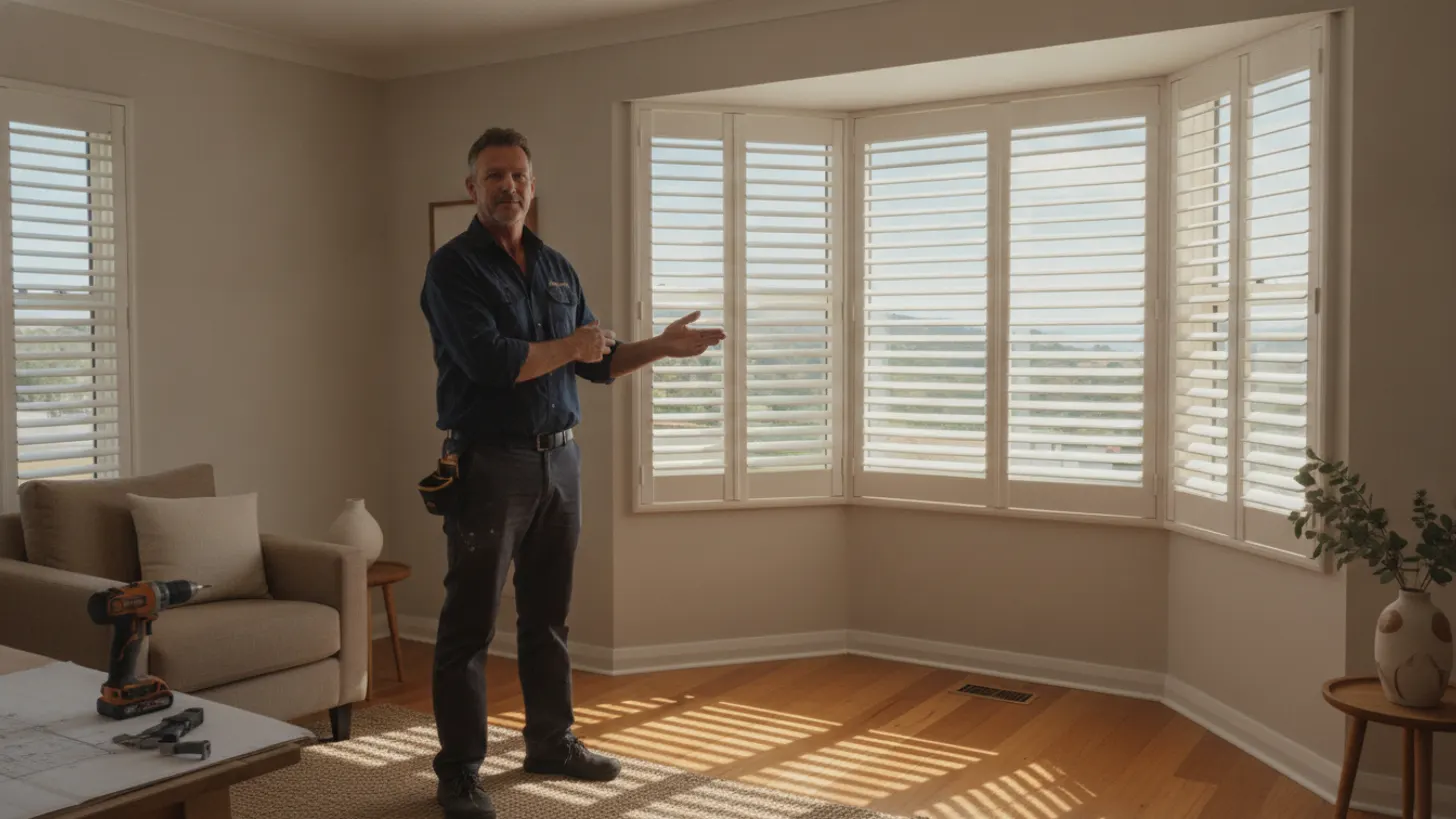
Three hinged pairs, one per face, handles most bays. Each pair folds back into its own reveal, the sill stays clear, and shaped corner posts absorb the angle so panels never fight each other. Bay window shutters Australia layouts only need tracks when a single face is too wide to hang on hinges.
A single hinged panel per face is tidier on narrow sashes, but it needs clear wall on the swing side, which a bay corner rarely gives you. Bi-fold stacks suit a wide centre face, at the cost of stack depth sitting against the jamb. A fixed upper panel over a hinged lower pair works where the top sash never opens and you want the glass line uninterrupted.
Odd returns, curved heads and five-sided bays are their own problem, and we cover those separately in our guide to custom shaped shutters for unusual NSW windows.
Can bay window shutters Australia improve privacy and usable sill space?
They do both, for one reason: the louvres tilt independently of the panel. You close the blades for privacy at street level and leave the top tier open for daylight, and because the frames sit in the reveal, the sill and window seat stay usable rather than disappearing behind fabric.
That is the practical gain over curtains in a bay. A curtain track has to cross the angles or stop short at each corner, and the stack lands on the sill. Panels stay in the plane of the glass. Bay window shutters Australia layouts therefore give back the bench depth that a bay was built to provide in the first place.
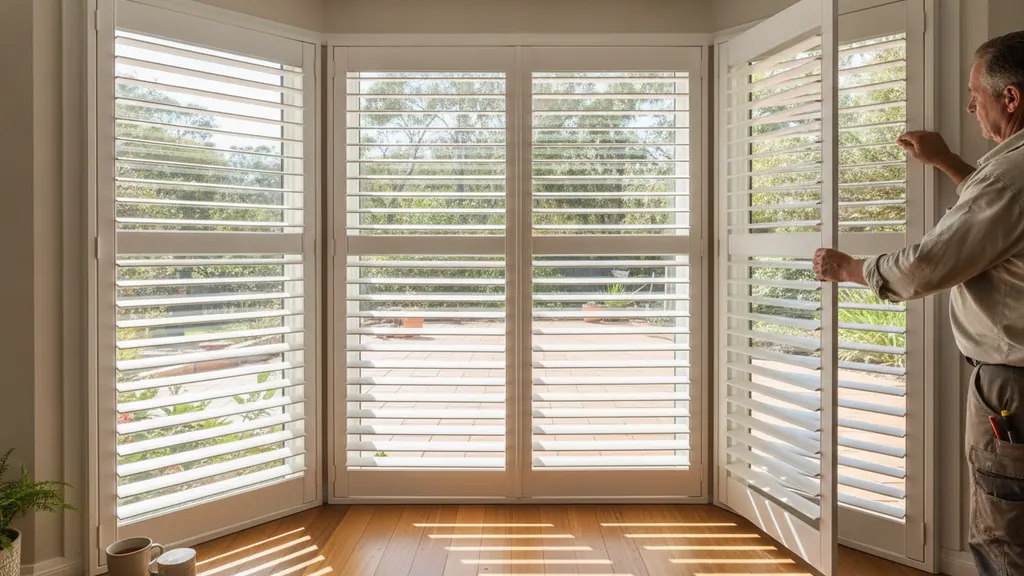
Heat is the other half of it. The Australian Government Your Home guide on orientation explains that window orientation drives how much solar heat gain and daylight a home takes in, and a bay usually faces three ways at once. A west face in Griffith behaves nothing like the south face beside it, so the tilt habits differ per panel. Household guidance from energy.gov.au on home energy use makes the same point about treating windows by exposure. For a deeper read on balancing the two, see our notes on controlling glare, privacy and daylight in living rooms.
What louvre sizes suit deep or narrow bay windows?
Match the blade to the face, not to the room. A narrow side sash with a 114mm louvre looks like one giant blade behind glass; a deep front face with 47mm louvres looks busy and blocks more view through. Bay window shutters Australia jobs often mix two sizes across the one bay for that reason.
Deep bays with a tall glass line read well in 89mm, because fewer blades means less visual clutter across a wide face. Narrow returns under about shoulder width hold their proportion better in 63mm. Keep the two sizes consistent by face rather than by panel, so each face closes as one surface.
Glazing performance shifts the decision too, since glass type and coverage change how much heat reaches the room, and a wider blade closes to a tighter overlap. Material choice runs alongside blade size, which we break down in our comparison of basswood, PVC and aluminium shutters.
How do bay window shutters Australia layouts plan for cleaning and window access?
Decide which sashes you genuinely use before the layout is drawn. Winder handles, flyscreen clips and security latches all need swing room, and a panel that fouls a handle will annoy you every day. Bay window shutters Australia layouts should be set out from the hardware backwards.
Three habits make a bay easy to live with. Hinge each pair so it folds back against the return rather than into the corner post. Leave the centre face as the one you open most, since it is the easiest to reach across a sill. And keep the corner posts accessible, because that is where dust collects.
Dust load is a regional question. Bureau of Meteorology climate data shows how dry the Riverina runs through late summer, and a paddock-side home in Temora needs dusting more often than a sheltered street in Wagga. Plan for a dry microfibre wipe on the blade tops rather than anything wet, and the finish lasts.
Planning and budgeting bay window shutters Australia
Three faces means three frames, three sets of panels and two shaped corner posts, so a bay costs more than the same glass area in a flat wall. The honest way to handle that is a site visit: we measure and quote on the spot, with the corner detail priced in rather than added later.
Bay window shutters Australia pricing moves on face count, material, louvre size, and whether any face needs a face-fit frame. The factors that shift a quote in this state are set out in our breakdown of window shutter pricing factors for NSW renovations. Ask for the corner posts, hinge sides and frame type to be itemised, because those three lines are where bay quotes differ most between suppliers.
Frequently asked questions
Can you put shutters in a bay window without losing the window seat?
Yes, if the frames sit inside the reveal rather than over the face. An inside-mount frame on each face keeps the cushion line clear and leaves the sill usable for plants or a reading spot. Bay window shutters Australia installs lose sill depth when a face-fit frame goes onto a shallow reveal, because the frame then sits proud of the wall. Check reveal depth at both jambs before ordering, and check it on every face, since older bays shallow out towards one corner. The Your Home guide chapter on shading explains why keeping the opening itself unobstructed matters for summer heat.
How do shutters fit around the angled corners of a bay window?
With a shaped corner post. The maker cuts a timber or composite post to the internal angle you recorded, usually 135 degrees on a splayed bay and 150 degrees on a canted one, and the panel stiles hinge off that post. Panels never meet stile to stile across the corner, which is what stops them binding as the frame moves with seasonal timber movement. Housing and materials research published by CSIRO is useful background if you want to understand why that movement allowance exists in a timber-framed Riverina cottage.
Do I need separate shutters for each window in a bay?
You need a separate panel set for each face, but it is one order and one install. Each face gets its own frame, its own width and its own drop, and the corner posts tie the sets together so the run reads as one piece of joinery. Bay window shutters Australia quotes are built this way because a single frame cannot bend around an angle. Renovation sequencing guidance from Master Builders Australia is worth reading if the bay is part of a larger job and trades have to follow each other.
What louvre size looks best in a bay window?
63mm is the safe middle for most bays. It gives a reasonable view through when open, still closes tight, and suits the narrow side faces that a 114mm blade would overwhelm. Deep front faces with tall glass carry 89mm or 114mm comfortably. On narrow Federation-era side sashes, 47mm keeps the proportion right. Household energy guidance from Sustainability Victoria on window coverings sets out the trade-off between blade coverage and daylight, which is the same trade-off you make when you pick a louvre width.
Can I still open the windows behind bay window shutters?
Yes, as long as the layout plans for it. A hinged pair per face swings clear of the sash, so awning and double-hung windows keep full travel. Bay window shutters Australia problems usually start with a fixed panel placed over an openable sash, or a bi-fold stack parked in front of a winder handle. Tell your installer which sashes you actually open before the layout is locked in. The Australian Government Your Home guide covers why cross ventilation through openable windows is worth protecting through a NSW summer.
How do you clean shutters in a bay window?
Open each pair, tilt the louvres to roughly 45 degrees, run a dry microfibre cloth along the blade tops, then reverse the tilt and do the other side. The corner posts are the dust trap, so finish there with a soft brush. In the Riverina, paddock dust after a dry spell means more frequent dusting than a coastal home needs. Household guidance published at energy.gov.au on looking after window coverings is a reasonable reference for keeping them operating as intended.