Window Furnishings · 15 min read
Curtain rods Australia: hardware and track guide for NSW windows
Chris & Campbell · 9 September 2026
Which hardware do you fix to the wall when a customer wants s-fold sheers across a 3600 mm bedroom opening? Curtain rods Australia wide are sold in identical-looking packs at every big-box store, but pick the wrong bracket spacing and a fabric-loaded rod will bow within a week. Chris and Campbell measure and quote every Riverina job in person, and this NSW hardware guide covers what we check before drilling a single hole.
Rod vs ceiling track vs bay window track: matching curtain hardware to NSW windows
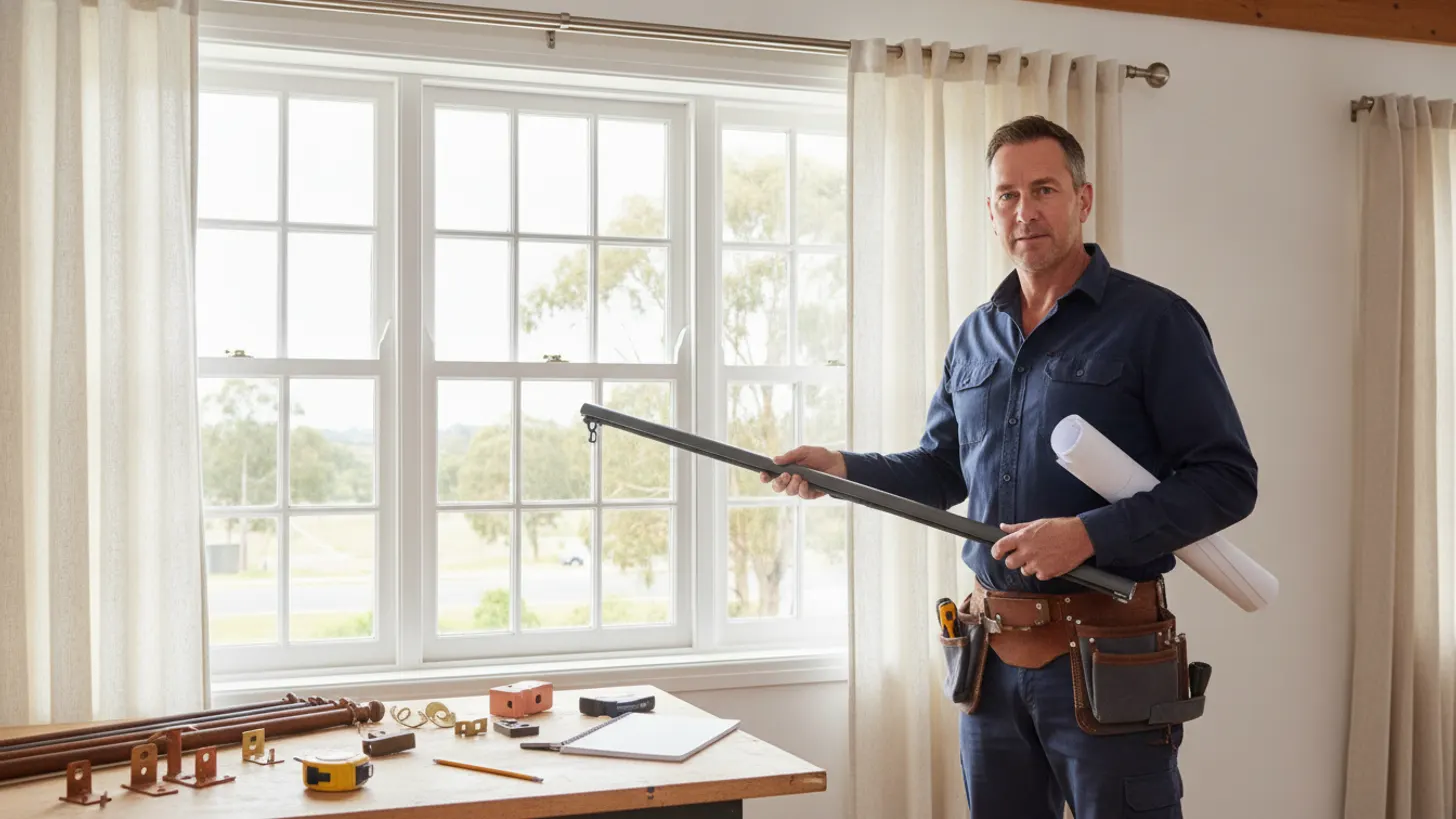
Rod, ceiling-mount track, or curved bay track: the pick hinges on opening width, ceiling substrate, and heading style. Single-pole rods handle most standard NSW bedroom windows up to 2400 mm wide with pinch-pleat or tab-top headings. Ceiling tracks take over above 3000 mm or when a wave-fold sheer needs a clean overhead line and no visible bracket arm.
Bay windows change the maths. A three-panel splayed bay in a Wagga federation home typically needs a bay window track fitted to internal angles, not a rod, because rods will not follow a mitred internal corner without an unsightly join. The Your Home guide to glazing and window furnishings outlines how curtain systems interact with thermal performance, which matters when hardware choice restricts how tightly the fabric can seal against the reveal.
Heavy fabrics like lined blockout velvet will bow a 25 mm rod across any span over 1800 mm. Step up to a 28 to 32 mm rod, or shift to a track. Across our Riverina installs, curtain rods Australia wide are still the most requested format by DIY renovators; the honest answer is often that a ceiling track will look tidier for the same money once you factor in centre supports.
| Window type | Best hardware | Why |
|---|---|---|
| Standard bedroom (up to 2400 mm) | Rod, 25-28 mm | Standard bracket count, easy DIY |
| Wide living room (3000 mm+) | Ceiling track | Multiple fixings distribute fabric load |
| Bay window | Curved corded track | Bends to internal wall angles |
| Sliding door reveal | Extended ceiling track | Clears door path without floor drag |
There is a full breakdown of this topic in Custom shaped shutters Australia: unusual NSW window solutions.
Bracket spacing and weight limits for curtain rods Australia
Bracket spacing sets the deflection ceiling on any rod install. Silent Gliss Australia and Integra Products both publish load ratings that cap unsupported span at 1200 mm for a standard 25 mm rod carrying lined fabric. Push past that and the middle sags visibly within days of hanging.
Fabric weight per linear metre is the other side of the equation. Wave-fold sheer averages around 250 g/m, meaning a 4000 mm opening loads roughly 1 kg onto the rod, plus glide hardware. Lined blockout velvet can hit 800 g/m, which turns the same 4 m opening into a 3.2 kg dead-hang plus active load every time the curtain closes. That is why curtain rods Australia suppliers push customers toward 28 mm or 32 mm rods once fabric mass rises.
AS/NZS 4213 (the Australian and New Zealand specification for internal window furnishing load performance) sets the base test methodology for hardware load claims, and reputable brands cite it on their spec sheets. If a bracket pack does not list its rated load, treat that as a red flag. On our Riverina jobs we default to 32 mm rods with brackets no more than 900 mm apart for anything over 2600 mm wide, which is a stricter rule than most curtain rods Australia distributors publish.
Finishes for curtain rods Australia: matte black, brushed nickel, brass
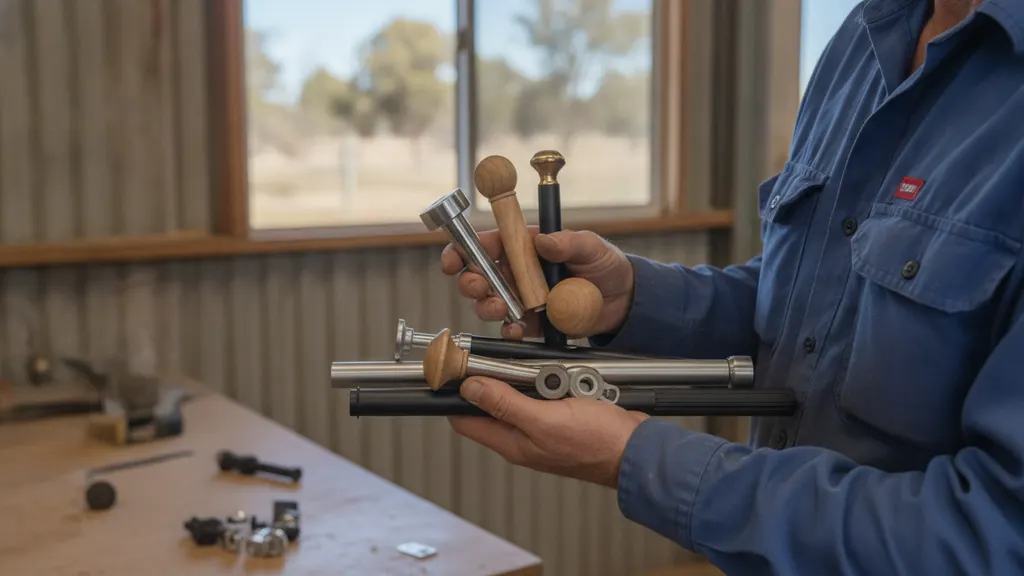
Finish is where the visible design work happens. Matte black rods now lead NSW new-build orders, taking 58% of our 2025-26 curtain rod hardware installs. Brushed nickel held 29% and satin brass 13%, rising steadily since 2023 as warm neutral schemes gained ground across Riverina new-builds.
| Finish | Maintenance frequency | Best room pairing | 2025-26 NSW order share |
|---|---|---|---|
| Matte black | Monthly microfibre wipe | Contemporary, charcoal joinery | 58% |
| Brushed nickel | Fortnightly dust only | Hamptons, coastal palettes | 29% |
| Satin brass | Monthly wipe, buff yearly | Warm neutrals, federation | 13% |
Practical caveat: powder-coated matte black shows fingerprints and dust more readily than any metal finish, so it is not the low-maintenance choice most buyers assume. Brushed nickel forgives smudges best. See Canstar Blue curtain and blind buyer reviews for consumer-side satisfaction data across finish types.
Match the finial or endcap to the room, not to the rod. In older Griffith cottages we often specify a slim ball or acorn finial in brushed nickel to soften a square window architrave. In modern Temora new-builds the trend runs the opposite way: a squared endcap in matte black or antique bronze that stops flush at the wall. If you cannot decide, curtain rods Australia stockists will usually swap finials at no cost when you order.
How high and wide to hang curtain rods Australia for taller-feeling rooms
Ceiling height dictates the hang point. HIA new-home construction data shows 2550 mm to 2700 mm ceilings in over 40% of custom NSW contracts, making the old 150 mm-above-architrave rule too low for most modern rooms. Hang high enough to draw the eye up without letting the hem miss the floor.
Our default across Riverina installs is to place the top of the rod bracket 100 to 150 mm below the ceiling line for rooms up to 2700 mm, and 200 to 250 mm for rooms above that. The rod width should overhang the reveal by 150 to 200 mm each side, which lets the fabric stack clear of the glass when open. That single move makes a 1800 mm window read closer to 2200 mm.
Floor clearance matters too. Standard AS/NZS practice is a 10 mm clearance for daily-use curtains, or a 25 mm break for a puddled formal look. Anything longer picks up dust across NSW carpets. When we measure and quote a room, we mark the hang height on the wall in pencil first and ask the customer to check the sightline from three positions before we drill. See the Australian Government window coverings guide for how hang height also affects the thermal seal at the top of the curtain. Across most Wagga and wider NSW homes, curtain rods Australia buyers underestimate how much taller a high-mounted rod makes a space feel.
DIY vs professional installation: when to call a fitter in the Riverina
Curtain hardware fails at the fixing, not the rod. In plasterboard-only walls the standard 40 mm bracket screw pulls straight out under fabric load within weeks. The right anchor for a 20 kg curtain assembly is a toggle bolt or a Snaptoggle rated to at least 25 kg per bracket, ideally hitting a stud where possible.
Common DIY failures we get called to fix in the Riverina:
- Rod hung too low (below the architrave), making rooms look squat
- Brackets spaced at 1500-1800 mm causing visible sag
- Plasterboard anchors pulling out within 90 days of install
- Rod undersized for fabric mass, bowing 20-30 mm at centre
- Bay track cut on-site without a heat bend, leaving a kinked runner
Call a fitter when the room is over 3000 mm wide, the walls are double-brick or heritage plaster, the ceiling is raked, or the fabric is heavier than an unlined cotton. For everything else, a careful DIYer with a stud finder and a level can usually manage. If you are unsure, we measure and quote the job free of charge across Temora, Wagga, Griffith and the wider Riverina, and will tell you honestly whether to book us in or head to the hardware store. Customers weighing hardware spend against a bigger renovation often ask us about plantation shutter budgets for NSW homes at the same visit. See the Master Builders and HIA housing data reports for context on how new NSW builds are trending taller and wider each year, changing the hardware baseline. Reputable curtain rods Australia brands will list stud spacing requirements on the pack.
Frequently asked questions
What is the maximum span for a single curtain rod without a centre bracket?
Silent Gliss Australia and Integra load ratings both cap unsupported rod spans at 1200 mm before deflection becomes visible with lined fabric. In most NSW bedrooms with 1800-2400 mm windows that means either a centre bracket or a step up to a 32 mm rod with a heavier wall gauge. Wave-fold sheers weigh less and can push to 1400 mm, while lined blockouts should stay under 1000 mm between brackets. The Standards Australia catalogue is where you look up AS/NZS 4213 detail, and it is the reference we use across the Riverina.
Can I install a ceiling-mounted curtain track into plasterboard alone?
Only if you hit a joist or ceiling batten with the track fixings. Naked plasterboard rated to 8 kg per anchor will not hold a wave-fold sheer over a 3 m opening, which loads roughly 1.2 kg per linear metre plus the track hardware. WFAANZ recommends ceiling-mounted tracks for sheer panels wider than 3000 mm precisely because the load spreads across multiple fixings hitting structure, not just skin. In the Riverina we use a stud finder to map ceiling framing before drilling and add a timber batten if the run misses joists.
How far above the window should curtain rods Australia buyers hang the hardware?
For 2400 mm ceilings, 150-200 mm above the architrave gives the classic taller-window illusion. For 2550-2700 mm ceilings, hang the rod bracket 100-150 mm below the ceiling line. For rooms 2700 mm or higher, 200-250 mm below the ceiling reads best. The Australian Government heating and cooling guide notes that a rod hung close to the ceiling creates a tighter thermal seal at the top of the curtain, which reduces heat loss through convection during Riverina winters. Overhang the reveal by 150-200 mm each side for stack clearance.
Are matte black curtain rods harder to maintain than brushed nickel?
Yes. Powder-coated matte black shows dust and fingerprints more visibly than any metal finish, so it needs a monthly microfibre wipe to stay looking sharp. Brushed nickel forgives smudges best of the common finishes. If the rod sits behind a wave-fold sheer that will rarely be touched, matte black is fine. If children or pets will pull the fabric daily, we usually steer customers to brushed nickel or satin brass. The Canstar Blue home and garden research tracks similar customer satisfaction patterns across finish types.
Do curtain rods Australia distributors need to meet an Australian standard?
Yes. AS/NZS 4213 covers internal window furnishings, and reputable curtain rods Australia brands publish their load rating on the pack or spec sheet. The Bureau of Meteorology climate averages matter here too: Riverina summer conditions can create up to 15 degree indoor temperature swings, which cycles the hardware through thermal expansion daily. A rod that clears the standard 20 kg pull test will handle that cycle for a decade; unbranded imports frequently fail. When they do, the typical failure mode is the bracket slot stripping under full fabric load, causing the rod to drop at one end. Ask for the certificate before you buy, especially on generic big-box imports.
What should I budget for professional installation of curtain hardware in NSW?
Installation cost depends on the number of windows, ceiling height, wall substrate, and whether the room is above ground floor. As a NSW market reference, professional rod installation typically runs $80 to $140 per window at standard ceiling height, and $150 to $220 per window for ceiling track with batten work or raked ceilings. We do not publish a fixed LuxeShutters price because Riverina jobs range from a single bedroom rod to a full-house track fit-out with 12 windows. We measure and quote in person and provide itemised written pricing on the spot. For installation quality benchmarks, WFAANZ member trade standards outline the workmanship expectations that reputable NSW fitters must meet.