Curtains · 16 min read
S-fold curtains Australia: modern wave style for NSW living rooms
Chris & Campbell · 21 August 2026
Wondering why every new-build display home in the Riverina now hangs curtains in soft, uniform waves instead of stiff pinch pleats? That look is what the trade calls s-fold, and s-fold curtains Australia wide have quietly become the default for floor-to-ceiling living rooms since 2.7-metre ceilings became the norm. This guide covers fabric, tracks, cost bands, and the fitting details that decide whether your wave hangs cleanly or bunches within a season. On a wide opening with high ceilings, levelling the track without a straight joist run is exactly why the 60 mm glider spec is not negotiable.
What are s-fold curtains Australia homeowners are asking for?
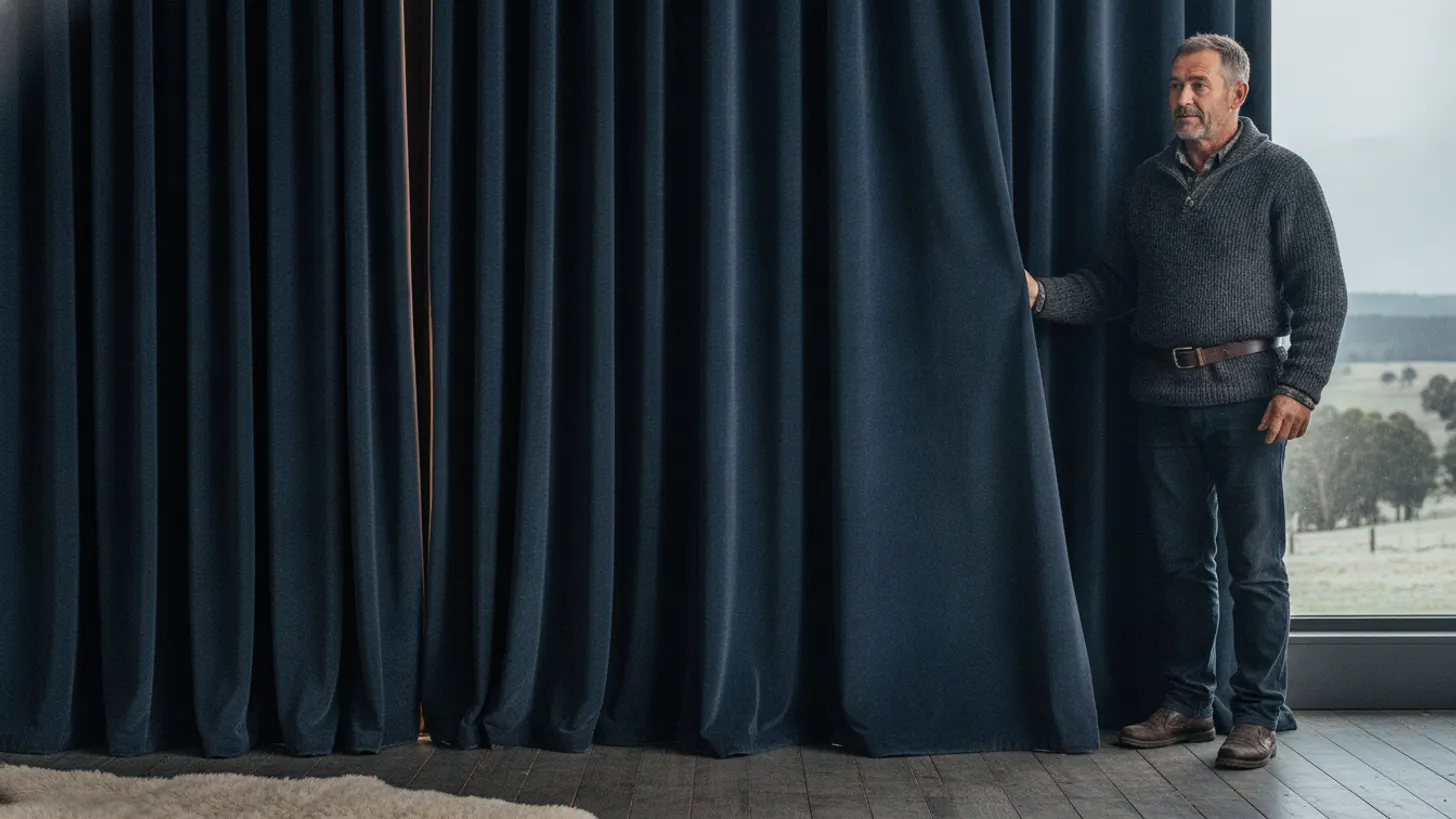
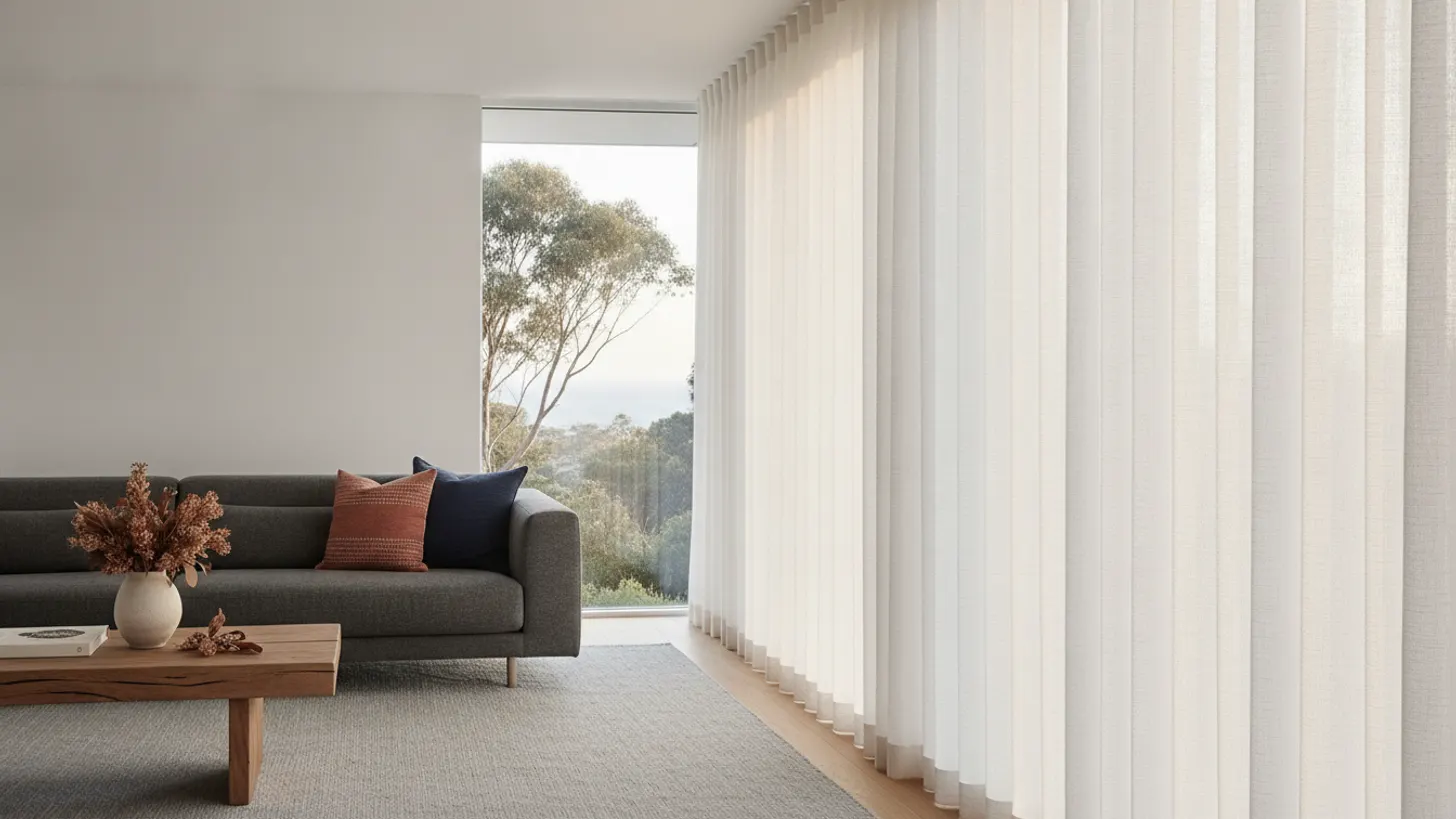
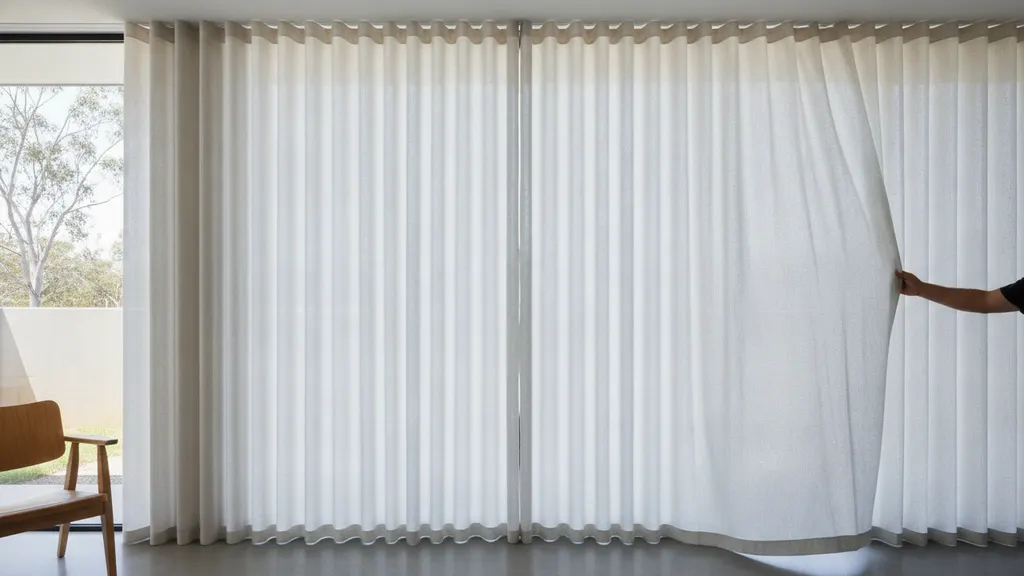
S-fold curtains hang from a ceiling-mounted or wall-mounted track using evenly spaced gliders that force the fabric into continuous, uniform waves. The look is minimal and contemporary, distinct from the triple-fold of a pinch pleat or the metal-ring look of eyelet curtains. S-fold curtains Australia buyers choose this heading when they want fabric to read as architecture, not decoration.
Compared to pinch pleats, s-fold curtains stack neatly at either end of the track and take less depth when open, which suits floor-to-ceiling windows in open-plan living room window treatments across NSW. Eyelet curtains produce larger, less regular waves and rely on the rod diameter. The same job is done here with a hidden track and a much cleaner ceiling line.
Homeowners often ask whether wave curtains, ripple fold curtains, and s-fold curtains are the same thing. They are: three names for one heading style, with s-fold and s-wave being the more common terms among Australian and NSW fitters. The federal Your Home guide treats them all as valid interior curtain treatments for glazing.
| Feature | S-fold / wave | Pinch pleat | Eyelet |
|---|---|---|---|
| Heading system | Flat tape with fixed gliders at 60 mm pitch, ceiling or wall track | Hand or machine-stitched triple pleats on hook tape | Metal rings punched through fabric, hung on a rod or pole |
| Fullness ratio | 1.8x to 2x | 2x to 2.5x | 1.5x to 2x |
| Track type | Precision glider track (ceiling or wall mount) | Standard curtain track or traverse rod | Curtain pole or rod |
| Best ceiling height | 2.7 m and above | Any height | 2.4 m to 2.7 m |
| NSW installed price (3 m window) | $900 to $1,500 | $600 to $1,100 | $400 to $850 |
Which fabrics work best for s-fold curtains Australia in NSW conditions?
Fabric weight and drape decide whether the wave holds. Too light and it flutters. Too stiff and the wave collapses into pleats. In the Riverina and across inland NSW, where the Bureau of Meteorology climate averages record summer highs regularly above 35°C, UV stability matters as much as drape.
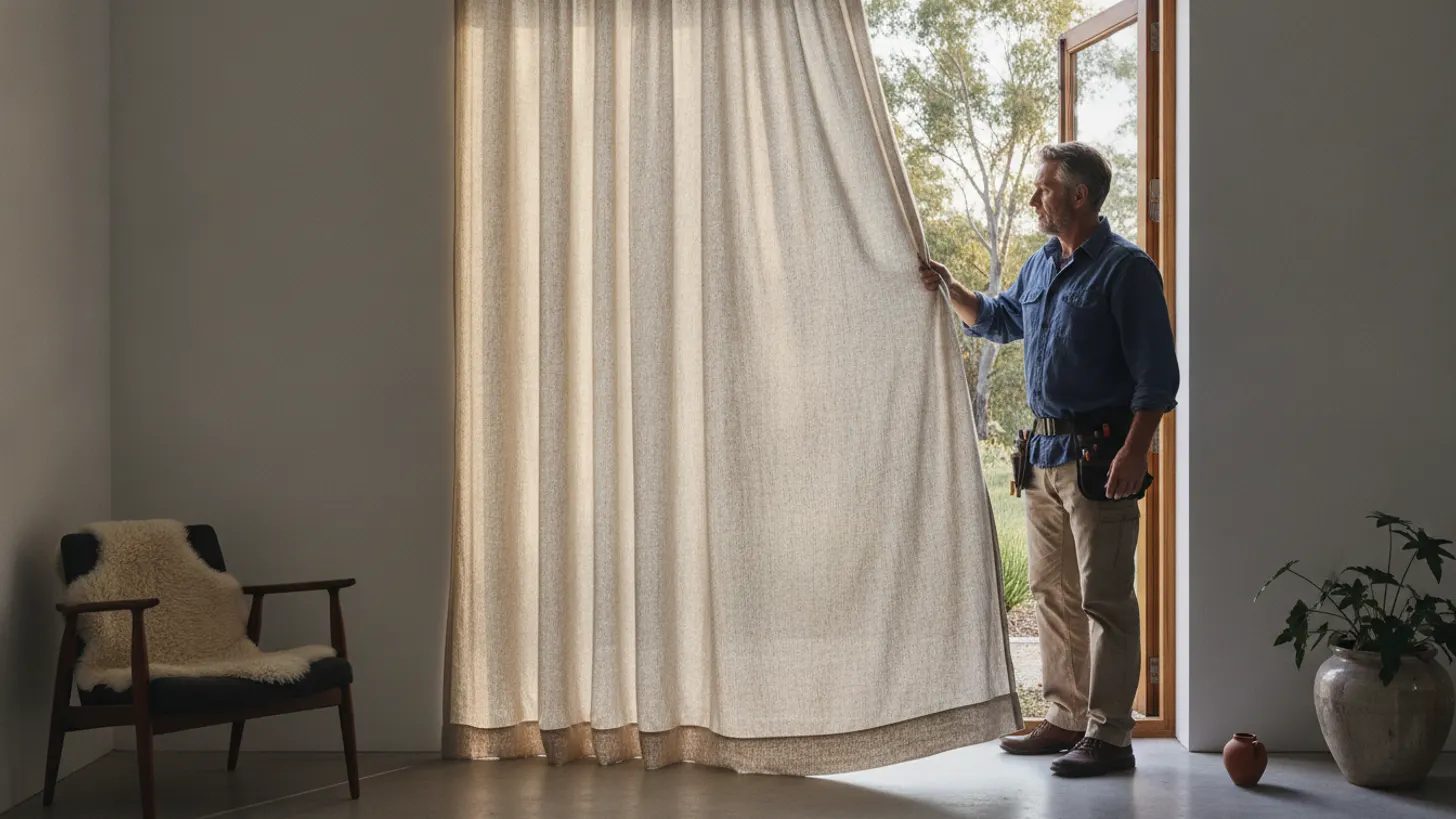
Linen-blend fabrics with a mid weight (around 200 to 300 gsm) hang the softest wave and remain popular for s-fold curtains Australia wide. Pure linens creep and crush over a hot inland summer, while a polyester content of 30 to 50 per cent in a woven blend holds the wave through those months without the stiffening you get from fully synthetic fabrics. Most precision glider track systems, including the ceiling-mount profiles used in new NSW builds, publish a 300 gsm upper weight limit in their fitting data sheets; exceeding that figure risks glider drag and an uneven pull across the wave. Triple-weave blockout fabrics also s-fold well and give the light-sealing behaviour a bedroom needs, without the stiffness that ruins the drape on lighter cottons. Sheers hang beautifully but need a fuller ratio, typically 2.0x to 2.2x, to keep the wave regular.
For a natural look without the creep, most Riverina fitters lean on the linen-blends covered in more depth in our linen curtains guide for NSW homes. If you want to see the wave shape without full opacity, sheer-only versions work well; read our sheer curtains guide for the compromises.
For a closer look at this, see Roman blinds vs curtains Australia: which suits your living room?.
What track systems do s-fold curtains Australia need to hang correctly?
The track is the whole trick. S-fold curtains Australia jobs use a specific ceiling-mounted or wall-mounted track with fixed carrier positions, gliders spaced at approximately 60mm intervals, so every wave sits at the same depth. Retrofit a standard curtain track and you get a lumpy imitation. Serious track brands publish glider spacing and maximum weight ratings in their data sheets.
Ask for that data sheet before you sign. Fabric fullness is the second variable. To achieve the regular, gapless wave, the fabric width must be 1.8x to 2x the finished track length. Under that ratio, gaps appear at the top of each wave. Over it, the fabric bunches and the wave crushes into itself. Fitters measure the finished track length first, then order fabric to that multiple. The Australian Bureau of Statistics 2021 housing census records a median living-room width of approximately 4.2 m in new NSW dwellings, which means a single-panel s-fold covering that opening needs between 7.6 and 8.4 m of fabric width before hem and seam allowances are added. Corded and motorised versions add pull cords or a wand at either end and change the stack depth, which matters when a sofa sits close to the wall.
Bendable versions handle bay windows, and low-profile recess tracks disappear into a plaster-lined pocket for the cleanest architectural look. Australian window furnishing standards published through Standards Australia cover cord safety and mounting hardware, and apply to any powered wave system.
How much do s-fold curtains Australia cost supplied and installed in NSW?
S-fold curtains Australia wide sit at the higher end of curtain pricing because the track and fabric fullness both cost more than pinch pleat equivalents. Canstar Blue's curtain pricing surveys track the general Australian curtain and blind market and confirm wave-heading styles run above pinch pleat and eyelet equivalents on like-for-like fabric.
A standard 3 m wide window in a linen-blend s-fold curtain, supplied and installed in the Riverina, typically runs between $900 and $1,500 including track, gliders, ceiling fixings, and labour. Corded systems sit toward the lower end of that range; motorised systems and triple-weave blockouts sit toward the upper end or above. These figures assume a 2.7 m ceiling height, and greater drops add to fabric metreage and fitting time.
A useful way to think about it: a 3m wide track finished in a 250 gsm linen-blend s-fold curtain in NSW carries a similar investment to a set of premium plantation shutters over the same window, purely because 1.8x to 2x fullness means much more fabric per opening. Track alone is a small fraction of the total. Fabric metreage and fitting time drive the price.
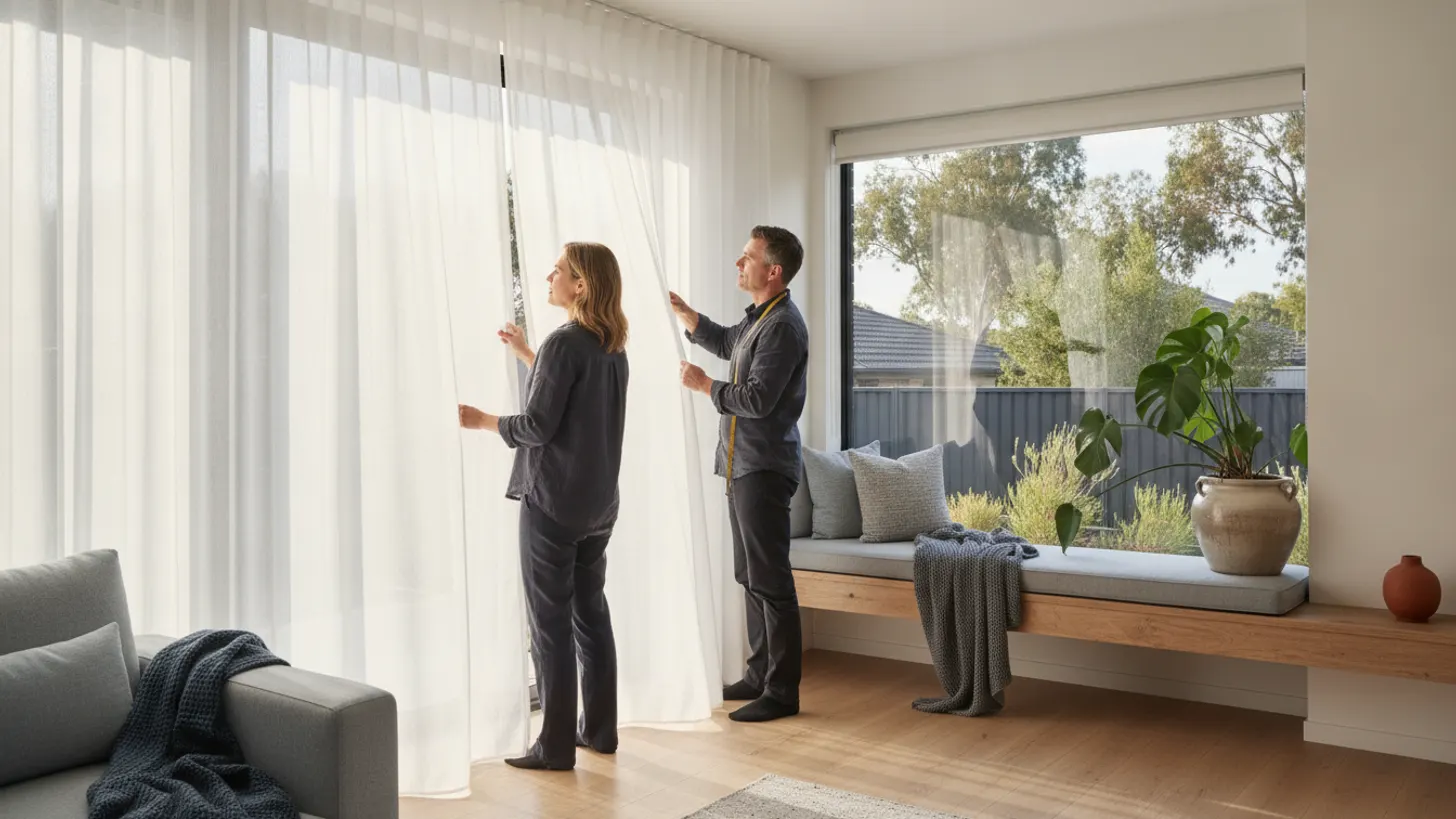
Do not accept quotes without an itemised breakdown of track type, glider count, fabric width per drop, and heading style. Those four lines tell you whether the wave will hang correctly. When we measure and quote in the Riverina we itemise every line on the sheet, and fabric metreage is always the largest figure.
| Cost driver | Share of total | Why it matters |
|---|---|---|
| Fabric metreage | Largest | Fullness of 1.8x to 2x means more fabric per window |
| Track and gliders | Moderate | Precision-glider track costs more than a standard rod |
| Fitting time | Moderate | Ceiling fixings and level runs take longer to fit |
| Motorisation (optional) | Variable | Adds a battery or wired motor plus a wand or app |
S-fold curtains Australia: right for floor-to-ceiling windows in new builds?
In a word, yes. New-build living rooms have gravitated toward 2.7m and higher ceilings, and floor-to-ceiling stacker doors are now common. S-fold curtains Australia buyers get the biggest visual return in these openings, because the drape reads as one clean vertical surface rather than a decorative topping on a window frame.
Thermal performance matters here too. Bare glazing is one of the largest heat gain points in an Australian home, and interior full-drop curtains sit closer to the glass and cover the reveal, which helps trap the pocket of still air between fabric and window. For an insulation-first comparison, our roman blinds vs curtains comparison covers the trade-offs.
CSIRO residential research and the federal energy.gov.au guidance on window coverings both confirm that curtains reduce summer cooling load and earn their keep only when they seal the top and sides of the window. S-fold ceiling-mount tracks help on the top edge, and wall-return brackets or a pelmet close the sides.
Frequently asked questions
How do s-fold curtains differ from pinch pleat curtains?
S-fold and pinch pleat curtains hang from different heading systems. Pinch pleat curtains have hand or machine-stitched triple pleats sewn into the top of the fabric, producing a decorative pleated header that sits above the track. S-fold curtains have a plain flat top with gliders clipped in at fixed intervals, forming continuous rolling waves without visible pleats. The wave heading needs a specific track and more fabric fullness, around 1.8x to 2x the track length, so the effect stays regular. The Your Home shading guidance lists both as valid interior curtain treatments for Australian homes.
What ceiling height suits s-fold curtains best?
S-fold curtains look best on ceilings of 2.4m and above, and the effect becomes striking at 2.7m or higher. Australian Bureau of Statistics housing data shows most new dwellings built after 2010 have living-room ceilings at 2.7m or higher, which is one reason the wave heading has taken over the display-home market. On low 2.4m ceilings the wave still works but the vertical scale feels compressed. On 3m and above it becomes the main design feature of the room. Track type stays the same, only fabric drop changes with ceiling height, per Your Home guidance.
Can s-fold curtains be motorised?
Yes. Motorised s-fold tracks are one of the fastest-growing categories in NSW new builds. Battery-powered motors clip into the same track sections used for corded systems, and rechargeable options avoid running mains cabling through a lined ceiling. The motor sits at one end of the track and drives a carrier that pulls the wave open and closed. Cord safety standards published through Standards Australia apply to any manually corded system within reach of children, which is one reason motorisation now dominates on floor-to-ceiling drops behind seating areas in NSW living rooms.
How much fabric fullness do s-fold curtains need?
S-fold curtains Australia specifications call for 1.8x to 2x the finished track length. That means a 3m track needs 5.4 to 6m of fabric width across the drops. Under 1.8x, the wave loses definition and gaps appear at the top. Above 2x, the fabric bunches and the wave crushes into itself. Fabric weight interacts with the ratio, so a heavier linen-blend can hold the wave at 1.8x while a lighter sheer may need 2.2x to look right. Track manufacturers publish fullness guidance in their data sheets, per Canstar Blue curtain research. Insist on the sheet before ordering.
Do s-fold curtains work with sheer fabric?
Sheer s-fold curtains work well and are one of the most popular combinations in Australian display homes, because the wave shape reads through the fabric and gives depth to what would otherwise be a flat panel. The trade-off is that a sheer at 1.8x fullness can look flat compared with a mid-weight linen-blend at the same ratio, so most fitters increase sheer wave curtains to 2.0x to 2.2x fullness. Layer under a mid-weight blockout on a second track for day and night control. The federal energy.gov.au window coverings guidance notes double-tracked layers give the best thermal outcome.
How long do s-fold curtains last in NSW conditions?
Track hardware on s-fold curtains Australia installations is designed for a decade or more of daily use, and quality manufacturers back the aluminium track with a 5 to 10 year warranty. Fabric life is where NSW conditions bite hardest. Inland summer sun through unscreened glass will fade even quality curtain fabric within five years, so UV-stable synthetics or synthetic-linen blends outlast pure natural fibres. The Bureau of Meteorology's western NSW temperature records show why fabric selection matters more here than in coastal Sydney. Wash sheer and light fabrics per manufacturer instructions, and treat most blockouts as dry-clean-only to avoid shrinkage.
We cover the details separately in Heritage home window treatments NSW: period style meets modern comfort.