Buying Guides · 18 min read
Bay window blinds and shutters Australia: fitting solutions for NSW
Chris & Campbell · 7 August 2026
Why do the blinds you ordered for your bay window arrive looking wrong at the corners? The angles are the answer. Bay window treatments Australia homeowners rely on almost never come off the shelf, because the geometry of a three-panel bay, whether 45-degree, 30-degree or square, rules out standard sizing. We measure and quote every bay job across the Riverina personally, so you know exactly what fits before you spend a cent.
Why standard blinds and curtains fail on bay windows in NSW homes
A bay window is not one window. It is three, four or five separate openings that meet at interior corner angles between 100 and 135 degrees. Off-the-shelf blinds are cut and bracketed for a flat 90-degree recess, so they cannot cover those diagonal joins cleanly and their fixing plates need parallel surfaces a bay simply does not present.
The bay window treatments Australia big-box retailers advertise as ready-made almost never work at those angles. Three failure modes turn up in almost every DIY bay we get called to repair. Corner light-gap: two blinds mounted independently leave a triangular slice of daylight at every join. Bracket clash: adjacent blinds fight for the same mounting screw in the corner mullion. Chain interference: pull cords and wands on one panel foul the neighbouring panel's fabric on the swing. None of these are fabric problems; they are geometry problems.
Bay and bow windows are not a rare architectural choice either. They still land in a meaningful share of new NSW builds, especially in period-style single-storey homes on larger blocks. The chart below shows the proportion reported by the Housing Industry Association in recent new-home design surveys.
The Bureau of Meteorology's long-run climate summaries at the BoM climate data portal confirm what our customers already know: summer surface temperatures push past 40 degrees Celsius on multiple days a year across the Riverina, so every millimetre of corner gap becomes a repeat solar leak into the room. This is why we will not quote a bay job over the phone or from a photograph.
Bay window treatments Australia homeowners should shortlist first
The bay window treatments Australia workrooms actually build cluster into four practical categories. Stock products fall away the moment corner angles enter the conversation: a 90-degree bracket cannot meet a 120-degree join without a visible light gap, so what survives for any genuine bay opening are custom-built systems for individual panel coverage or a continuous fabric run across the bent opening.
Bay window treatments Australia: plantation shutters and corner posts
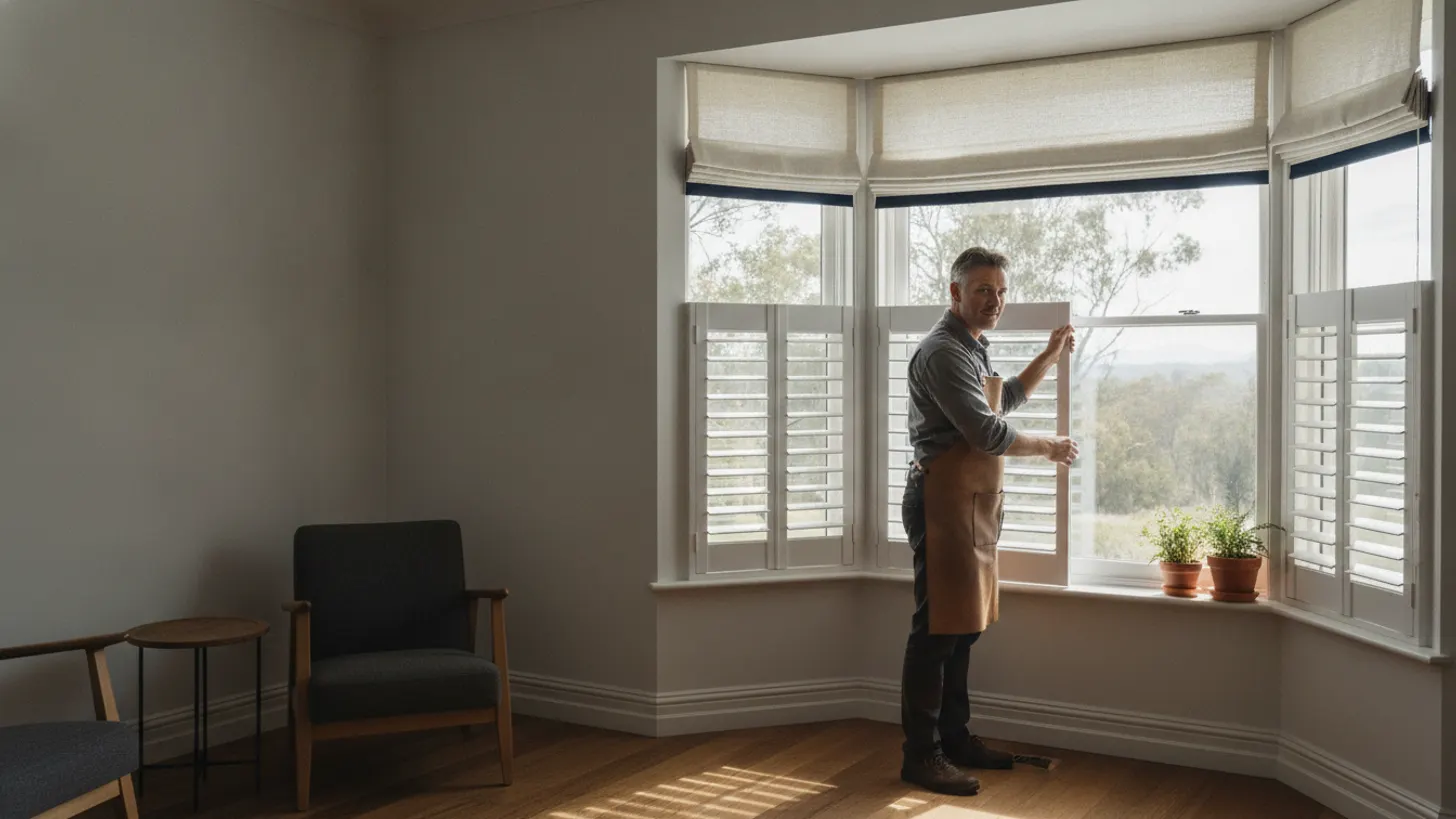
Hardwood or PVC shutters split into one leaf per bay panel, joined by hinged corner posts. This is the treatment plantation shutter workrooms build most often on angled bays, and it is what our CWGlobal partnership fits across the Riverina. Because each panel is measured to fit its own opening, corner light gaps drop to a few millimetres. Our plantation shutters versus roller blinds comparison covers the base tradeoffs before you factor in the bay premium.
Bay window treatments Australia: roman blinds per-panel fitting in NSW
Fabric romans work on bays because each blind is a discrete piece, so the corner joins are simply where two separate blinds meet. Choose block-out lining for west-facing openings in Wagga or Griffith and lighter linens for north-facing living rooms where morning sun is welcome.
Bendable bay curtain treatments: track systems for angled and bow bays
A bay-bendable track lets one continuous curtain close across the entire opening. The tradeoff is depth: floor-length curtains eat 150 to 200 millimetres of window-seat clearance, so joinery below the sill needs to be planned around the drape stack.
Cellular blind bay window treatments: thermal performance in NSW
Honeycomb blinds trap still air inside their cells, adding an R-value uplift that the Australian Government's household energy research ranks as one of the cheaper thermal upgrades a homeowner can make. On a west-facing bay in the Riverina, that difference is the gap between a usable afternoon room and a heat trap.
Bay window treatments Australia plantation shutters can conquer at any angle
Among the bay window treatments Australia customers pick most often, plantation shutters lead by a wide margin because the frame system is built for the geometry. Instead of trying to bend a single blind around the angle, the shutter fabricator makes each panel as a separate leaf and joins them with corner posts that hinge or split on the diagonal.
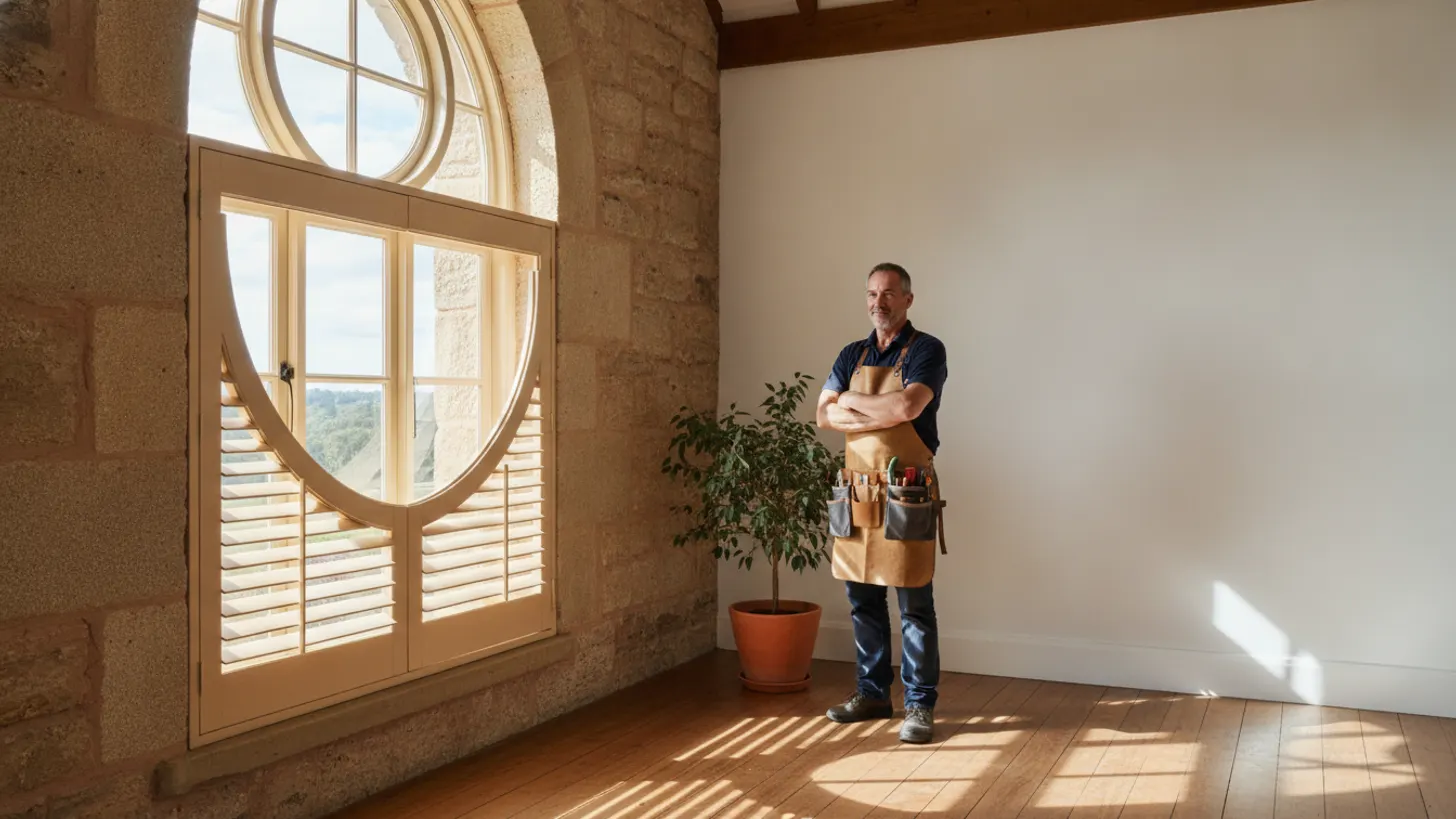
Three corner post styles handle almost every configuration you will see in NSW. A hinged corner post, the most common bay-window fitting in the Riverina, uses two vertical stiles joined by a piano hinge cut to the exact interior angle the bay presents (135 degrees for a shallow bay, 120 for a medium, 100 for a deep one); the hinge lets each panel open on its own axis without fouling its neighbour, and a hinge cut two degrees short will produce a 4-millimetre shadow gap at the frame face when the panel is fully closed, which is why angle measurement matters more than any other single dimension on a bay job. A split L-post has two flat stiles mitred to the wall angle and screwed to a common corner block, making it the preferred choice on heritage homes where the original plaster architrave must stay undisturbed. A cranked or curved corner post is milled to follow a bow window's true curve; these run 30 to 50 percent above straight-post pricing and carry a longer lead time because the post blanks are custom machined to order rather than cut from standard stock.
For NSW heritage homes with original bay joinery, split frames often win because they preserve the plaster architrave rather than covering it. Our heritage window treatment guide covers the compliance and style calls that come with pre-1940s bay windows. For curved bays and full bow configurations, our bow window treatments guide walks through cranked-post options and lead times across the Riverina.
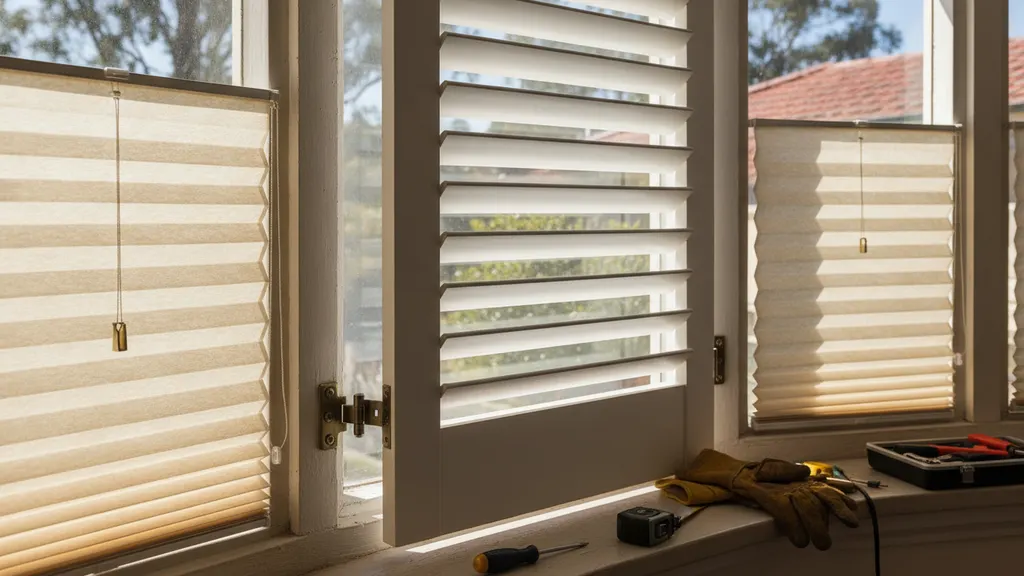
Independent thermal-performance research summarised at yourhome.gov.au glazing guidance shows internal shutters can cut heat gain through single-glazed windows by more than a third when the louvres are closed and angled, which is the difference between a west-facing living room being usable at 4pm or not.
How to measure and order bay window treatments Australia suppliers actually build
Every bay window treatments Australia quote we produce starts with three measurements taken per panel and a fourth taken across the whole opening. Getting these wrong turns a 4-week lead time into a 10-week rework loop, which is why we will not accept customer-supplied measurements on angled openings.
The three per-panel measurements are height at three points (top, middle, bottom), width at three points (top, middle, bottom), and diagonal drop from top-left to bottom-right. The whole-opening measurement is the interior corner angle at each join, taken with a digital angle finder pressed to the wall reveal at reveal depth, not at the wall face. Always work in millimetres and always record the deepest reading, because a shutter leaf that fits the tightest point will fit everywhere else across the bay.
Face-fit versus recess-fit is the next decision on every bay quote. Recess-fit means the shutter frame sits inside the window reveal, which suits sills and reveals over 90 millimetres deep and produces a clean, built-in appearance. Face-fit mounts the frame on the wall in front of the reveal, which is the safer call when reveal depth varies across the bay, as it does on almost every 1920s to 1960s NSW home we survey. On those period homes, the window-board depth can differ by 15 to 25 millimetres between the centre panel and the side panels, making recess-fit impossible without packing. Face-fit also lets the installer run a cover fillet across the frame edge that hides any small gap between the shutter frame and the wall plaster.
We learned the recess-fit trap the hard way. Quoting a three-panel bay from a homeowner's own measurements is where recess-fit depth goes wrong most often. When we arrived on install day, the centre panel reveal measured only 68 millimetres at its narrowest point, a fact the original window board had been concealing. The centre shutter frame would not seat without forcing the joinery. We converted all three panels to face-fit on site, cut new cover fillets to hide the frame edges, and absorbed the extra day's labour and materials. That job is the reason every bay quote we now issue requires an on-site measure, without exception.
| Bay configuration | Typical corner angle | Recommended treatment | Lead time |
|---|---|---|---|
| Square bay (3 panels) | 90 degrees | Plantation shutters, split frames | 4 to 6 weeks |
| Shallow angled bay | 135 degrees | Plantation shutters or per-panel romans | 4 to 6 weeks |
| Standard angled bay | 120 degrees | Plantation shutters with hinged corner posts | 5 to 7 weeks |
| Deep angled bay | 100 degrees | Plantation shutters or bendable-track curtains | 5 to 8 weeks |
| Curved bow window | Curved (no fixed angle) | Cranked-post shutters or bendable-track curtains | 6 to 10 weeks |
Lead times of 3 to 6 weeks are standard across Australian custom shutter workrooms, and bay orders sit at the longer end because each panel is a separate manufacturing job. Under the corded window covering safety rules maintained by Standards Australia, every panel also needs the correct anchor and tension device fitted at install, which is more work on a bay than a single-blind order.
What bay window treatments cost compared to flat windows in NSW
The bay window treatments Australia buyers price up carry a clear premium over flat windows, running 25 to 60 percent above comparable flat-window pricing per industry consumer surveys. The premium stacks from three sources: more product per opening, custom corner hardware not available off the shelf, and greater measurement and installation time. Treatment type and bay complexity shift the exact band.
For bay window treatments Australia customers pricing in 2025, expect these bands to hold within 10 percent through the year. Consumer benchmarks compiled by Canstar Blue's blinds and curtains price research show plantation shutters sit at roughly a 40 to 60 percent bay premium, per-panel romans at 25 to 35 percent, bendable-track curtains at 50 to 70 percent, and cellular blinds at 20 to 30 percent. The cooling-load reduction on west-facing bays brings back part of that premium each summer, particularly in Wagga and Griffith where afternoon temperatures regularly exceed 38 degrees Celsius.
Timber species, colour matching to existing joinery, motorisation and child-safe cord replacement all shift the number. For a Wagga or Temora new build, our Wagga Wagga climate-specific treatment notes break down which uplifts are worth paying on which orientation.
Frequently asked questions
Can I fit standard off-the-shelf blinds to a bay window?
Almost never on an angled bay. Off-the-shelf products are cut for 90-degree recesses and their brackets need parallel top and bottom surfaces, which a 120-degree or 135-degree corner does not offer. On a square bay (three panels at 90 degrees) you can technically fit three separate stock roller blinds, but the corner light gaps and bracket clash usually push homeowners back to custom within 12 months. The yourhome.gov.au glazing guidance recommends bespoke internal treatments for any non-standard window profile, which covers every bay we see in the Riverina.
How many separate blinds or shutters do I need for one bay window?
One per panel, always. A three-panel bay needs three shutter units, three roman blinds or three roller blinds, joined at the corner posts (for shutters) or simply meeting at the corner mullion (for blinds and romans). Bendable-track curtains are the exception because a single fabric drape closes across the whole bay on one continuous track. Count the number of separate glazing panes in your bay opening from inside the room, and that is your unit count. For odd four-panel or bow configurations we scope on-site because the corner post count changes the quote.
Do plantation shutters actually work on angled bay windows?
Yes, and this is the treatment plantation shutter fabricators build most often for bays. Angled configurations use hinged corner posts that meet the wall at the exact interior angle of the bay (100 to 135 degrees), so each shutter panel opens on its own hinge without fouling the next. The fabricator cuts each hinge mortise to the precise bay angle before delivery, which means a correctly made set of shutters closes flush across all three panels with no visible gap at the joins. Split frames handle heritage joinery where you want the original architrave to stay visible rather than be covered by a box frame. Cranked corner posts follow curved bow windows. The one configuration that is particularly hard is a very deep bay under 100 degrees, where the corner post crowds the panel swing and a bendable curtain track becomes the cleaner call.
How long do bay window treatments Australia take to make?
Standard lead times on bay window treatments Australia workrooms actually build run 3 to 6 weeks for flat windows and 5 to 8 weeks for bays because each panel is a separate manufacturing job. Curved bow windows with cranked posts push toward 10 weeks. Imported-timber supply has run at the longer end through 2025 across Australian shutter workrooms. If you need a treatment for an event or settlement date, book the measure-and-quote visit at least 10 weeks out to give yourself contingency on delivery and installation.
Why do bay window treatments cost more than flat window treatments?
Three reasons stack up for bay window treatments Australia buyers. You are buying more product per opening (three or more panels instead of one), custom corner brackets or hinged posts (not stock hardware) and more measurement and installation time (an average bay install runs 90 to 150 minutes versus 20 to 40 for a flat window). Consumer pricing research from Canstar Blue's blinds and curtains reviews puts the typical bay premium at 25 to 60 percent versus an equivalent flat window, with plantation shutters and bendable-track curtains at the top of that range.
Can bay window treatments improve energy efficiency in NSW homes?
Yes, and the effect is larger on bays than flat windows because bays typically account for a bigger share of a room's glazing area. A west-facing three-panel bay in the Riverina can represent 40 to 60 percent of a living room's total glass, so fitting it well produces a measurable drop in afternoon temperature. Internal plantation shutters cut solar heat gain through single-glazed windows by more than a third when the louvres are closed and angled at 45 degrees, and cellular blinds achieve a similar result through the air cells trapped between the facing fabric layers. Both approaches add thermal resistance between the glass and the room air, reducing heat gain in summer and heat loss in winter. CSIRO building-performance research at CSIRO's research on sustainable buildings recommends well-fitted internal window coverings as a top-tier retrofit for older Australian homes, including those with west-facing bays across the Riverina.