Plantation Shutters · 16 min read
Home office plantation shutters Australia: glare and screen comfort
Chris & Campbell · 30 October 2026
"Can I keep the shutters shut and still see my screen?" That question comes up on nearly every Temora and Wagga quote we do for a study. The honest answer is yes: home office plantation shutters Australia installs are designed to aim light at the ceiling instead of the monitor. Angle the louvres up, keep the glass out of your sightline, and the room stays bright while the screen stays readable.
How do home office plantation shutters Australia buyers control screen glare?
Glare is direct light hitting your eyes or the screen face, and a louvre tilted to roughly 45 degrees redirects that beam onto the ceiling. Shutters fix it by splitting the window into adjustable panels, keeping the diffuse light and losing the direct hit. Nothing else in a window furnishing range gives that much control at the glass.
Two problems show up at a desk. Direct sun landing on the glass washes the contrast out of the screen, and a bright window inside your field of view forces your pupils to keep readjusting between a dim monitor and a hot patch of sky. Tilting the louvres up to that same angle throws the beam over your head onto the ceiling, which bounces a softer light back down. The Australian Government YourHome guide to passive design and daylighting counts that sort of daylight control as a way to reduce reliance on electric lighting during the day, and a study is where it pays off, because the lights are usually on from 8am.
Angle control is the part fabric cannot copy
A roller blind has two useful positions, up or down, and the openness factor of the cloth decides the rest. Home office plantation shutters Australia installs let homeowners set the top half of the window to bounce light at the ceiling and close the bottom half against a low western sun, which is the exact situation most Riverina studies hit between 3pm and sunset in summer. Sustainability Victoria's guidance on window coverings makes the same point about adjustability being what separates coverings in practice rather than on paper.
We cover the details separately in Nursery plantation shutters Australia: safer sleep spaces in NSW.
What louvre size works for home office plantation shutters Australia installs?
Three louvre widths dominate the Australian market: 63mm, 89mm and 114mm. Narrow blades give you more steps of adjustment and a tighter block when closed. Wider blades give a clearer view out and fewer lines across the window. At a desk, the finer steps usually win.
For home office plantation shutters Australia jobs, we normally recommend 89mm as the default, and 63mm where the window is small or the desk sits within a metre of the glass. The reason is geometry: a narrower blade needs less rotation to cut the same slice of sky, so you can find the setting that kills the glare without dropping the room into gloom. A 114mm blade looks better on a tall lounge window than it does above a monitor.
A mid-rail is the fix for most desks
Panel layout matters as much as blade width. A four-panel bi-fold across a wide window leaves two stacks of timber sitting in the daylight when open, which is fine in a lounge and annoying beside a desk. Hinged panels that swing clear, or a mid-rail that lets you run the top and bottom sections independently, suit a study better. A mid-rail set at monitor height is the single change that fixes the most desks: closed below, tilted above. Our guide to basswood, PVC and aluminium shutter materials covers which frame holds a tight tilt over years of daily handling, and Standards Australia's catalogue of window covering standards is where the cord and child safety requirements for internal coverings sit.
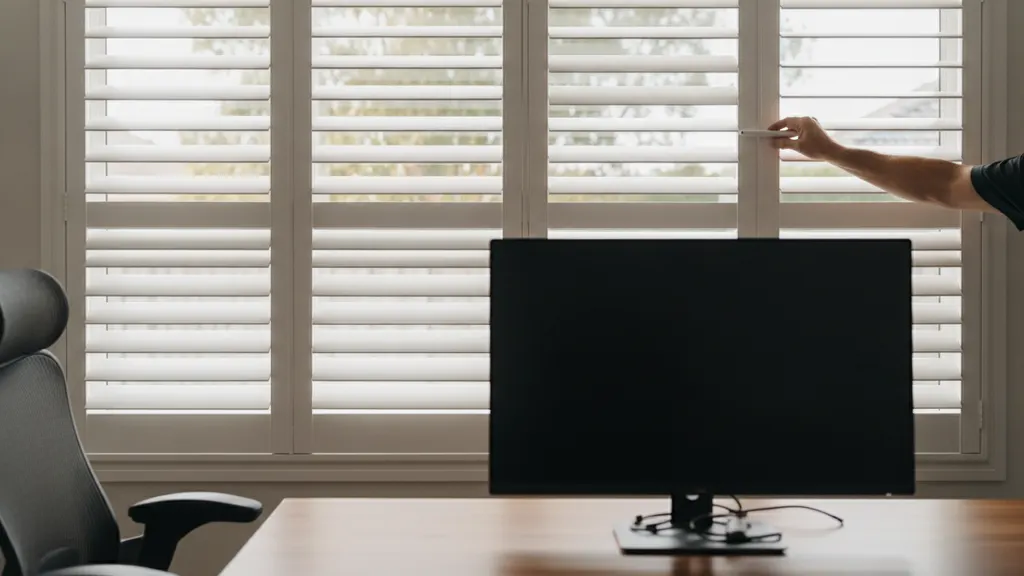
Where should a desk and monitor sit relative to the window?
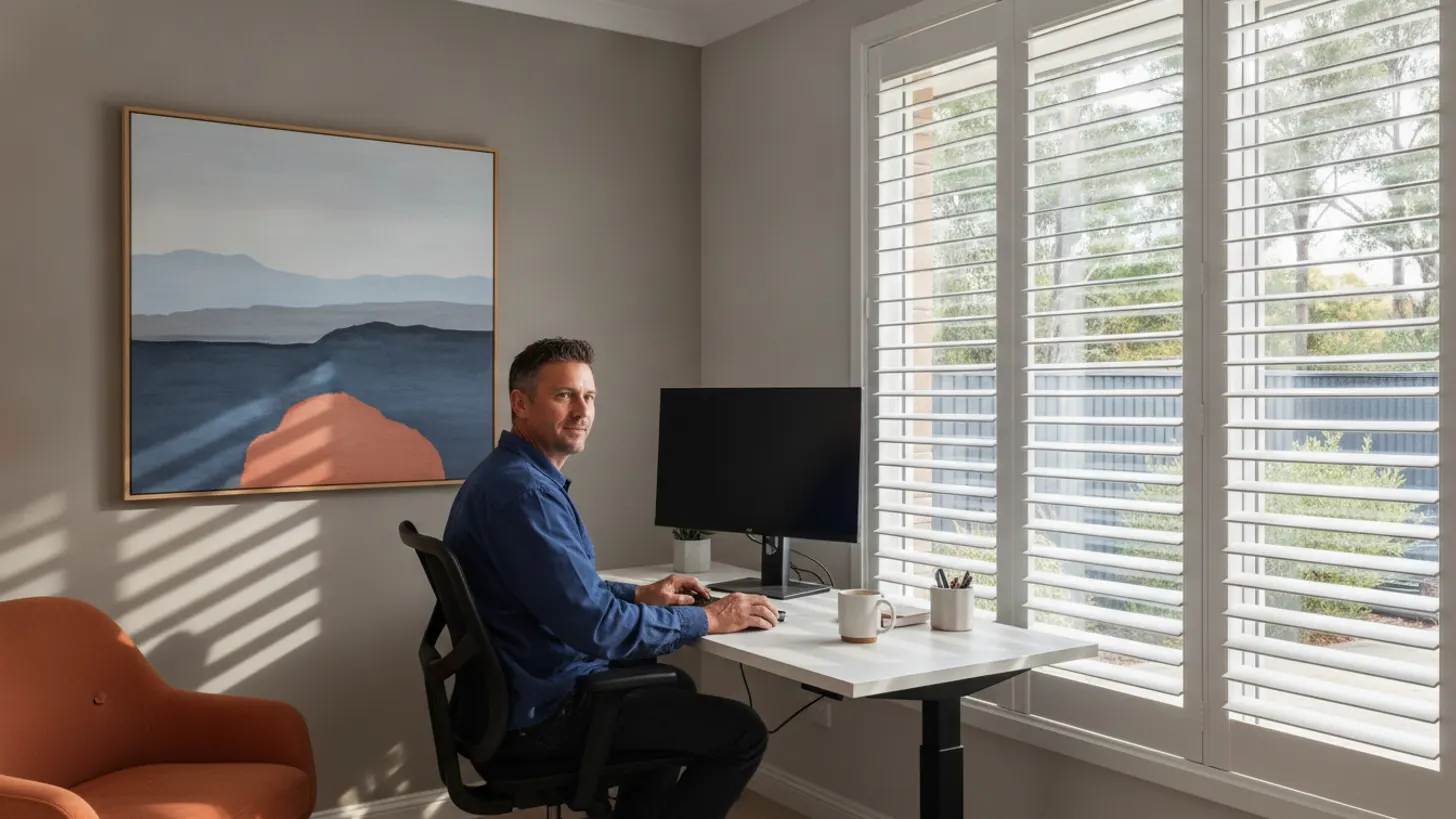
Side-on is the answer: turn the desk roughly 90 degrees from the window so neither your eyes nor the screen face straight into the glass. Facing the window gives you glare straight down the barrel, and backing onto it turns the monitor into a mirror. Side-on keeps the view and the daylight.
Distance is the other half of the setup. The US Occupational Safety and Health Administration workstation guidance recommends placing a monitor roughly 20 to 28 inches from the eyes, which is about 51cm to 71cm, or an arm's length for most people. That range only stays comfortable if the brightness around the screen holds steady, and steady brightness is what Australian home office plantation shutters buyers are really paying for.
Light direction counts for as much as distance. If the window has to sit behind the screen because the room gives you no other option, home office plantation shutters Australia installs handle it better than a blind does, since you can close the lower tier behind the monitor and leave the upper tier tilted for ceiling bounce. Where the desk must face the glass, keep a sheer layer in the mix as well: our notes on controlling glare, privacy and daylight in a living room apply to any room with a screen in it.
Can home office plantation shutters Australia support daylight without a dark room?
Yes, as long as you treat the window as two zones instead of one: close the louvres and tilt them up around 45 degrees and they still deliver working light off the ceiling. A fully open panel is for the days you want the view. Dark studies come from blockout fabric and dark paint, not from timber blades.
The ceiling does the work. A white or near-white ceiling returns most of what you throw at it, so an upward tilt turns the window into a wide, low-contrast light source instead of a point of glare. Match that with a desk lamp you can dim, and the brightness holds from morning to late afternoon with the lights off. The Australian Government's energy.gov.au guidance on household lighting and window coverings sets out why cutting daytime lighting load is one of the cheaper changes available in an existing home.
Daylight also makes the break habit easier to keep. The 20-20-20 rule promoted by the American Optometric Association asks for a 20 second look at something roughly 20 feet away every 20 minutes, and an open upper tier gives you that distance target without leaving the chair. For home office plantation shutters Australia fit-outs, we often keep the top tier clear of the sightline for that reason alone.
How do home office plantation shutters Australia compare with blinds and curtains?
Across the five criteria that matter most at a desk, shutters win three, roller blinds win one, and curtains win one: shutters take adjustability and service life, blinds take price and true blockout, and curtains take softness and echo control. Adjustability decides your day when a screen is in the room, which is why shutters usually get the nod.
The table below is how we frame it on site when a client asks us to measure and quote for a study. None of it is absolute: a layered answer, where home office plantation shutters Australia homeowners pair shutters with a light curtain for acoustics, is common in NSW houses where the study doubles as the spare bedroom.
| What matters at a desk | Plantation shutters | Roller blinds | Curtains |
|---|---|---|---|
| Fine glare control | Best: louvre tilt in small steps | Limited: up, down or fabric openness | Limited: open or drawn |
| Daylight with the window covered | Good: upward tilt bounces light | Depends on fabric openness | Sheer layer only |
| Privacy while the room stays lit | Good at a partial tilt | Poor at a partial setting | Needs sheer plus blockout |
| Full blockout for editing or filming | Fair: light lines at the blades | Best with blockout fabric | Good with blockout lining |
| Echo on calls | Hard surface, little help | Little help | Best: soft mass absorbs |
Cost lands where you would expect, with made-to-measure shutters above blinds on most jobs. Canstar Blue's consumer research on window furnishings is a fair starting point for market-level comparisons, and our breakdown of what drives shutter cost on NSW renovations explains which measurements move the number. If call quality is the louder complaint in your study, read how shutters and soft layers handle outside noise before you spend the budget on the window alone.
Frequently asked questions
Will home office plantation shutters Australia installs leave a room too dark?
Not if you run them by tier. Closed louvres tilted upward still throw usable light onto the ceiling, which bounces back down as soft ambient light with no hot spot on the screen. The studies that end up gloomy are usually the ones with blockout fabric or a dark ceiling, not the ones with timber blades. Most home office plantation shutters Australia installs we do end up living at a partial tilt from mid-morning to late afternoon with the lights off. The Australian Government's YourHome guide to daylight control treats daylight control of this kind as a way to reduce reliance on electric lighting.
What louvre size should home office plantation shutters Australia buyers pick?
For home office plantation shutters Australia projects, 89mm is the safe default and 63mm is better when the window is small or the desk sits close to the glass. Narrower blades rotate through more usable settings, so you can trim the glare in small steps instead of jumping from bright to shut. The 114mm blade suits tall living areas where the view matters more than fine control. Sustainability Victoria's energy efficiency guidance on window coverings makes the broader point that adjustability is what separates coverings in daily use, and at a desk you adjust far more often than you do in a lounge.
Should my desk face the window or sit side-on to it?
Side-on. Facing the window puts a bright sky directly behind your monitor, so your eyes fight the contrast all day. Backing onto the window turns the screen into a mirror of whatever is behind you, including your own silhouette on a video call. Side-on keeps the view, keeps the daylight, and takes the window out of your sightline. Pair that with the viewing distance the US Occupational Safety and Health Administration's computer workstation eTool recommends, roughly 20 to 28 inches from the eyes, and most screen comfort complaints in a study settle down without touching the light fittings.
Are shutters better than blinds for video calls?
For face lighting, usually yes. A tilted louvre lets you aim soft light at your face from the side while blocking the beam that blows out the camera exposure. A roller blind either lets the window through or shuts it off, and a half-raised blind often leaves a bright band right behind your head. That control is why home office plantation shutters Australia buyers tend to prefer them in rooms used for meetings. The American Optometric Association's advice on digital eye strain is a useful reminder to keep breaking focus between calls as well.
Do shutters help with heat in a west-facing home office?
They help, and in the Riverina that matters. A closed shutter adds a blade layer and a pocket of still air at the glass, which slows the radiant heat reaching your desk through the worst part of the afternoon. On one west-facing study we fitted in Griffith, closed shutters alone still let the room climb through the 3pm to 6pm run in January, so the homeowner added an external zipscreen to cut the heat at the glass before it ever reached the louvres. CSIRO's building research on thermal performance is the place to read how window layers change the heat load on a room. Check the run of afternoon sun in the Bureau of Meteorology climate records for your town, then decide whether a western window also needs an external layer like that.
Can shutters be fitted to an existing study window without a renovation?
Almost always. Shutters fit to the existing reveal or to the face of the architrave, so no wall work is needed on a standard study window. We measure and quote on site, check the reveal depth, note any sill, latch or shelf that limits panel swing, and set the hinge side so the panels clear the desk. Master Builders Australia's renovation guidance is worth a read if the study is part of a larger job, because sequencing matters. Timber wants a dry, square opening, which is one of the things the measure checks.