Shutters · 15 min read
Nursery plantation shutters Australia: safer sleep spaces in NSW
Chris & Campbell · 30 October 2026
“Will anything near the cot still be safe once she can pull herself up?” That question comes up on nearly every nursery measure and quote we do in the Riverina. A plantation shutter is a fixed interior panel built from wide horizontal slats, called louvres, hinged to the window frame instead of hung on a cord, and parents keep landing on the same answer: nursery plantation shutters Australia wide carry no loose cord, no chain and no weighted end within reach. Louvres tilt shut for a daytime nap, then wipe clean after a spill.
How nursery plantation shutters Australia improve light control and privacy
A shutter controls light in two stages, which is what a nursery needs. Closing the panel blocks the view in, and tilting the louvres then decides how much daylight lands on the cot. That two-stage control is why nursery plantation shutters Australia wide get fitted in rooms where a 2 pm nap matters.
Blade width drives the result. A narrower blade puts more closed edges across the opening, so a shut 63 mm louvre leaves less daylight than a shut 114 mm one. Nothing fully blocks light on its own, because daylight still tracks around the frame, which is why the Australian Government YourHome glazing guide treats the whole opening rather than just the covering as the thing to seal. Parents chasing true darkness layer a blockout behind the panel, the same approach we use in a master bedroom window treatment plan.
Privacy runs the other way after dark. With the lamp on, an uncovered window shows the room to the street, and louvres tilted up still leave a sight line from below. Tilt down, or close the panel fully, for change-table privacy on a front-facing room. Sustainability Victoria guidance on windows and window coverings makes the related point that a tight-fitting covering also slows heat moving through the glass overnight.
Those three widths are the stock sizes a fitter will offer. The 63 mm blade is the nursery default in our work because it darkens best, at the cost of a slightly busier look when the louvres are open.
We cover the details separately in Home office plantation shutters Australia: glare and screen comfort.
Are nursery plantation shutters Australia safer than corded blinds?
Safer in one specific way: there is no cord. Product Safety Australia warns that looped blind and curtain cords can create a strangulation risk for young children, and a hinged panel removes that loop from the room. Every other difference between nursery plantation shutters Australia buyers consider is comfort, not safety.
Australian product safety guidance also requires safe installation information to be supplied with corded internal window coverings, which tells you something useful: the hazard is controlled by how the cord is secured, and that control can fail. A tension device can be left unscrewed, a chain can be lifted off its cleat, a new tenant can pull the anchor out and never replace it. A shutter panel has nothing to re-secure. If fabric suits the room better, choose a cordless blind built for child safety rather than a corded blind with an add-on anchor.
Two shutter details still need checking. Bi-fold panels on a wide window fold into a stack that can pinch small fingers along the hinge line, and a low panel on a tall opening can be climbed once furniture sits against it. Both are solvable at the measure, not after the fit.
What NSW parents should check before ordering nursery plantation shutters Australia wide for child safety
Five things decide whether a nursery job is safe and quiet or a callback. Fixing method, cord-free operation, finish, gap control, and who actually fits it. Get those in writing on the quote, because a supply-only shutter fitted by a handyman is where most nursery problems start.
- Fixing: panels screwed into the reveal or a fitted frame, not pressure-fit, with fasteners rated for the wall type.
- Operation: no cord, chain or loop anywhere in the room, including on any secondary covering behind the shutter.
- Finish: a sealed paint or polymer surface that takes repeat wiping, with low-odour coatings cured before delivery.
- Gaps: light gaps and finger gaps both specified, since a clearance that reads fine in a living room reads differently beside a cot.
- Installer: the person measuring is the person fitting, which is how our measuring and fitting process runs.
Standards Australia, publisher of the Australian standards for internal window coverings is the reference your supplier should be able to name without hesitating. If a sales rep cannot say which standard the product is made to, that tells you how the rest of the job will go.
The last row is the whole argument. A shutter is the only option in that matrix that both removes the cord and tilts for a dark room, which is why it keeps winning nursery jobs.
How to position nursery plantation shutters Australia around cots, beds and play areas
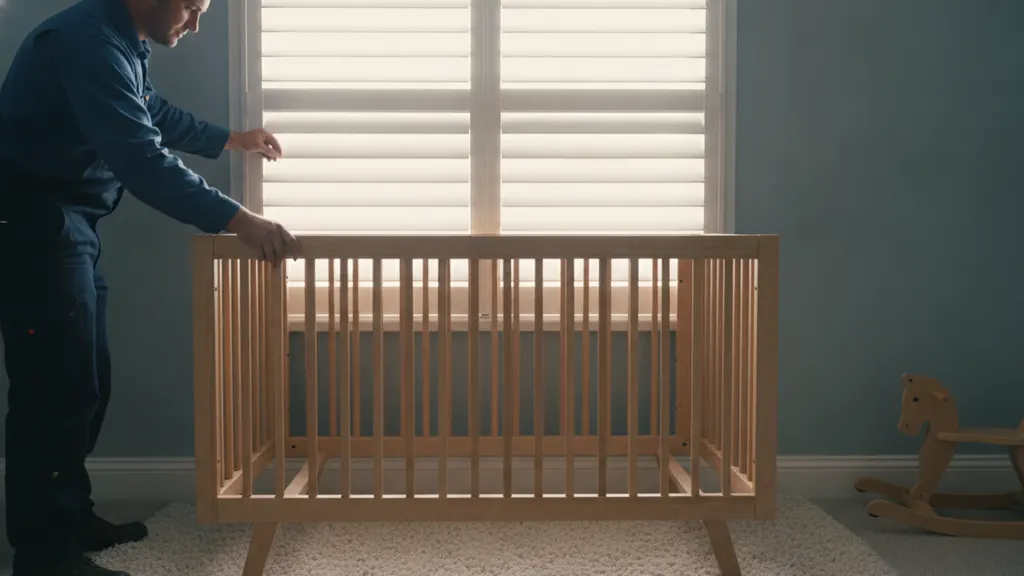
Place the furniture first. Kidsafe NSW recommends keeping cots, beds and furniture away from accessible window covering cords, and the same logic covers climbing: a cot, toy box or change table under a window becomes a step up the moment a toddler can stand. Hardware on nursery plantation shutters Australia fitters install should still sit above reach.
Window orientation matters for heat as much as safety. A west-facing nursery cops the late sun right at bedtime, and the YourHome shading guide is blunt about the order of operations: stop the sun outside the glass first, then handle whatever gets through. Internal louvres closed from mid-afternoon slow that heat, while an awning or eave stops it earlier. CSIRO research on Australian housing comfort and energy use points the same way on where the real gains sit.
The layout rules we use are plain. Keep the cot on a wall without a window where the room allows. Leave a hand's width of clear wall beside the panel so a bi-fold stack has somewhere to sit. Keep the sill clear of anything climbable. Run play storage along the opposite wall so the window side of the room stays empty as the child gets taller.
Which finishes make nursery plantation shutters Australia easiest to clean
Painted polymer and aluminium wipe down best, painted basswood looks best, and the gap between them only shows after a year of sticky hands. For nursery plantation shutters Australia parents will be cleaning weekly, pick the finish that takes a damp cloth without softening or marking.
| Material | Nursery cleaning | Humidity and spills | Fit notes |
|---|---|---|---|
| Painted basswood | Damp cloth, dry straight after | Keep clear of steam and standing water | Lightest panel, widest span per panel |
| PVC or polymer | Warm soapy water, repeat wiping fine | Handles humidifiers and sweating glass | Heavier, wide openings may need a mid-rail |
| Aluminium | Damp cloth inside, hose-safe outside | Best in wet or exposed rooms | Usually specified for exteriors and wet areas |
Our full basswood, PVC and aluminium comparison runs through weights and spans. The short version for a nursery: basswood in a dry, well-ventilated room, polymer where a humidifier runs or the glass sweats, which is the same reasoning behind moisture-resistant bathroom shutters. Airflow matters either way, and Australian Government energy advice for households covers how window management and ventilation work together through a hot night.
Frequently asked questions
Are plantation shutters actually safe for a baby's room?
They remove the main hazard rather than managing it. Product Safety Australia warns that looped blind and curtain cords can create a strangulation risk for young children, and a hinged or bi-fold shutter panel has no cord, chain or weighted end to pull on. The remaining checks are mechanical: panels screwed into a sound frame, hinges tight, no gap a small hand can lever open, and no offcut or packaging left in the room after the fit. If you are also layering a blockout behind the shutter, make sure that covering is cordless too, because one corded product undoes the whole point.
How dark can plantation shutters make a nursery during the day?
Closed louvres cut most daylight but not all of it. Light still enters along the blade edges and around the frame, so a shutter on its own reads as deep shade rather than true blackout. For a baby who wakes at first light, we either specify the narrowest 63 mm blade with a tight frame fit, or add a blockout roller or lined curtain behind the panel. Australian Government YourHome guide to glazing and window coverings explains why the gap around the opening matters as much as the covering itself, and sealing that gap is usually the cheaper fix.
What louvre size is best for a nursery?
Three widths cover almost every job: 63 mm, 89 mm and 114 mm. For a nursery we lean to 63 mm, because the narrower blade stacks more closed edges across the opening, trims daytime light better and leaves a smaller line of light when shut. The 89 mm blade is the usual middle choice and gives a cleaner view out when open. The 114 mm blade suits large living room windows more than small nursery ones. Blade choice also changes panel weight, so check hinge and frame spec against the Australian standards for internal window coverings published by Standards Australia.
Can I fit a shutter over the window right behind the cot?
You can, and it is one reason parents pick shutters, but move the cot anyway if the room allows. Kidsafe NSW recommends keeping cots, beds and furniture away from accessible window covering cords, and the same thinking applies to anything climbable, since a cot under a window becomes a step up once a toddler can stand. Leave the sill clear, keep operating hardware above reach, and avoid putting a change table where a child can push off the panel. We mark the cot position on the plan during the measure and quote so the panel layout works around it.
How do I clean shutters in a child's room?
A damp microfibre cloth and warm water handles most of it, including milk, sunscreen and fingerprints. Work along the blade rather than across it, and dry timber straight away so moisture does not sit in the paint line. Skip abrasive pads and keep spray away from the hinge. Painted basswood, polymer and aluminium all wipe down, but polymer and aluminium tolerate repeat wet cleaning best, which is why they get specified for bathrooms and laundries. A fortnightly dust beats a twice-yearly scrub, and the Australian Government YourHome maintenance advice makes the same point about protecting finishes early.
Do plantation shutters keep a nursery cooler in a Riverina summer?
They help, but shading the glass from outside helps more. Bureau of Meteorology climate averages for inland NSW show Riverina summer afternoons regularly sitting above 35 C, and a west-facing window turns that into a hot room by bedtime. An internal shutter slows heat that has already come through the glass, while an awning, zipscreen or eave stops it arriving. Closing louvres mid-afternoon and opening them once the outside air drops is the pattern that works in Temora and Wagga. Pair that with external shade and the air conditioner cycles less overnight.