Shutters · 14 min read
Coastal window shutters Australia: corrosion-resistant NSW guide
Chris & Campbell · 9 October 2026
Three years ago we fitted a job at Culburra Beach with standard 304 fittings because the client wanted to save on cost, and within eighteen months the hinges had seized solid with rust bleeding through the paint. We pulled every hinge and track screw and redid it in 316 stainless at our own cost. That job taught us to specify hardware and finishes first, material second, on every coastal window shutters Australia quote we write since.
What makes coastal window shutters Australia jobs harder than inland work?
Salt does the damage, not the sea view. Airborne chlorides settle on fasteners, hinges, tracks and coating edges within the first kilometre of the coast, then sit there in humid air and corrode the metal that holds a shutter together. That is why coastal window shutters Australia installers treat exposure category, not colour, as the first decision.
Australia has a formal way to describe that exposure. Standards Australia AS 4312, the atmospheric corrosivity classification standard provides an Australian method for classifying atmospheric corrosivity in different environments, including coastal locations, so a site can be described as a category rather than guessed at from a postcode. The NSW Environment Protection Authority identifies salt spray, humidity and wind exposure as relevant coastal environmental conditions when assessing building durability, and those three factors are what decide whether an external panel lasts a decade or a few summers.
Wind counts twice. It carries salt inland, and it loads the panel. A bare headland block with a steady onshore breeze collects salt further from the water than a sheltered pocket two streets back, and the long-run wind observations held by the Bureau of Meteorology climate and wind records show how persistent those onshore patterns are along the NSW coast. Two houses the same distance from the beach can need different hardware.
There is a full breakdown of this topic in Can landlords install shutters for rental properties Australia? NSW law explained.
We cover the details separately in Bamboo blinds Australia: natural woven wood window treatments NSW.
We cover the details separately in Plantation shutters energy efficiency Australia: NSW heat guide.
We cover the details separately in Plantation shutters home value Australia: NSW resale guide 2026.
We cover the details separately in Apartment window shutters Australia: strata approval guide NSW.
There is a full breakdown of this topic in Acoustic shutters Australia: reduce outside noise in NSW homes.
We cover the details separately in Kitchen window shutters Australia: ventilation and cleaning guide.
We cover the details separately in Window shutters installation Australia: measuring and fitting guide.
We cover the details separately in Bushfire shutters Australia: BAL ratings and NSW compliance guide.
There is a full breakdown of this topic in Window shutters cost Australia: pricing factors for NSW renovations.
Which materials suit coastal window shutters Australia in salt air?
The material shortlist for coastal window shutters Australia wide runs to five options, and it is shorter than the showroom suggests. Powder-coated extruded aluminium and PVC handle chlorides without rusting. Painted timber holds up indoors, away from driven spray. Stainless fittings carry the load, and the alloy grade decides how long they last.
| Material | Behaviour in salt air | Best coastal use |
|---|---|---|
| Powder-coated extruded aluminium | Does not rust; coating edges and fixings are the wear points | External blades, zipscreen frames, exposed openings |
| PVC and polymer | Unaffected by chlorides; can soften under sustained heat load | Wet rooms and sheltered coastal interiors |
| Basswood and painted timber | Absorbs humidity; the finish breaks down fastest on windward faces | Internal rooms set back from the weather |
| 304 stainless fittings | Lower chloride resistance than 316 (ASSDA) | Sheltered, regularly washed positions only |
| 316 stainless fittings | Molybdenum improves chloride resistance (ASSDA) | Hinges, fasteners, tracks and locks near surf |
The alloy difference is not marketing. The Australian Stainless Steel Development Association identifies molybdenum-containing 316 stainless steel as more resistant to chloride exposure than 304 stainless steel, which is why marine fittings are quoted in 316. On a typical hinge and track set for coastal window shutters Australia projects, that upgrade from 304 to 316 adds roughly 15 to 20 percent to the hardware line, a small figure next to a full reinstall. For the blade itself, exposure and ventilation drive the choice, a point the Australian Government Your Home guide to building materials makes across every external element of a house. If you want the full material breakdown inland and coastal, our guide to plantation shutter materials in Australia compares basswood, PVC and aluminium side by side.
Aluminium or timber for coastal window shutters Australia?
Outside, aluminium. Inside, timber if the room is sheltered. That is the short answer for coastal window shutters Australia buyers, and it holds across the roughly 300 km of coastline from Bondi to Batemans Bay. Aluminium does not swell, does not rot and does not rust; its weak points are coating edges and the fittings that hang it.
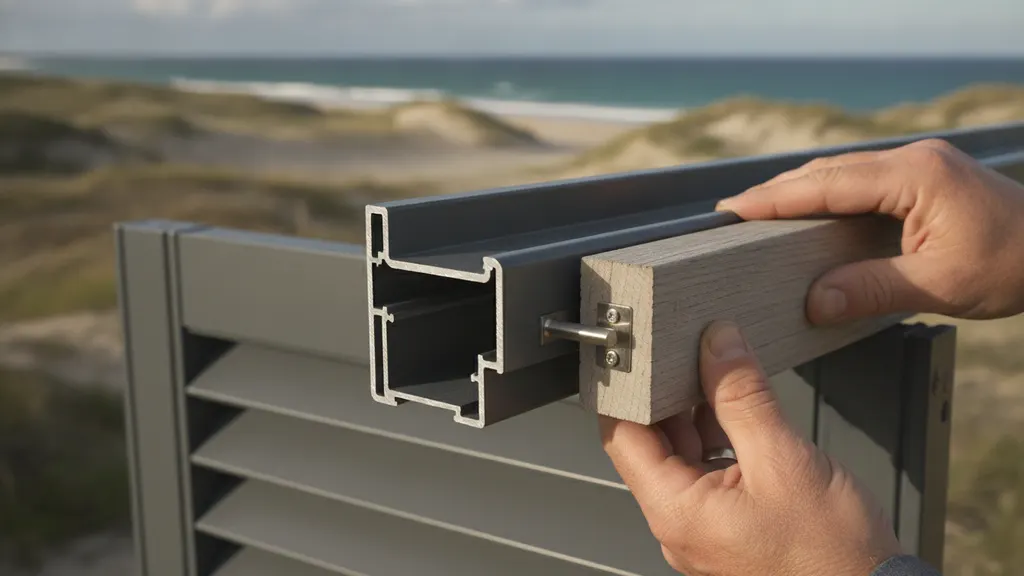
Timber still earns its place. A painted basswood shutter in a bedroom or living room set back from the weather gives the look that a beach house usually wants, and that is the same thinking behind Hamptons style window treatments for coastal NSW. Push timber into a bathroom, a laundry or an exposed stairwell and the finish goes first, which is why moisture-resistant bathroom shutters are a separate product line. Research on material performance in aggressive environments, including the work published by CSIRO on materials and manufacturing, keeps landing on the same conclusion: the substrate matters less than the coating and the fixings that hold it there.
What hardware and finishes should coastal homeowners specify?
Specify the metal before the colour. Hardware is where most shutter specifications on the NSW coast quietly fail: blades can outlive hinges by 10 years or more, and a seized track or a corroded lock body makes a sound shutter useless. Write the alloy grade and the coating system into the order, not the invoice.
Ask for four things in writing: the stainless grade for every fastener, hinge pin and track screw; the powder coat system and whether it carries a marine-rated warranty; isolation between dissimilar metals so a steel bracket is not bolted to an aluminium frame; and a fixing detail into the wall that suits the exposure of that elevation. That hardware schedule for coastal window shutters Australia jobs usually adds less than 5 percent to the total job cost. Guidance on specifying durable external work from Master Builders Australia treats that detailing as part of the build, not an extra. Locks and motors deserve the same scrutiny, which is covered in our guide to security shutters for NSW homes. We measure and quote on site so the metal schedule matches what the wind is actually doing at your openings.
How do you maintain coastal window shutters Australia through a Sydney summer?
Maintenance near the coast is simple and non-negotiable. Fresh water, a soft brush, a dry cloth, and a look at the coating edges every three months within 1 km of the surf. Owners of shutters near the NSW coast who rinse salt off hardware get years more service than those who wait for a sticking panel.
Run the same routine on every exposed opening: hose the frame and tracks, brush the hinge barrels, wipe dry, then check the bottom rail and any chipped coating and touch it up. Salt that is rinsed away does nothing. Salt that cycles through wet and dry phases lifts coatings from the edge inward. Our plantation shutters cleaning guide covers the indoor version of the same job. Keeping external shutters working also keeps their shading benefit through summer, and both Sustainability Victoria guidance on window coverings and the Australian Government energy.gov.au household advice on window coverings make the same point: stopping heat outside the glass beats fighting it inside. Humidity swings on the coast also mean checking that internal timber panels still swing clean, something buyer research published by Canstar Blue on window furnishings ranks high in long-term satisfaction.
Frequently asked questions
Do window shutters rust if you live near the beach?
Plated steel screws, mild steel brackets and unsealed fixings will corrode within sight of the water, and they take the whole panel down with them. Blades are the durable part: powder-coated extruded aluminium and PVC do not rust at all. The fix is a metal schedule written before fabrication, which is why coastal window shutters Australia buyers should price hardware separately from blades. The Your Home materials section on durability and exposure sets out how exposure shapes material choice, and a seaside elevation sits at the harsh end of that scale.
Is 316 stainless steel worth the extra cost over 304?
Near salt, yes. The Australian Stainless Steel Development Association identifies molybdenum-containing 316 stainless steel as more resistant to chloride exposure than 304 stainless steel, and chlorides are exactly what onshore wind delivers to your hinges. The cost difference applies to a handful of small parts: fasteners, hinge pins, track screws and lock bodies. Replacing a corroded hinge set later costs more in labour than the upgrade costs at order time. Materials research published by CSIRO on alloy performance in aggressive environments backs the same logic: hardware is the smallest part of the job with the largest consequence.
How far from the ocean do I need marine grade shutter hardware?
Distance alone does not settle it for coastal window shutters Australia projects. A house 2 km inland on a bare ridge with a steady onshore breeze can collect more salt than a sheltered house 400 m back behind a dune and a row of banksias. Prevailing wind direction, terrain and whether surf is breaking all change the answer, and long-term wind records from Bureau of Meteorology Climate Data Online show how persistent those onshore patterns are on the NSW coast. Classify the site, then specify. Guessing from a map is how hardware gets under-specified.
Can I put timber plantation shutters in a beach house?
Yes, in rooms set back from the weather and not exposed to driven spray. Painted basswood behaves well in a bedroom or living room with normal ventilation. It is the wrong pick for a bathroom, a laundry, an exposed stairwell window or any external application on a windward wall, where humidity swings and salt attack the finish before the timber. Buyer research published by Canstar Blue on window furnishings covers the material trade-offs across blinds, shutters and curtains. The rule on site is simple: timber for sheltered interiors, aluminium and PVC wherever the weather reaches.
How often should coastal shutters be cleaned?
Quarterly for anything outside or within a block of the surf, and twice a year further back. Rinse tracks, hinges, locks and the bottom rail with fresh water, dry them, then check for coating chips and touch them up. Salt that is washed off does nothing; salt left to cycle through wet and dry phases pulls coatings apart from the edges. Keeping the mechanism working also keeps the shade benefit, and Sustainability Victoria guidance on window coverings explains how closed external coverings cut heat gain. A hose and ten minutes beats a replacement order.
Do external aluminium shutters handle coastal wind?
Purpose-built external shutters and zipscreens are engineered for wind load, which is more than most internal products are asked to do. The parts that matter are the guide channels, the locking mechanism and the fixings into the wall, and those should be specified to the exposure of the elevation rather than copied from an inland job. Stopping heat before it reaches the glass is the other benefit, and Australian Government energy.gov.au household guidance on window coverings explains why external shading outperforms internal shading. Ask for the wind rating and the fixing detail in writing.