Shutters · 16 min read
Bathroom shutters Australia: moisture-resistant window solutions
Chris & Campbell · 30 September 2026
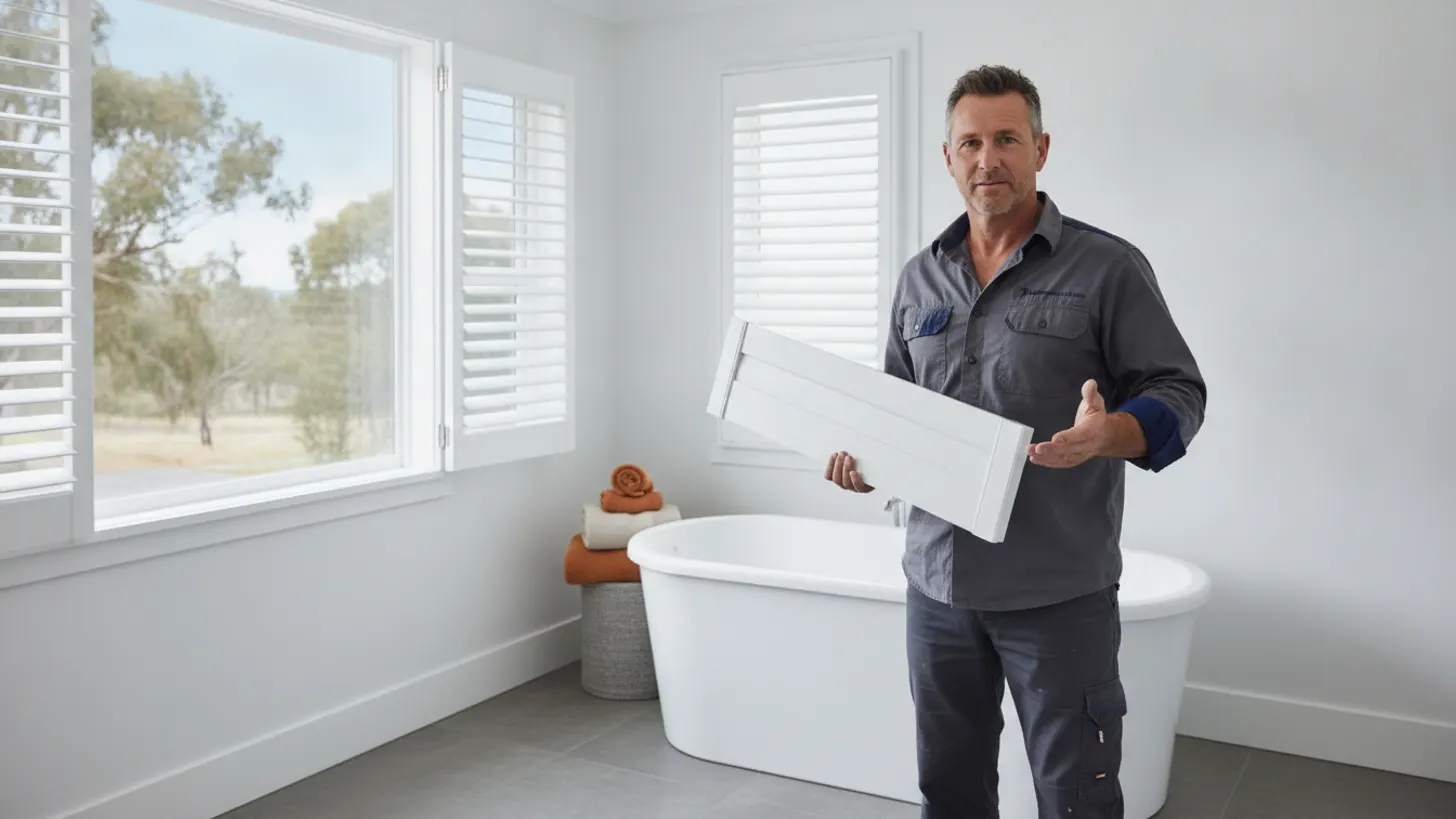
“Will shutters actually survive a bathroom?” It is the first thing homeowners ask when we measure an ensuite. The short answer is yes, if you pick the right material and keep the ventilation working. Raw timber swells and delaminates in a hot shower room; quality PVC and aluminium do not. That one decision separates bathroom shutters Australia homeowners keep for the long haul from panels that warp after two humid summers.
Do bathroom shutters Australia buyers need special materials for humid NSW rooms?
Yes, provided the material suits a wet area. A bathroom swings from dry to saturated several times a day, so the frame and the louvres have to cope with steam, splashing and repeated wiping. That rules out raw timber and points you at PVC, polyresin over an aluminium core, or powder-coated aluminium.
Inland New South Wales makes the job easier than the coast. Records published through the Bureau of Meteorology climate data service show inland districts sit drier for most of the year than coastal Sydney or the Far North Coast, so how much moisture a wet-area shutter has to shrug off changes with the postcode. In the Riverina the risk is rarely ambient humidity. It is the short, intense burst of steam from a hot shower in a small room with the door shut and the fan off.
That burst matters because of how wet areas are classified. The Australian Building Codes Board identifies wet areas as locations where building materials and finishes need to withstand moisture exposure. A shutter is not a waterproofing element, but anything mounted a metre from a shower rose lives under the same conditions as the wall behind it. When we measure and quote an ensuite, the first questions are how far the window sits from the shower and whether the glass takes direct spray.
There is a full breakdown of this topic in Acoustic shutters Australia: reduce outside noise in NSW homes.
There is a full breakdown of this topic in Motorised shutters Australia: smart home control for NSW homes.
We cover the details separately in Plantation shutters home value Australia: NSW resale guide 2026.
We cover the details separately in Layering window treatments Australia: curtains and blinds for NSW.
We cover the details separately in Bamboo blinds Australia: natural woven wood window treatments NSW.
We cover the details separately in French door shutters Australia: NSW guide to sliding and hinged doors.
We cover the details separately in Can landlords install shutters for rental properties Australia? NSW law explained.
We cover the details separately in Hamptons style window treatments Australia: coastal NSW guide.
We cover the details separately in Apartment window shutters Australia: strata approval guide NSW.
We cover the details separately in Arched window shutters Australia: custom solutions for NSW homes.
Which materials for bathroom shutters Australia resist moisture and mould?
Painted PVC and aluminium win in wet rooms because neither absorbs water. Timber and MDF cores swell, the paint film cracks, and mould settles into the split. Polyresin louvres over an extruded aluminium spine sit in between: a timber look on a core that ignores steam.
Mould needs three things, moisture, a food source and time. PVC and aluminium remove the food source, which is why building science work through CSIRO building and condensation research keeps returning to material selection and drying time rather than cleaning products. Specifying the right substrate for bathroom shutters Australia buyers install in a wet room costs far less than replacing a swollen panel two years later.
| Material | Wet-area verdict | What fails first | Where it suits |
|---|---|---|---|
| Basswood or cedar | Not recommended | Louvre swelling, paint cracking at the blade ends | Dry bedrooms and living rooms |
| Painted PVC (extruded) | Best value choice | Nothing structural; surface scuffs | Bathrooms, ensuites, laundries |
| Polyresin with aluminium core | Strong | Hinge wear on wide panels | Wide bathroom windows, timber-look jobs |
| Powder-coated aluminium | Strong | Coating chips if knocked | Splash zones, outward-facing wet areas |
| MDF or composite board | Avoid | Core swells once water enters an edge | Dry rooms only |
Builder guidance from Master Builders Australia on National Construction Code compliance treats wet-area material selection as a durability question rather than a finish question, and window furnishings sit under the same logic. If you want the substrates compared in detail, our breakdown of plantation shutter materials and the head-to-head on timber versus PVC shutters go further than a table can.
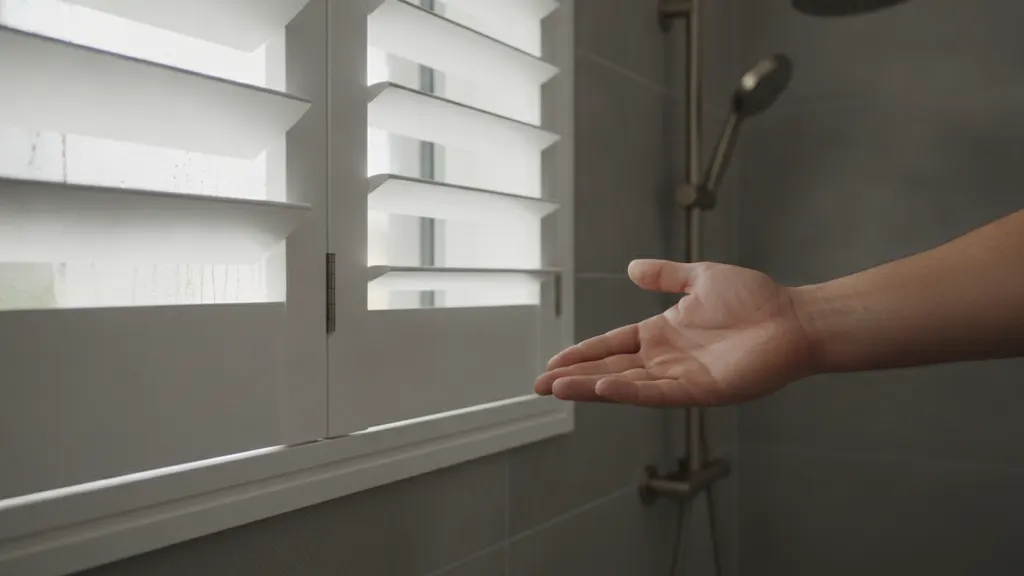
How much ventilation does a bathroom still need with bathroom shutters Australia installed?
All of it. Shutters change how a window looks, not how much air it can move, though they do change how often people bother to open it. The National Construction Code 2022 Housing Provisions require bathrooms to have either natural ventilation through openings or mechanical ventilation meeting the applicable provisions.
If you are relying on the window, the openable area has to be sized against the room. The Housing Provisions set a minimum ventilating area of 5% of the floor area of the room served, so a 6 square metre bathroom needs at least 0.3 square metres of openable window. Fit a panel that stops the sash opening and you have created a compliance problem as well as a comfort one.
Where the window cannot do the work, a fan does. The Housing Provisions set minimum exhaust flow rates by room type, drawn from the mechanical ventilation standard catalogued by Standards Australia, publisher of AS 1668.2: 25 litres per second for a bathroom or sanitary compartment, 20 for a laundry, 40 for a kitchen.
The practical version is the one pushed by Your Home passive design guidance: run the fan through the shower and for a stretch afterwards, then open the louvres once the steam has cleared. Anyone treating bathroom shutters Australia as a set-and-forget fixture ends up trapping damp air against the glass, and that is where condensation and mould start.
Privacy options for bathroom shutters Australia that keep daylight
Angle beats blockout. A closed louvre tilted upward kills the sightline from ground level while still bouncing daylight onto the ceiling, so you get privacy without switching a light on at 7am. That is the main reason shutters outperform a frosted film or a heavy blind in a bathroom.
Three configurations cover almost every bathroom we see:
- Tier-on-tier: two independently hinged panels, so the bottom half stays shut for privacy while the top half opens for air and view.
- Split-tilt: one panel with two louvre sections on separate tilt rods, the neatest option on a narrow ensuite window.
- Cafe style: shutters over the lower half only, with clear glass above, good where the outlook is high and nobody overlooks you.
Daylight is worth protecting. Home comfort guidance from Sustainability Victoria treats natural light and controlled ventilation as part of everyday liveability rather than a luxury. For bathroom shutters Australia specifiers pair with glazing, the strongest combination is obscure or frosted glass in the lower sash plus an adjustable louvre above it. If you want a softer layer as well, the thinking behind sheer curtains for privacy without losing light applies here too, although fabric near a shower adds a maintenance job.
Cleaning and maintaining bathroom shutters Australia over time
A microfibre cloth, warm water and a mild detergent handle a bathroom shutter. Do it fortnightly and it takes five minutes. Leave it three months and soap scum bonds to the louvre face, then somebody reaches for an abrasive cleaner and scratches the coating permanently.
NSW Health recommends controlling indoor moisture and promptly drying damp surfaces to help reduce mould growth. That is the whole maintenance plan in one line. After a long shower, tilt the louvres open and let the frame dry instead of wiping once a fortnight and hoping. Watch the bottom rail and the hinge line, because water pools there first.
Hardware on bathroom shutters Australia installs deserves the same attention as the panel. Stainless steel or marine-grade hinges and magnets belong in a wet room; plain steel will bloom rust inside a year. Anyone buying in a coastal or high-humidity area should ask exactly what the hinge is made of before signing. Our full guide to cleaning plantation shutters lists the products to avoid, and the easy-clean kitchen blinds piece covers the same problem in a greasier room.
Fitting, hardware and the mistakes we see in wet bathrooms
The worst call-back we have had was a Griffith ensuite in March 2025. The previous installer had packed a full basswood tier-on-tier hard against the shower recess with no drainage gap, and eighteen months of steam swelled the bottom two louvres until they jammed shut. Swapping the panel for painted PVC on the same frame cost the owner close to $640 on top of what they had already paid for the timber set. Most of the bathroom shutter failures we get called out for are fitting failures like that one, not material failures on their own.
Four things we check on site:
- Reveal depth, because a shallow tiled reveal usually means a face-fit frame instead of a recessed one.
- Clearance from the shower screen and the tap set, so panels swing without striking glass or spouts.
- Whether the sash still reaches full travel once the frame is installed.
- Drainage and airflow behind the panel, so water landing on the sill can dry.
Plan all of this before the tiler starts if the bathroom is part of a renovation. Household guidance from energy.gov.au makes the same point about window treatments generally: they work best when they are specified alongside the window, not bolted on afterwards.
Bathroom shutters Australia: frequently asked questions
Can I put plantation shutters in a bathroom that has a shower?
Yes, as long as you choose a wet-area material and keep the panel out of the shower enclosure itself. PVC and aluminium-core shutters handle the steam and splash cycle that would swell a timber louvre within a couple of seasons. The Your Home guide published by the Australian Government covers moisture and condensation control in wet rooms, and the advice comes down to material choice plus drying time. Practically: keep the frame clear of the shower screen, run the exhaust fan during and after the shower, and wipe standing water off the bottom rail rather than letting it sit.
Are PVC bathroom shutters actually waterproof?
Water resistant is the accurate word. An extruded PVC panel does not absorb water the way a timber louvre does, so steam, splashes and repeated wiping will not swell it, but no shutter is a waterproofing layer and none should sit inside a shower recess. Materials durability work through CSIRO research programs frames wet-area performance as resistance to repeated wetting and drying rather than a simple waterproof label. For bathroom shutters Australia homeowners buy for an ensuite, PVC or polyresin over an aluminium core gives you that resistance at a sensible price.
Will fitting shutters make a bathroom mould problem worse?
Only if they stop you ventilating. Mould needs moisture and time, so the risk sits with a damp room that never dries out, not with the shutter. PVC and aluminium give mould nothing to feed on, unlike a fabric blind or a swollen timber louvre. Humidity and climate records from the Bureau of Meteorology show how much ambient moisture varies between coastal and inland New South Wales, which changes how fast a bathroom dries on its own. Tilt the louvres open after showering, keep the fan running long enough to clear the steam, and the shutter helps rather than hurts.
Do I still need an exhaust fan if my bathroom window has shutters?
If your bathroom relies on mechanical ventilation, yes, and the fan sizing does not change because you fitted shutters. The National Construction Code 2022 Housing Provisions require bathrooms to have either natural ventilation through openings or mechanical ventilation meeting the applicable provisions, with 25 litres per second the minimum exhaust flow rate for a bathroom or sanitary compartment. Household guidance at energy.gov.au also makes the point that running the fan long enough to clear steam matters as much as the rated size. A shutter that blocks the sash from opening shifts the room onto the fan by default.
How do I clean bathroom shutters without wrecking the finish?
Warm water, a mild detergent and a microfibre cloth, fortnightly. Wipe along the louvre rather than across it, dry the bottom rail, and skip anything abrasive or solvent based, because scratches in a painted PVC surface are permanent and they hold soap scum. Household cleaning product reviews at Canstar Blue give a sense of which cleaners stay mild enough for coated surfaces. On bathroom shutters Australia owners have had for years, the giveaway is a chalky film at the louvre ends where spray landed and dried, which a soft toothbrush lifts without damage.
What is the best privacy setup for a bathroom window facing a neighbour?
Tier-on-tier shutters, or a single panel with split tilt. Both let you keep the lower louvres shut at all times while the upper section opens for air and daylight, which is what people actually want in an ensuite. Pair that with obscure or frosted glass in the lower sash and the privacy survives someone forgetting to close a louvre. Your Home passive design guidance on shading is a useful reminder that blocking a window outright costs you daylight and comfort, so aim for control over the sightline instead of blackout.