Blinds · 16 min read
Skylight blinds Australia: manage heat and glare in NSW homes
Chris & Campbell · 2 October 2026
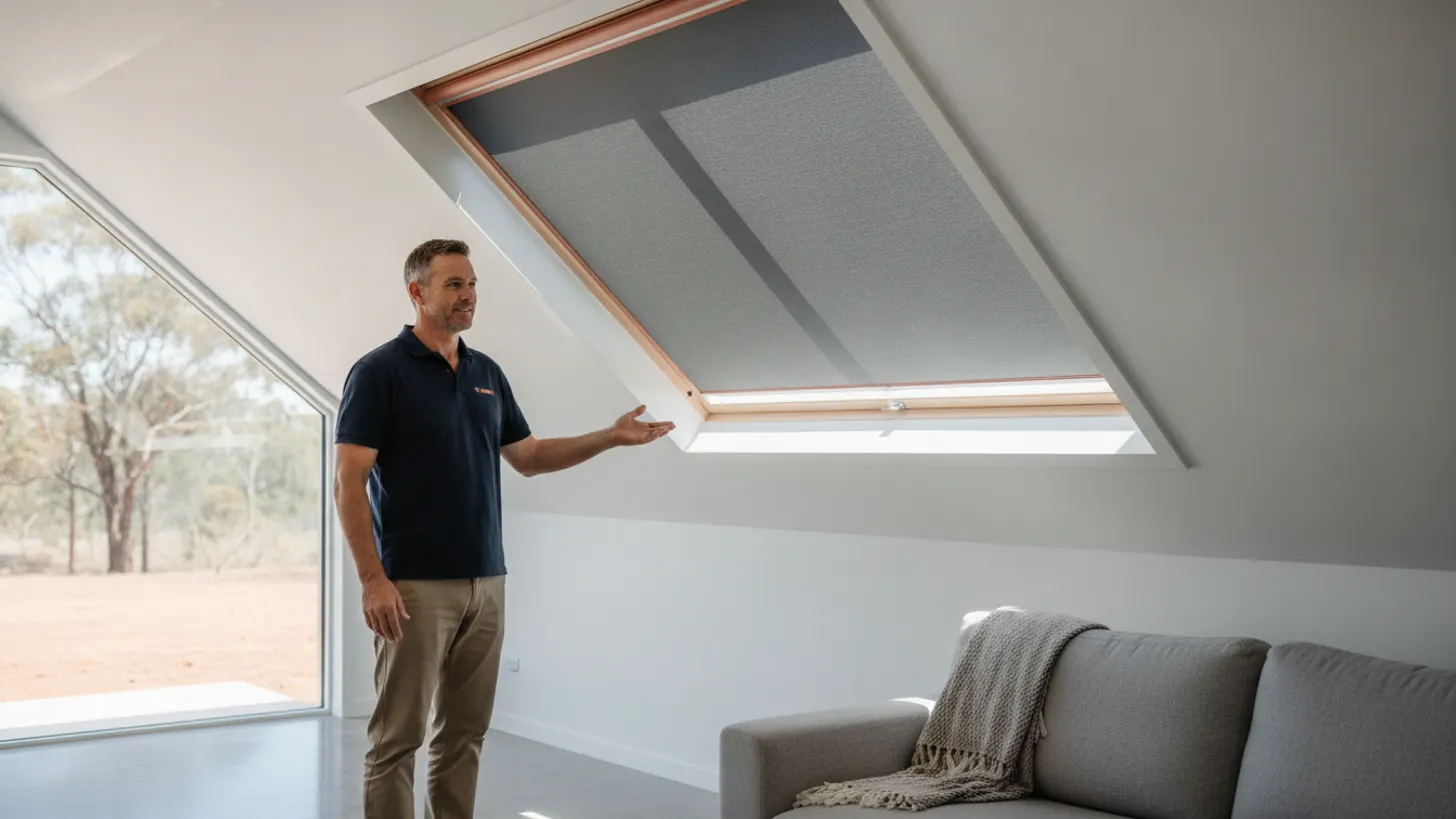
"Why is the loft hotter than the rest of the house by 10am?" That question comes up on nearly every Riverina job with a roof window, and the answer is almost always unshaded glass pointed at the sky. Well-chosen skylight blinds Australia homeowners fit to that opening cut the direct beam before it reaches the room, hold heat at the glass, and give you back a usable space in February.
Why do skylights overheat and glare in NSW rooms?
A skylight overheats because it faces the sky, not the horizon. The U.S. Department of Energy states that skylights can gain more solar heat than vertical windows of the same area, purely because of that roof orientation. High summer sun strikes the glass close to head-on, while a wall window sees the same sun at a glancing angle.
Geometry sets the limit. At about 34 degrees south, the band covering Temora, Wagga and Griffith, the noon sun sits near 79 degrees above the horizon in late December and falls to roughly 32 degrees in late June. Bureau of Meteorology climate records for inland NSW show long summer runs above 35 degrees, so that steep beam lands on the same patch of floor day after day. Glare follows the same path. A living room can be bright enough to wash out a screen at 2pm and still feel dull by 6pm, because all the light arrives from one small, very intense opening.
Hanging heavier curtains on the wall windows does nothing here, because the load is arriving overhead. That is exactly the gap skylight blinds Australia are designed to close, and it is the same reasoning behind our guide to window treatments for Temora's extreme heat and cold: shade the opening that is actually heating the room.
What skylight blinds Australia homeowners choose: fabrics and controls
Two decisions matter: what the fabric does to light and heat, and how you reach the blind. Get the fabric wrong and the room ends up dark but still hot. Get the control wrong and a blind three metres overhead never gets touched, which is the most common failure we are called out to fix, showing up in close to a third of the callouts we do each year.
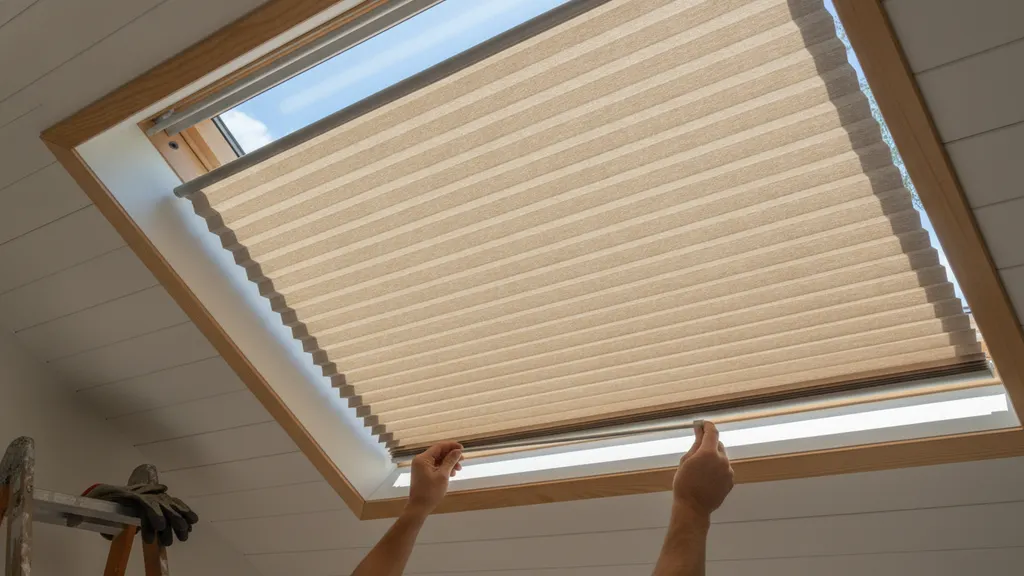
Fabric first. Blockout fabric with a light or reflective outer face stops the beam and the view, which suits bedrooms. Sunscreen mesh cuts a large share of the glare while keeping the sky visible. Openness factor, the percentage of the weave left open, is the number to ask about: it runs from around 1% in a near-blockout mesh to about 14% in an airy weave, so a lower figure blocks more glare and a higher figure keeps more view. Honeycomb fabric adds sealed air cells, the same principle the Your Home glazing guidance describes for slowing heat flow through glass. Among the fabric options skylight blinds Australia suppliers stock, those three families cover almost every brief, and the choice should follow the room rather than the showroom display.
Control comes next. A telescopic pole works on a low-set roof window in a hallway. A crank or geared wand suits a shaft up to about three metres. We learned that limit the hard way on an early Griffith job, fitting a manual chain control on a four-metre shaft the owners could not reach without a ladder; the blind sat open through two summers before they called us back to retrofit a solar motor. Above that, or for anything you want running to a schedule, the practical answer is motorised skylight blinds Australia installers fit with battery, solar or hardwired drives, and the logic we set out for motorised shutters and smart home control in NSW carries straight across to roof windows. Skylights also sit inside the energy-efficiency provisions of the National Construction Code published by the Australian Building Codes Board, so a new opening is assessed on thermal performance, not looks.
We cover the details separately in Cordless blinds Australia: child safety guide for NSW families.
We cover the details separately in Bamboo blinds Australia: natural woven wood window treatments NSW.
We cover the details separately in Layering window treatments Australia: curtains and blinds for NSW.
We cover the details separately in Acoustic shutters Australia: reduce outside noise in NSW homes.
Related reading: Security shutters Australia: privacy and protection for NSW homes.
We cover the details separately in Arched window shutters Australia: custom solutions for NSW homes.
Blockout, sunscreen or honeycomb: comparing skylight blinds Australia options
There is no single winner. Blockout wins on sleep and screen glare, sunscreen wins where you want to keep the sky, and honeycomb wins on heat flow in both directions, the difference that counts once Riverina summers push past the 35-degree runs Bureau of Meteorology records show for inland NSW. The Your Home shading guidance ranks stopping sun before it reaches the glass above any internal fix, so treat fabric as the second line of defence.
| Fabric | Glare control | Summer heat | Winter heat loss | View kept |
|---|---|---|---|---|
| Blockout | Highest | Good with a reflective outer face | Some improvement | No |
| Sunscreen mesh | Moderate to high, depends on openness | Partial | Little | Yes |
| Blockout honeycomb | Highest | Best of the four | Best of the four | No |
| Light-filtering honeycomb | Moderate | Good | Good | Filtered |
Read that table against your room, not a brochure. CSIRO building thermal performance research has long shown that cutting unwanted solar gain does more for summer comfort than adding cooling capacity, which is why fabric that blocks the beam usually beats fabric that only tints it. If insulation is the main goal, our guide to honeycomb blinds and energy savings in NSW goes deeper on cell structure, and it applies directly to skylight blinds Australia buyers compare for lofts and extensions.
How skylight blinds Australia buyers improve bedroom comfort and energy use
A roof window in a bedroom is a sleep problem before it is an energy problem. Summer daylight in inland NSW starts early, and unshaded roof glass puts full light on a pillow well before six. Blockout fabric running in a sealed side channel is what turns that room back into somewhere people can sleep.
The energy side follows the same fabric. Household guidance from energy.gov.au puts shading and glazing improvements ahead of equipment upgrades for cutting summer cooling load, and Sustainability Victoria's home energy material makes the same point about treating glass first. Less heat through roof glass means the air conditioner cycles less often through the afternoon. For families, pair that with the approach in our blackout blinds for a baby room guide, which covers darkness and cordless safety together.
Running costs stay low, because most of the skylight blinds Australia households install are either manual or driven by a small battery motor topped up from a solar panel. Canstar Blue household electricity comparisons are a better guide to what an afternoon of cooling costs you than any figure a window furnishing company could put on it.
There is a full breakdown of this topic in Plantation shutters energy efficiency Australia: NSW heat guide.
Measuring and installing skylight blinds Australia on sloped ceilings
A sloped ceiling is rarely square and a light shaft almost never is. Across our Riverina jobs, roof window openings run out of square by 10-15mm often enough that we measure the top, the middle and the bottom every time, record the smallest figure, and note the pitch. Every millimetre of out-of-square shows up later as a light gap down the edge of a closed blind.
Check the frame type before anything else. Branded roof windows take proprietary blinds that clip into the sash. A site-built shaft with a plasterboard lining needs a face-fixed kit with guide channels or tensioned cables so the fabric holds against the slope instead of sagging away from it. Corded systems within reach of children must meet the internal window covering rules developed through Standards Australia, which is why cordless or motorised is standard for the skylight blinds Australia families ask us to fit in kids' rooms.
On an extension or a new roof, order the blind at the same time as the window. Master Builders Australia renovation sequencing guidance is blunt about retrofitting into a finished lining: it costs more and looks worse. We measure and quote on site across the Riverina so the shaft, the pitch and the reach all land on one order, and our new build window treatment planning guide sets out what to specify first.
Frequently asked questions
Do skylight blinds actually stop heat, or do they only fix glare?
Both, though heat and glare come from different mechanisms. Because a roof window faces the sky, the U.S. Department of Energy notes it can gain more solar heat than a vertical window of the same area, so anything sitting in that beam is doing real work. An internal blind stops the direct beam and the radiant flash off floors immediately. Honeycomb fabric goes further, holding still air against the glass. The Australian Government's Your Home passive design material still ranks external shading as the stronger heat control, with the skylight blinds Australia households fit inside doing the daily light and comfort job.
What is the best skylight blind fabric for a bedroom?
Blockout fabric in a side channel, or a proprietary frame that fits the sash. A bedroom needs the beam gone and the edge light gone, and an unchannelled blind leaks a bright line down two sides that wakes people at dawn. Where the room also runs hot in summer and cold in winter, a blockout honeycomb gives you darkness plus the sealed air cells described in the Your Home insulation chapter, which slows heat moving in either direction through the glass. Choose a light or reflective outer face so the fabric sends some of the sun back out rather than storing it overhead.
Can I add a blind to a skylight I already have?
Usually yes. Branded roof windows from the major manufacturers take proprietary blinds that clip straight into the sash, so the fit is exact and the fabric sits close to the glass. A site-built light shaft is a different job: you face-fix a kit at the ceiling line with guide channels or tension cables that hold the fabric against the slope. Replacing the whole unit is only worth it where the glazing itself is single-glazed and failing, and energy.gov.au household advice is a sound place to weigh a glass upgrade against a shading upgrade before you spend.
Are motorised skylight blinds Australia installers fit worth the extra cost?
It depends on reach, not on gadget appeal. A blind you can touch from the floor with a pole gets used; one three or four metres up a shaft does not, and an unused blind is money wasted. Battery, solar or hardwired drives let you close the fabric before the afternoon peak rather than after the room has already heated, and a timer does it when nobody is home. The running cost of a small blind motor is minor next to cooling, and Canstar Blue household electricity comparisons give you a fairer sense of that cooling cost than any sales sheet.
Will a skylight blind trap heat against the glass and make the room hotter?
Some heat does build between the fabric and the glass, which is why the detail matters. A blind fitted close to the sash with a small air gap and a light or reflective outer face sends a share of the sun back out through the glass instead of storing it in the cavity. An openable roof window helps further, because venting the shaft lets that hot layer escape upward rather than drifting into the room. The Your Home thermal mass chapter applies the same principle to glass and surfaces: control where heat is absorbed, then give it a way out.
Do skylight blinds help in winter as well as summer?
Yes, mainly by slowing heat loss at night. Glass is the weakest part of any roof, and an uncovered skylight sheds warmth all night through a Riverina winter, which is why rooms with roof windows feel cold by morning even with the heater running late. A closed honeycomb blind traps air against the glass and cuts that loss. During the day you want the opposite: open the blind and let the low winter sun in, the free heating set out in the Your Home passive solar heating chapter. Manual or scheduled control makes that routine realistic.