Exterior Window Furnishings · 16 min read
Outdoor window shutters Australia: weather protection for NSW homes
Chris & Campbell · 4 November 2026
"Will anything actually stop the heat before it hits the glass?" That is the first question we get on a Temora or Wagga verandah in January. The honest answer: outdoor window shutters Australia wide work because they block the sun outside the window, not after it has already warmed the room. Get the material and the fixing right and an exposed western window stops being the hottest spot in the house.
What types of outdoor window shutters Australia suit NSW sun, wind and rain?
Four families cover almost every job we quote: aluminium plantation-style panels, hinged Bahama shutters, sliding or bi-fold screens, and roller shutters in a guide track. On an exposed Riverina gable we run brackets as tight as 450mm apart rather than the 600mm used on a sheltered wall, because each family handles sun, wind and rain differently, so wall exposure decides the pick.
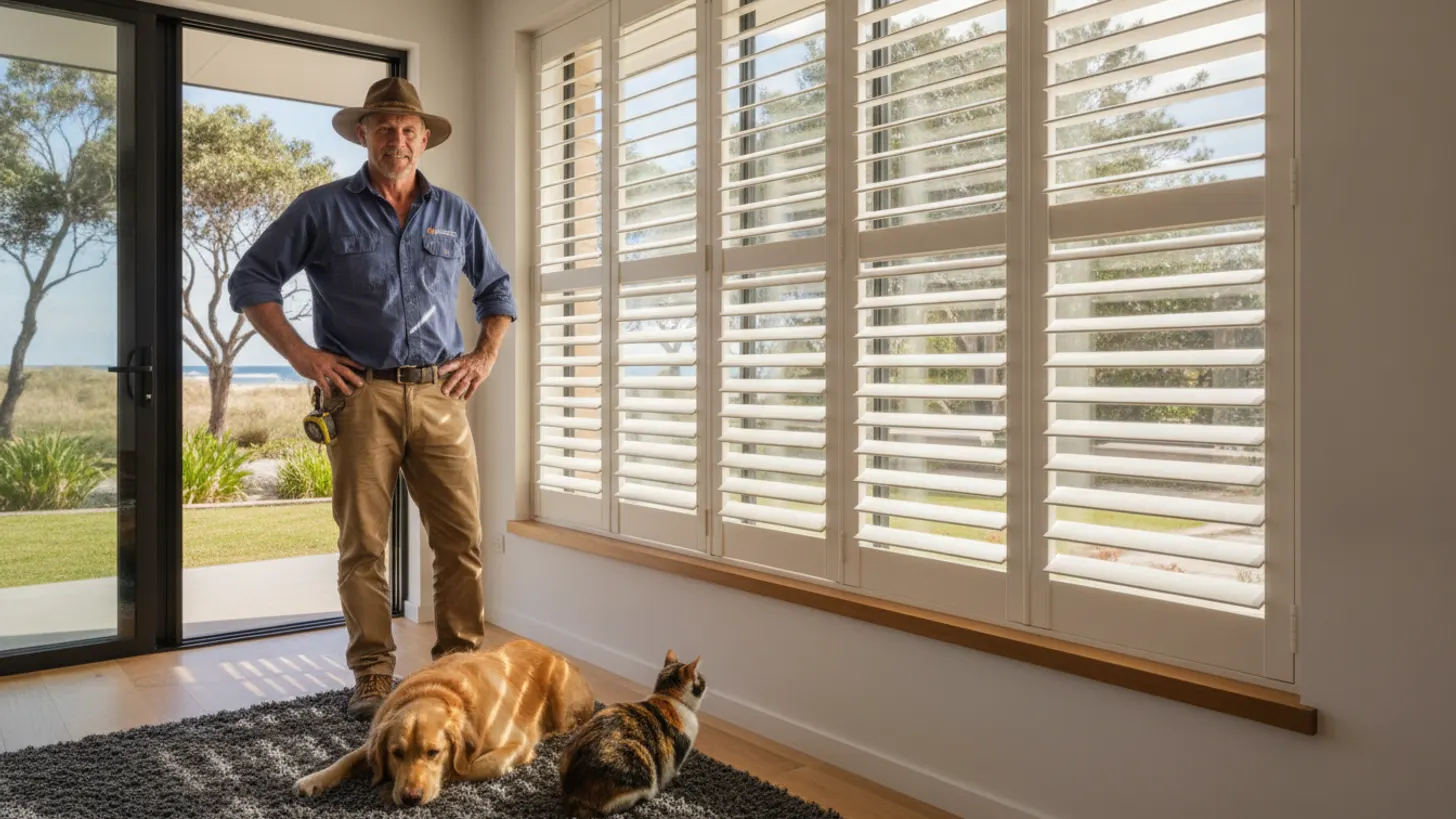
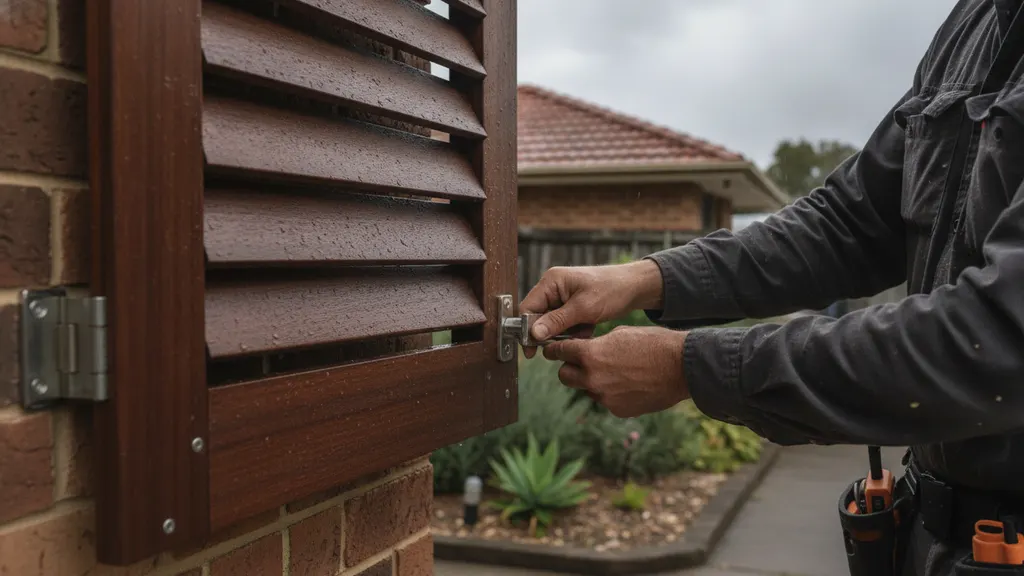
Aluminium plantation-style panels are what most people picture when they search for outdoor window shutters Australia: wide blades set in a frame, hinged or sliding, angled to cut the sun while air still moves through. On a north or west wall in the Riverina that airflow matters as much as the shade, because a sealed panel pressed hard against glass traps a pocket of hot air right where you do not want it.
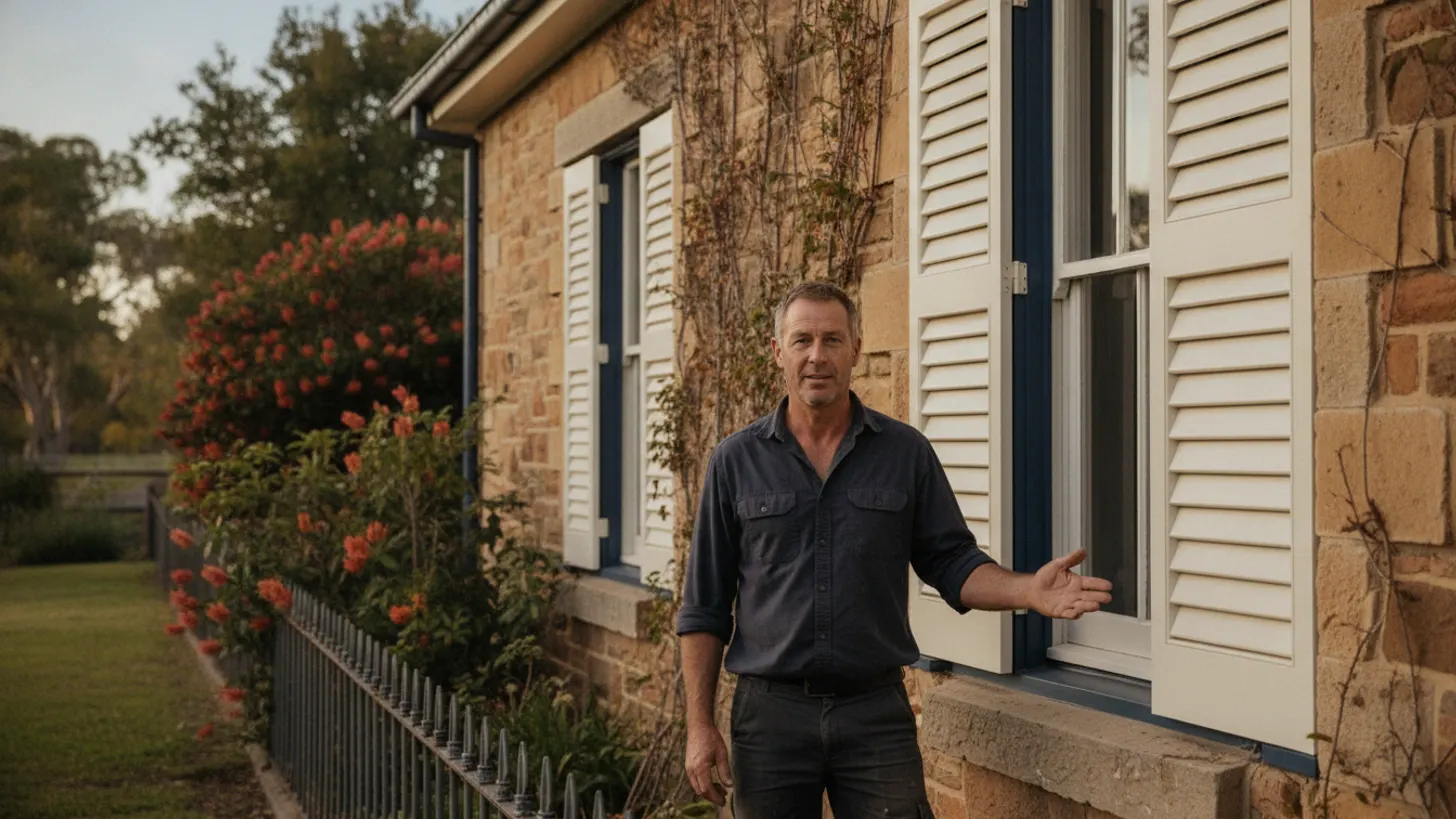
Bahama shutters hinge at the head and prop out over the opening, shedding rain and holding permanent shade without killing the view out. Sliding and bi-fold screens suit wide verandah and entertaining openings where you want the whole span open in April and shut in January. Roller shutters sit in side guides and close fully, the only group here that also works as a lock-up and a night-time heat barrier. Most homes end up mixing two of these, which is normal for a Temora or Wagga job.
How hard a shutter has to work depends on the UV you actually get. ARPANSA sets the trigger for sun protection at a UV Index of 3 or above, and the ARPANSA UV Index and sun protection advice treats that level as the point where exposure starts doing damage. The UV Index itself is just the 0-to-11+ scale weather services use to rate how strong the sun's ultraviolet radiation is on a given day. The Bureau of Meteorology daily UV forecast for NSW publishes those readings for Australian locations, Riverina towns included, so you can count how much of your year sits above the threshold before spending a dollar on hardware.
There is a full breakdown of this topic in Heritage home shutters Australia: sympathetic window upgrades.
We cover the details separately in Pet-friendly shutters Australia: safer windows for dogs and cats.
How outdoor window shutters Australia differ from interior plantation shutters
The difference is where the heat gets stopped, and on a west-facing pane in January that gap can run 15-20°C between the glass and the room air. Interior shutters filter light after the sun has already crossed that glass. Outdoor window shutters Australia homeowners fit to west-facing rooms intercept it first, which is the whole point.
The YourHome passive design shading guidance explains that external shading reduces solar heat entering windows before it reaches the glass. Internal coverings cannot do that, so we talk through both sides when a client is weighing interior plantation shutters against an external screen. Our guide to plantation shutters and energy efficiency in NSW heat covers the inside half of the trade-off.
Build quality differs too. The outdoor window shutters Australia suppliers make for exterior duty carry thicker blades, heavier stiles, UV-stable powder coats, drainage in the bottom rail, and hardware rated for weather rather than for a lounge room. Interior basswood will cup and split within a season on an exposed wall. The two products look related in a brochure and are not the same thing on site.
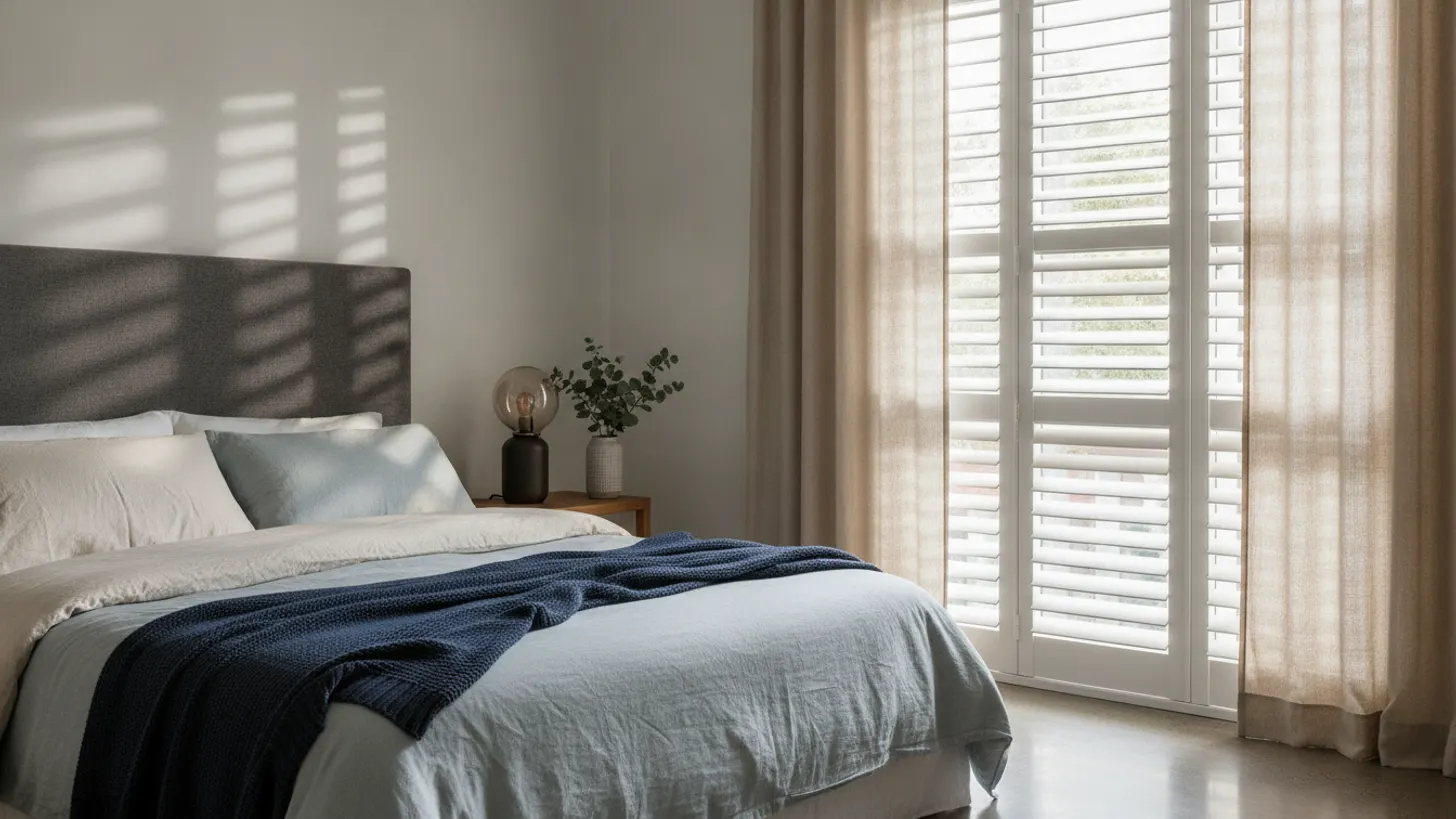
Related reading: Bedroom plantation shutters Australia: privacy and light control.
Which materials keep outdoor window shutters Australia from fading and corroding
Powder-coated extruded aluminium does most of the heavy lifting outdoors, and a good powder coat on a west wall typically runs 12-15 years before it chalks, well past paint on timber in the same spot. Composites and timber still have their place, but the rule we apply when specifying outdoor window shutters Australia is plain: match the finish to the exposure of that one elevation, not to the house as a whole.
Fading and corrosion are the two failure modes behind most warranty calls on outdoor window shutters Australia jobs. Fading comes from UV breaking down the coating, which is why a high-durability powder coat earns its cost on a west wall. Corrosion comes from salt and moisture sitting on untreated fasteners. CSIRO research into materials weathering in Australian conditions is the background on how coatings and substrates degrade under this kind of exposure, and it is why we will not put a standard-grade fastener on a job near the water. We saw the payoff on a Griffith re-fit in March 2024, where swapping cupped, ten-year-old timber shutters for powder-coated aluminium on the same bracket spacing brought that west bedroom's afternoon glass-side reading down from a measured 42°C to 31°C within the first week. If salt air is your issue, our corrosion-resistant coastal shutters guide has the full spec.
| Material | Outdoor performance | Best NSW fit | Watch for |
|---|---|---|---|
| Powder-coated extruded aluminium | Holds shape and colour under high UV | Exposed north and west walls | Coating grades vary, ask which one |
| Marine-grade aluminium with stainless hardware | Best corrosion resistance | Coastal and estuary sites | Costs more than standard grade |
| uPVC and composite | Unaffected by moisture | Sheltered wet areas, verandah returns | Can soften under long full sun |
| Western red cedar and hardwood | Looks superb, needs upkeep | Shaded south and east elevations | Recoating cycle on hot walls |
| Perforated aluminium screen | Shades while keeping airflow and view | Entertaining areas and screening | Less night privacy than solid blades |
Can outdoor window shutters Australia improve privacy and reduce solar heat gain?
Yes to both, with a caveat about night privacy. Even on a UV Index 8 day, the heat benefit from angled blades or a perforated screen is immediate, and the sight line from the street drops during daylight while you still see out. After dark a lit room reverses that, so only solid blades or a closed roller give full cover.
On heat, the mechanism is the one YourHome describes: stop the sun outside the glass. That is why outdoor window shutters Australia homeowners fit over west-facing living room glass do more for afternoon comfort than any internal treatment at the same window. Adjustable blades let you dump heat in January and pull winter sun in July, which a fixed awning cannot do.
If security is part of the brief, a roller shutter closes the opening completely and reads as a physical barrier from the footpath. Privacy, shade and security overlap more than people expect, and our security shutters guide for NSW homes covers where paying for that overlap makes sense.
Installing outdoor window shutters Australia wide: what to plan for before we measure and quote
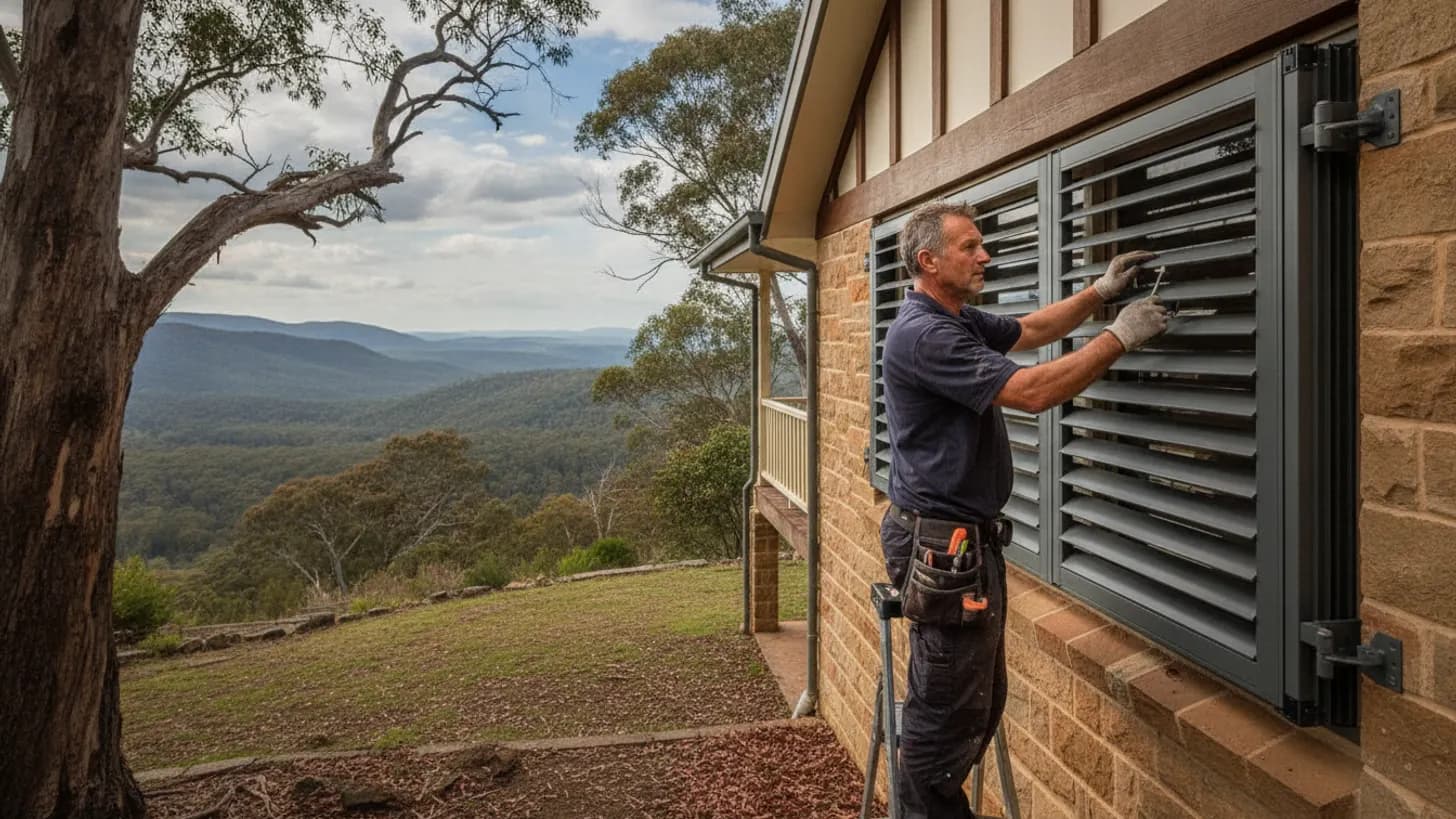
Three things decide an install: what the wall is made of, how you reach it, and what the wind does to it, and on an exposed Riverina block that can tighten bracket spacing from a standard 600mm down to 450mm. We work those out on site, because the fixing detail for installing outdoor window shutters Australia wide changes between brick veneer, rendered block and lightweight cladding.
Clearance and drainage come next. A hinged panel needs swing room past downpipes, meter boxes, taps and flyscreens. A roller needs headbox space above the reveal, or a recess built in. Water has to run off and away rather than pool in a bottom rail. Our measuring and fitting guide walks through the checks we run before anything gets ordered.
Wind load sets bracket spacing and maximum panel size, and there is no arguing with it on an exposed rural block. If your property sits in a bushfire prone area, the shutter spec interacts with your BAL rating, short for Bushfire Attack Level, the scale that sets how much radiant heat and ember attack a building element has to withstand, which our BAL ratings and NSW compliance guide sets out.
Upkeep is light but real: rinse the panels, wipe the tracks, check the hinges and stays, twice a year for most homes. Skipping it rarely breaks anything quickly. It just makes a ten-year product look five years older than it is.
Frequently asked questions
Do outdoor shutters really keep a room cooler than inside blinds?
Yes, and the reason is physics rather than marketing. An external shutter puts a barrier between the sun and the glass, so most of that heat is absorbed and re-radiated outside the building. An internal blind only slows heat that has already crossed the glass line. YourHome shading guidance from the Australian Government makes the same point, putting external shading ahead of internal treatments for summer heat control. On a west-facing bedroom window in Wagga the difference shows up through the afternoon, when the glass stays cool enough to put your hand on.
What material lasts longest on an exposed NSW wall?
Powder-coated extruded aluminium with stainless steel hardware is the default for exposed walls across the Riverina. It will not swell after a storm, it is not termite food, and a good powder coat holds colour under high UV far longer than paint on timber. Timber still earns its place on shaded southern and eastern elevations where the look carries the room. Sustainability Victoria window coverings guidance is a useful read on matching the covering to the exposure rather than to the showroom photo. Closer to salt air the spec changes again, to marine-grade coatings and fixings.
Can outdoor shutters be fitted to brick veneer or rendered walls?
Yes, but the fixing detail changes with the substrate. Brick veneer needs the load taken into masonry with the right anchors, not into a render skin. Lightweight cladding usually needs packers or a sub-frame fixed back to studs or noggings. Rendered blockwork is straightforward once you know what sits behind it, which is why we check the wall build-up when we measure and quote rather than guessing from a photo. That same wall build-up check is what tells us when a job needs a licensed trade rather than a handyman fix, well before anyone picks up a drill.
How much maintenance do external shutters need each year?
Less than most people fear, and more than nothing. A fresh water rinse clears the salt, dust and pollen that dull a powder coat, and a wipe through the guide tracks keeps rollers running without binding. Hinges, stays and locks want a look over and a light lubricant at the same time. Upkeep differs between product types too: aluminium tolerates a missed clean far better than timber, so match the routine to what is actually on your wall. Twice a year suits most Riverina homes, and more often on dusty paddock frontages or within sight of the water.
Will outdoor shutters cut my summer power bill?
They cut the cooling load, which is the part of the bill shading can actually touch. Stopping sun before it hits the glass lowers the peak heat your air conditioner has to fight through the afternoon, so the unit cycles less at the hottest part of the day. Australian Government advice on energy.gov.au about reducing cooling load puts shading of east and west glass near the top of the list. The saving depends on your glass area, orientation and how you run the house, so we will not put a percentage on it for you.
Do I need council approval or a wind rating for exterior shutters?
Wind loading matters everywhere, and approval depends on your site. External shutters and screens are fixed to the building and have to stay there in a gust, so bracket spacing and panel size follow the wind loading standard AS/NZS 1170.2, published through Standards Australia. AS/NZS 1170.2 is the joint Australian and New Zealand standard that sets the wind actions a fixed structure like a shutter bracket has to survive. Heritage items, strata schemes and bushfire prone designations can add a planning step on top of that. Councils across the Riverina read these differently, so we check your lot before quoting rather than after. A short call to your council planning desk usually settles the question in minutes.