Window Coverings · 15 min read
Venetian Blinds Australia: Timber, Aluminium or PVC Compared
Chris & Campbell · 24 July 2026
Sydney logs around 2,636 sunshine hours a year in Bureau of Meteorology climate averages, which puts sustained UV load on every slat that hangs behind a window. Choosing between timber, aluminium, or PVC venetian blinds Australia wide comes down to more than looks alone. Slat material decides how the blind copes with heat, humidity, and 15 years of daily cord pulls. This guide breaks down the three options the way we measure and quote them on site across the Riverina.
What are the main types of venetian blinds Australia homeowners choose?
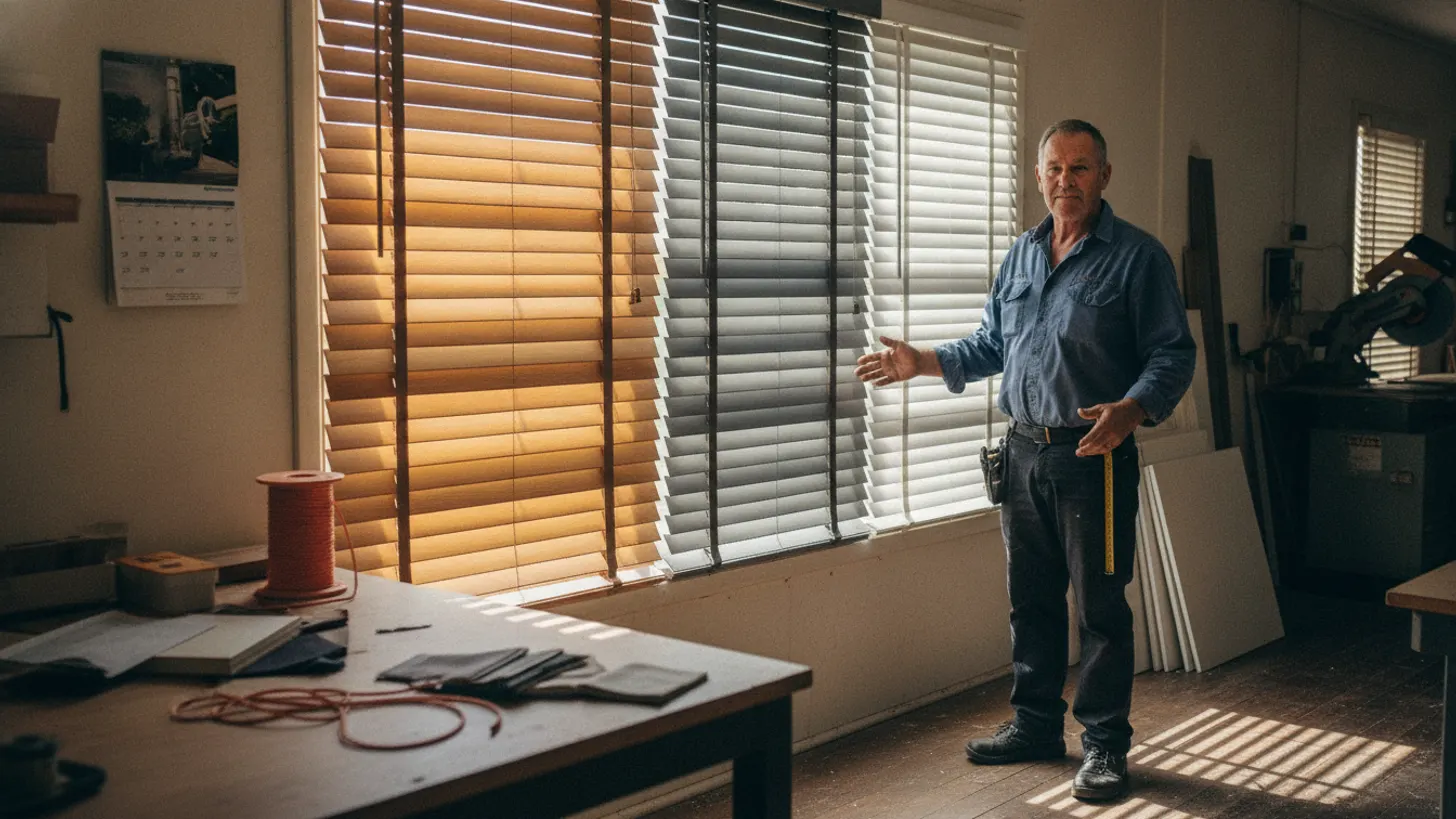
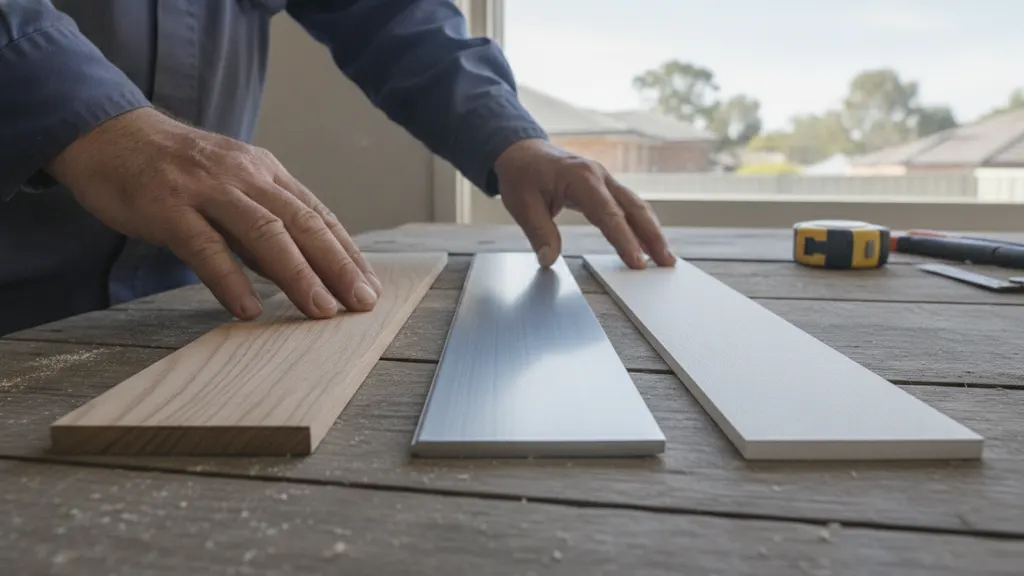
Australian window fitters quote three slat families across the venetian blinds Australia market: real timber (mostly basswood or western red cedar), extruded aluminium, and PVC, also called faux-wood or polymer. Canstar Blue's window furnishings category data shows aluminium commands the largest share by unit volume in Australia, with PVC closing the gap on timber year on year. Each slat type sits at a different price and durability point, and each behaves differently under NSW sun and Riverina humidity swings.
Basswood is the workhorse timber. It is light enough to hold 63mm and 89mm slats without sagging, takes stain evenly, and matches most floor palettes without argument. Cedar is denser, holds finish longer under UV, and adds 20 to 30 per cent to the material cost. Real timber is still the choice for bedrooms, studies, and formal living rooms where the tactile look matters.
Aluminium slats come in 16mm, 25mm, and 50mm widths. The 25mm micro-slat is the old office look that still wins in laundries, garages, and rental kitchens because it wipes clean in seconds and refuses to warp. The wider 50mm profile softens the industrial edge and reads more like timber from a few metres away.
PVC slats copy the width and profile of timber at roughly half the price. According to Canstar Blue's window furnishings category, PVC has taken share in the Australian retail blind market as buyers demand a timber look without the timber budget. PVC is not maintenance-free but it laughs off humidity in a way basswood cannot.
Timber vs aluminium: humidity performance in NSW rooms
Short answer first: aluminium wins in wet rooms, timber wins in dry rooms, and PVC sits in the middle for both. Aluminium venetian blinds carry a typical product life of 15 to 20 years in humid conditions compared with 10 to 15 years for untreated timber slats in the same environment, based on manufacturer service data. Choosing venetian blinds Australia wide should start with room type, not slat colour.
In a Wagga bathroom with a shower running twice a day, we would not fit basswood at all. Even with a factory poly-lacquer, moisture drives micro-cracks along the grain within four to six years, and once the finish lifts, the slat is done. Aluminium tilts and lifts through the same duty cycle without complaint. For a full audit of moisture-safe options, see our guide to bathroom blinds Australia moisture resistant.
Aluminium has one downside: heat transfer. In a north-facing living room with double-brick walls, aluminium slats can hit 55 degrees on a January afternoon and radiate warmth back into the room. YourHome shading guidance from the federal government notes that reflective external shading works better than internal slat blinds for solar heat control. Timber slats stay cooler to the touch but let the same solar load in through the glass.
Choosing slat width by room size and ceiling height
Slat width changes the whole feel of a room. Narrow 25mm slats disappear at the head and stack tight. Wide 63mm and 89mm slats read as a design feature, close down to almost full block-out, and match the sightlines of plantation shutters. Pick slat width off ceiling height first, then window width. For venetian blinds Australia wide, 50mm is the safe default across NSW project homes with 2.4m ceilings.
For standard 2.4m ceilings, 50mm slats stack to roughly 110mm at the head, which clears most reveal depths without cutting into daylight. Bump up to 63mm on 2.7m and taller ceilings; the room absorbs the extra width without looking busy. Reserve 89mm slats for feature windows in double-height voids, entry rooms, or heritage properties with tall sashes.
Window width matters too. On sliding doors over 2400mm wide, tilt rods on 50mm slats can bow under gravity. Split the blind into two panels or step up to 63mm slats with a heavier ladder tape. For the plantation-shutter alternative in the same rooms, our home office window treatments notes lay out the tradeoffs on glare and privacy.
Light control and privacy: how slat tilt works
Venetian blinds beat roller blinds on precision light control. A 45-degree downward tilt cuts direct glare to under 15 per cent of incident solar load while keeping the view open, something a single-layer roller blind cannot replicate without a second blind in the stack. In a home study or a west-facing living room, that fine-grained daylight-versus-glare control is why fitters keep specifying venetians over cheaper roller options.
Privacy depends on which way you close the slats. Concave-down, meaning the bowl of the slat faces the floor, blocks upward views from the street and works best on ground-floor windows. Concave-up blocks views from a first-floor neighbour looking down. Most people set slats concave-down by day and reverse at night for full block-out with the room lights on.
Australia's cord-safety framework matters here too. Every corded venetian blind sold in Australia must meet the ACCC Consumer Goods (Corded Internal Window Coverings) Safety Standard 2014. Related product standards are published by Standards Australia. That precision of tilt is why venetian blinds Australia buyers keep choosing them over rollers year after year.
What quality venetian blinds Australia cost in NSW in 2026
Across the venetian blinds Australia market in 2026, aluminium 25mm installs at $180 to $260 per square metre supplied and fitted; basswood 50mm sits at $380 to $520/sqm installed, a $200/sqm gap that comes down almost entirely to slat material. What moves the final number beyond that: room count, stair access, motorisation, and a freight premium that runs higher inland than in metro Sydney. The ranges below align with Canstar Blue's window furnishings pricing for the wider NSW retail market and are supply-and-install figures, not sticker prices; they will move with aluminium, timber, and freight costs through the year.
| Material | Installed range per sqm | Best fit |
|---|---|---|
| Aluminium 25mm | $180 to $260 | Kitchens, garages, rentals |
| PVC 50mm | $260 to $380 | Bathrooms, humid rooms, budget living |
| Basswood 50mm | $380 to $520 | Bedrooms, studies, formal living |
| Basswood 63mm/89mm | $480 to $620 | Tall-ceiling feature windows |
| Cedar wide-slat | $580 to $780 | Heritage homes, premium builds |
Extras that move the number: motorisation typically adds $250 to $450 per blind, decorative tapes add 8 to 12 per cent, and mid-rail rope-and-tape systems add another 10 per cent to the material cost. The federal energy.gov.au smart-home guidance is worth a read if you are budgeting motorisation into a new build.
For a Temora bathroom or a Wagga kitchen, aluminium usually wins on total cost of ownership because it will still be operable at year 15. Basswood in the same room is often replaced by year eight. That seven-year replacement gap almost always offsets the material saving when quoting venetian blinds Australia wide. Regional install notes at window treatments for Temora extreme climate cover the specific hardware we use inland.
Frequently asked questions
Are venetian blinds Australia wide legal to install with corded controls?
Yes, corded venetian blinds remain legal to sell and install in Australia provided they meet the Consumer Goods (Corded Internal Window Coverings) Safety Standard 2014, which the ACCC enforces. Every blind must ship with a cleat, cord-tensioning device, or breakaway connector so that cords cannot form a loop within 1.6 metres of the floor. The installer must fix the cleat during installation, not leave it in the box. For homes with young children, we recommend cordless or motorised operation. See our guide to child safe blinds Australia for the full parent checklist.
How often do timber venetian blinds need re-oiling in NSW?
Untreated timber slats need a light oiling every 12 to 18 months in most NSW climates, dropping to every 8 to 10 months near the coast where salt air is heavier. Factory poly-lacquered slats, which is what almost all reputable Australian retailers now sell, do not need re-oiling at all; they need a soft microfibre and a periodic wipe with a barely damp cloth. Avoid spray polishes with silicone, which builds a residue that attracts dust. The Bureau of Meteorology climate data service publishes regional humidity averages to help match maintenance intervals to your postcode.
Do aluminium venetian blinds insulate a room in winter?
Aluminium slats alone provide only a small thermal barrier because the metal itself is a conductor. The insulating benefit comes from the closed air layer trapped between the blind and the glass. Closing slats fully at dusk in winter can hold that layer in place and reduce night-time heat loss through single-glazed windows by roughly 10 to 15 per cent. For real insulation gains, pair a venetian with heavy curtains or a honeycomb blind behind. The YourHome glazing guide is the go-to resource for weighing internal window treatments against secondary glazing.
Which slat width suits a small kitchen window?
25mm aluminium is the practical default for kitchen windows under 900mm wide. Narrow slats stack to less than 60mm at the head, which keeps the top of the window clear for cleaning splashback tiles behind, and they wipe down without absorbing cooking grease. 50mm slats work on wider kitchen sliders but can look oversized on standard 600mm by 900mm windows. For hygiene-sensitive kitchens like fish shops or cafes, aluminium is the only material that stays compliant long-term. Our kitchen blinds Australia easy-clean guide covers food-safe finishes in detail.
Can I install venetian blinds inside or outside the window reveal?
Both options work. Reveal-fit (inside the frame) is cleaner visually and lets curtains sit over the top later. Face-fit (outside the frame) blocks more light around the edges and suits reveals shallower than 65mm. On aluminium windows, we drill through the reveal plaster or timber, not the aluminium frame, to preserve any factory seal. On timber reveals, we pre-drill with a 2mm bit to prevent splitting. If the site has render or brick around the window, we use nylon plugs rated for 4kg minimum per fixing. According to Master Builders Australia, correct fixing is the single biggest driver of blind warranty claims.
How long does a full-house measure and quote take in the Riverina?
A typical LuxeShutters measure and quote for a three-bedroom Riverina home takes 60 to 90 minutes. Chris or Campbell will drop by, take exact reveal or face measurements for every opening, photograph any tricky sightlines, and hand over an itemised written quote before leaving. We cover Temora, Wagga, Griffith, and towns in between. Turn-around from ordered to installed is usually four to six weeks depending on slat material and stain choice; PVC is the fastest, cedar the slowest. Independent supplier reviews are aggregated at Canstar Blue.