Roller Blinds · 15 min read
Sunscreen roller blinds Australia: UV and glare control for NSW homes
Chris & Campbell · 19 August 2026
Can you actually see out during the day if you fit sunscreen roller blinds Australia homeowners keep asking about for north- and west-facing rooms? Yes, and you can still cut most of the glare and UV punching through the glass. The trick is matching openness factor to the room's aspect and the view you want to keep. This guide walks through the numbers, the trade-offs, and what to budget across the Riverina and wider NSW in 2026.
What are sunscreen roller blinds Australia homeowners install for hot rooms?
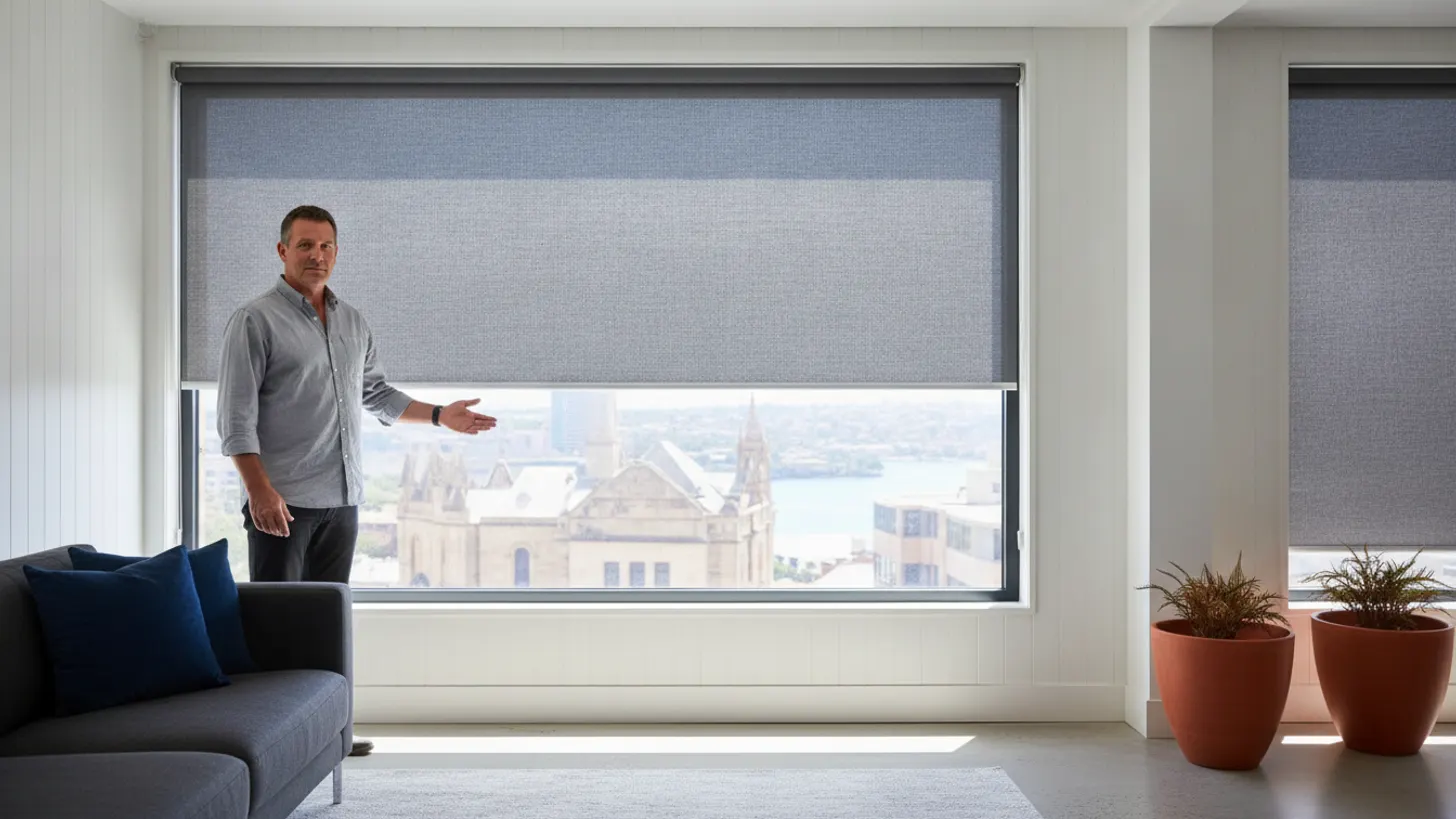
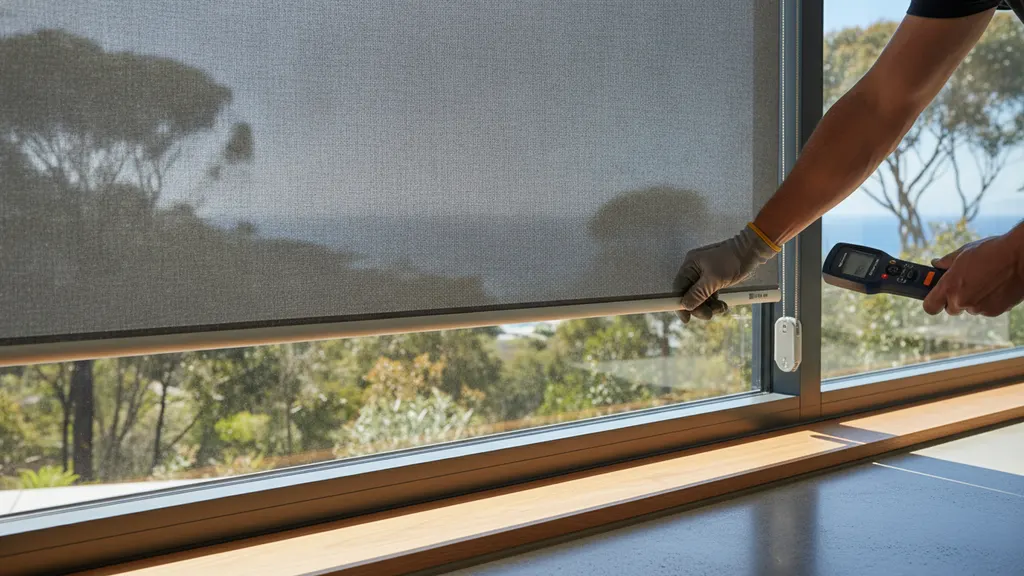
Sunscreen roller blinds are single-layer woven or knitted fabrics on a roller that block up to 99 percent of UV while keeping the outside view. Unlike blockout, the yarn leaves microscopic gaps (the openness factor), so daylight still filters through even when the blind is fully down. Think of it as sunglasses for the window, not a curtain.
The fabric is usually a fibreglass or polyester weave coated with PVC. It is dimensionally stable in heat, does not sag on wide spans, and shrugs off the salt-heavy air we deal with on coastal NSW jobs. Blockout blinds stop 100 percent of light, which is perfect for bedrooms but useless if you want to look at the garden. Sunscreen sits in the middle: solar control without the cave.
For most north- and west-facing living rooms across the Riverina, sunscreen roller blinds Australia buyers ask about first are the 3 or 5 percent openness fabrics because they knock down the harsh afternoon glare without darkening the room. The Your Home government design guide on glazing explains why passive shading pays back fastest on those aspects.
How to choose the right openness factor for your NSW home
Openness factor (OF) is the percentage of open space between the fibres. It runs from about 1 percent up to 14 percent. The lower the number, the tighter the weave, the more privacy and glare rejection you get, and the less you see out. European standard EN 14500 lays out how the fabric is tested and rated.
Sunscreen roller blinds Australia fabricators typically stock four broad OF bands, and these are the rough rules we use when we measure and quote in a home:
- 1-3% OF - maximum privacy and glare control; view is muted but present. Bedrooms with a view, home offices with screen glare, street-facing windows.
- 4-5% OF - the everyday compromise. Clear garden view, still cuts 90 percent of direct view-through from outside. What most Riverina living rooms end up with.
- 7-10% OF - light glare control; best where the view matters most (waterfront, rural outlooks) and privacy is not the priority.
- 10-14% OF - near-sheer, chosen mainly for architectural rooms where the fabric acts as a scrim rather than a solar shade.
At 3 percent OF, the fabric blocks around 97 percent of direct view-through while still passing diffused daylight, per EN 14500 light-transmission test methods. That specification carries the load in glare-heavy west-facing rooms across Wagga and Griffith.
Fabric colour matters too. Light-coloured sunscreen reflects more heat but slightly hurts the outward view; dark charcoal loses a bit of thermal performance but gives a sharper, more transparent look through the fabric. On sun-hammered walls we usually recommend a mid-grey or bronze weave for the best compromise between heat rejection and view clarity.
For a closer look at this, see Home office window treatments: control glare and boost productivity.
Do sunscreen roller blinds Australia buyers get privacy day and night?
The honest answer: yes during the day, no at night. That is the single most misunderstood point about sunscreen fabrics and the one we cover before we measure and quote anything, because if a client wants full night privacy from one blind, sunscreen alone is the wrong product.
By day, the light outside is much brighter than the light inside. The bright side of the fabric acts as a mirror to anyone standing outside; they see a wall of colour, not you. Sydney averages 2,636 hours of sunshine per year according to the Bureau of Meteorology climate averages, so that daytime differential holds for most of the year across NSW.
After sunset, the physics reverses. Interior lights become the bright side. Anyone outside can see silhouettes and, with a low-openness fabric, a soft version of what is going on inside. A 3 percent OF weave still leaves 3 percent of the surface as open holes, which is enough for shape and movement to read from the street.
That is why we install so many double roller blinds across Wagga and Temora: sunscreen fabric on the outer roller for day, blockout on the inner roller for night. Two blinds on one bracket, independent control. If a second blind is not an option, sunscreen roller blinds Australia buyers on the ground floor should pair the fabric with sheer curtains or a translucent block-out backing.
There is a full breakdown of this topic in Master bedroom window treatments Australia: privacy and light control.
Energy efficiency benefits of sunscreen roller blinds Australia deliver for NSW power bills
A 3 percent openness sunscreen fitted internally can reduce SHGC by up to 0.40 on an unshaded north-facing window, per WERS-rated test data. That figure matters because most window heat in an Australian summer arrives as radiation through glass, not air infiltration. Cut the radiation and you cut the cooling load, with the largest gains on west and north-west walls.
The energy.gov.au household insulation guide is blunt about it: internal blinds are the last line of defence against solar heat, and the earlier in the light path you catch the sun (external awning, then external screen, then internal blind), the better the outcome. Sunscreen roller blinds Australia homeowners fit internally can still reduce the direct radiant load on a hot wall by a meaningful margin, and they combine well with tinted glass or an external awning where budget allows.
The Australian Window Association runs the Window Energy Rating Scheme (WERS), which independently rates window coverings (including sunscreen fabrics) for solar heat gain coefficient (SHGC) and visible light transmittance (VLT). When you see a WERS-rated fabric, the number has been tested, not marketed. CSIRO residential sustainability research backs sunscreen fabrics as a low-cost retrofit for reducing summer cooling loads in Australian homes.
Pairing sunscreen with a well-sealed insulated home matters too. Our energy-efficient window coverings guide covers the thermal maths in more depth for readers who want the deeper breakdown.
There is a full breakdown of this topic in Honeycomb blinds Australia: insulation and energy savings for NSW.
How much do sunscreen roller blinds Australia cost in NSW and what to budget in 2026?
In the Riverina and wider NSW in 2026, a manually operated sunscreen roller blind runs roughly $280-$420 supplied and fitted to a standard window. Motorised battery models add $180-$350 per blind. When sunscreen roller blinds Australia quotes cross our desk, fabric, motor, brackets, and installation are itemised separately so nothing hides in a lump sum.
Sunscreen fabrics sit mid-range on the cost ladder because the yarn is more specialised than plain-weave blockout. Motorised sunscreen runs above manual chain: the motor unit, battery or hardwire supply, and hub integration all add to the total.
| Configuration | Typical driver | Where it fits |
|---|---|---|
| Manual chain, mid-grade sunscreen | Standard sizes, single window | Bedrooms, home offices |
| Manual chain, premium 5% OF sunscreen | Wide spans, view retention | Living rooms, dining |
| Motorised battery, premium fabric | Hard-to-reach windows | Raked ceilings, stairwells |
| Motorised hardwired, hub-integrated | Whole-home automation | New builds, renovations |
Two cost drivers people forget: fabric width (some premium weaves have a max width of 2.4m or 2.7m; beyond that you need a mullion and two blinds, which changes the visual line) and colour match to existing joinery. Sunscreen roller blinds Australia distributors stock a limited standard palette, and special-order colours can add 3-4 weeks of lead time on top of the standard turnaround.
For a fuller cost breakdown by room type see our roller blinds buyer's guide.
Frequently asked questions
Do sunscreen roller blinds block UV?
Yes. Most sunscreen fabrics block between 85 and 99 percent of UV depending on openness factor and fabric weight. Even a 5 percent OF weave typically stops around 95 percent of ultraviolet radiation, which is what causes fading in timber floors, art, and upholstery. UV rejection and light rejection are not the same number: a fabric can be visually transparent and still stop nearly all UV. Independent WERS ratings, referenced in the Your Home shading guide, publish tested UV block figures for named fabrics so you can compare products directly.
Can I see through sunscreen roller blinds at night?
No, and neither can you keep others from seeing in through a single sunscreen layer. After dark the room's own lights become the brighter side, so silhouettes read from the street through any openness above 1 percent. If night privacy is a hard requirement, pair sunscreen with a blockout roller (a double roller setup) or a heavy sheer curtain. This is why nearly every living room job we measure and quote in Temora and Wagga specifies two rollers on the one bracket. Bureau of Meteorology records confirm just how many bright daylight hours NSW gets, which is why the daytime performance is worth having even without night cover.
What openness factor is best for a north-facing living room in NSW?
For most north-facing NSW living rooms, a 3 to 5 percent openness sunscreen sits in the sweet spot: enough view retention to enjoy the garden, enough weave density to knock down summer glare and UV. Rooms with an open water view or long rural sightlines can push to 7-10 percent OF because the view is the whole point; rooms next to a footpath usually go to 3 percent for the added privacy. Fabric colour matters as much as OF, with mid-grey or bronze holding a sharper outward view than white weaves at the same openness. The Your Home glazing chapter covers aspect and shading in more depth.
Are sunscreen blinds worth it if I already have tinted glass?
Yes, in most cases. Tinted glass reduces solar heat but does not eliminate glare, and it does nothing for the harsh angle of the low winter sun. Standard tinted glass typically reduces SHGC to around 0.35; adding a 3 percent openness sunscreen fabric internally can push the combined SHGC below 0.20, per WERS-rated product data. Sunscreen also adds an adjustable layer you can raise entirely on overcast days and drop when the sun swings around. Pairing tint with an internal sunscreen roller blinds Australia layer is one of the more cost-effective ways to control both glare and heat load in NSW homes. It also gives you a night-privacy path when combined with a second blockout blind.
How long do sunscreen roller blinds Australia homeowners fit last in NSW conditions?
A quality PVC-coated fibreglass sunscreen fitted internally will typically hold colour and dimensional stability for 10 to 15 years in NSW conditions, sometimes longer. UV degrades all polymer fabrics, so a west-facing blind in Griffith is going to weather faster than a south-facing one in Sydney. Look for a fabric warranty that explicitly covers UV degradation, and follow the manufacturer's cleaning schedule (a soft brush and lukewarm water is usually enough). Our roller blinds cleaning guide walks through the routine that protects the warranty.
Can motorised sunscreen blinds integrate with home automation?
Yes. Most current motor brands (Somfy, Rollease Acmeda, and their equivalents) speak Zigbee, Z-Wave, or radio protocols that pair with Google Home, Apple HomeKit, or Alexa via a hub. That means you can schedule the blinds to drop at 3pm on north-facing rooms to pre-cool before you get home, or trigger them from a temperature sensor. Sunscreen roller blinds Australia installers should confirm which hub you already run before quoting motors; retrofitting a mismatched protocol costs more than getting it right on day one. CSIRO residential energy research notes that scheduled shading can reduce peak cooling demand.